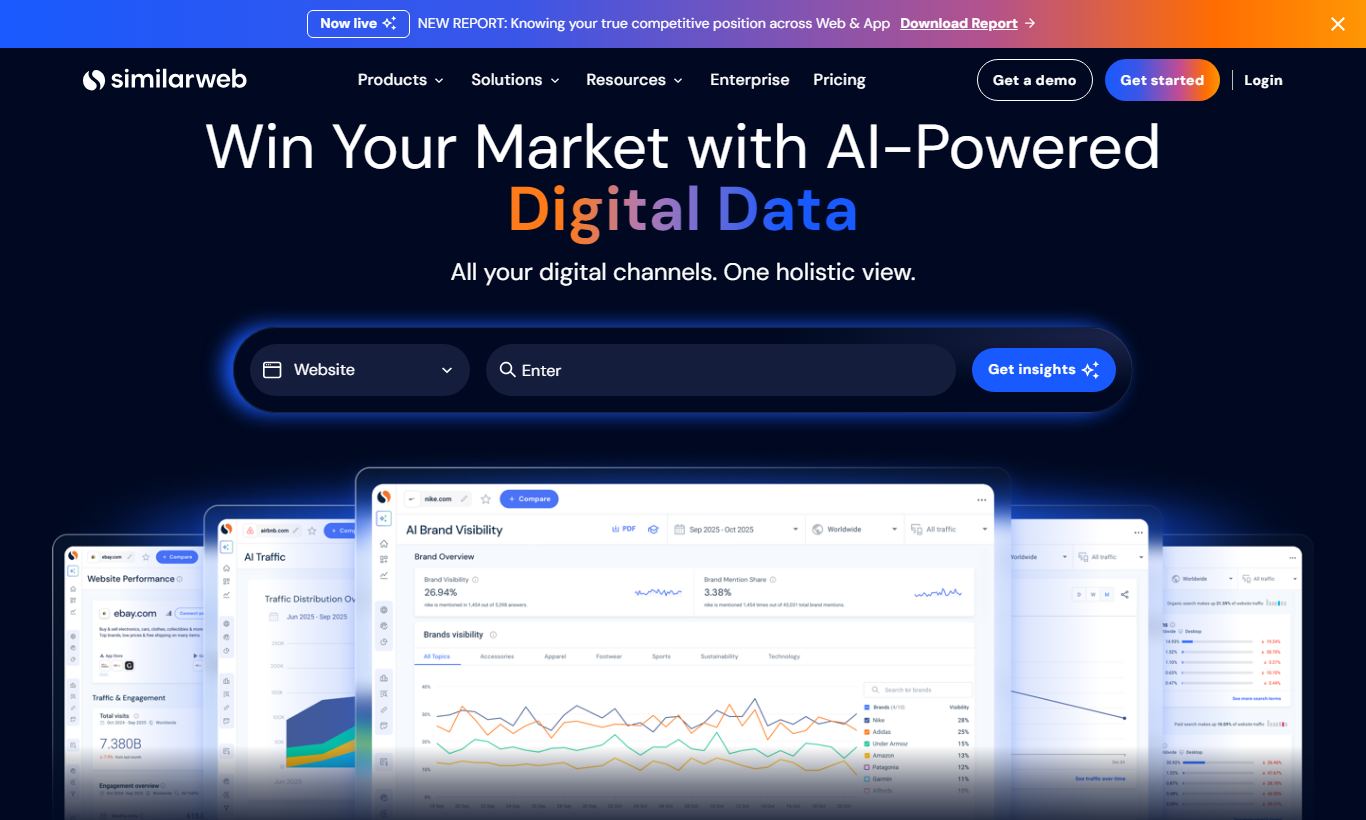
Similarweb is a digital intelligence platform that gives marketers, analysts, and SEO professionals a rare window into website traffic, audience behavior, and competitive positioning. Its data covers over 100 million websites, pulled from a proprietary panel of hundreds of millions of real users, ISP data, and web crawlers. That mix makes its estimates among the most cited in the industry. The platform shines brightest for competitive research: figuring out where rivals get their traffic, which keywords drive them, and how their engagement metrics trend over time. Pricing is steep for small teams, and the free tier is heavily restricted. But for mid-market and enterprise teams that need reliable third-party traffic intelligence, Similarweb is the gold standard. Read our full analysis to decide if it fits your budget and workflow.
What we love
Watch out for
Similarweb at a glance
What to test in your Similarweb trial
7-day free trial
- Check traffic estimates for one of your main competitors against their known analytics if possible
- View the channel breakdown (organic, paid, social, referral) for 3-5 competitor domains
- Review keyword data showing which organic keywords drive competitor traffic
- Export a referral source report for one competitor to evaluate link-building prospects
- If applicable, run an Industry Analysis report for your category with 3+ competitors
- Confirm if the paid plan tier you need fits your budget before the trial ends
Quick Verdict
Similarweb earns its reputation as the most complete competitive intelligence tool in the SEO and digital marketing space. If you've ever needed to answer "where does my competitor actually get their traffic?" with something more rigorous than a guess, Similarweb is built for exactly that question. Its panel-based methodology blends real-user behavior data, ISP-level signals, and web crawlers. The result is traffic estimates that industry analysts consistently treat as the closest available proxy to ground truth for third-party site measurement.
Similarweb isn't for everyone, though. The free plan hands you only three months of history and five results per report. That's enough to confirm the platform's value, but not enough to do real work. Meaningful access starts at several hundred dollars per month, and full-featured enterprise licenses run into five figures annually. For an in-house SEO team at a Series B company, a digital agency benchmarking clients, or a strategy team tracking a competitive landscape, the ROI case is easy to make. For a solo blogger or a startup under ten people, the price is genuinely hard to justify.
Start Your Free Trial →What is Similarweb?
Similarweb was founded in 2007 in Tel Aviv by Or Offer and has grown into a publicly traded company (NYSE: SMWB) serving over 4,500 enterprise customers globally. It started as a browser extension that crowdsourced user traffic data. Since then it's evolved into a full-stack digital intelligence platform used by companies like Google, Adidas, Airbnb, and Booking.com. The platform covers SEO research, competitive benchmarking, market analysis, and media planning, and it handles each of those jobs with more depth than almost any single-category tool.
Its primary audience is mid-market and enterprise marketing teams, digital agencies managing multiple client accounts, and corporate strategy teams doing M&A or market-entry research. The platform is organized into distinct products: Website Analysis, Keyword Research, Industry Analysis, App Analysis, and Shopper Intelligence, each sold in modular tiers. This means you can, in theory, buy only what you need. In practice, most serious users end up needing at least two or three modules.
Key Features
Feature Checklist
Traffic & Engagement Analysis
At its core, Similarweb estimates total monthly visits, unique visitors, pages per visit, average visit duration, and bounce rate for virtually any website on the internet. For high-traffic domains (above roughly 50,000 monthly visits), the estimates are remarkably accurate. Third-party tests comparing Similarweb data against verified Google Analytics figures routinely show accuracy within 10-20%. For lower-traffic sites, variance increases significantly, and that's worth keeping in mind before you trust the numbers too much. The traffic breakdown by channel (direct, organic search, paid search, social, referral, email, and display) is where practitioners spend most of their time, because it reveals which acquisition bets are actually working for competitors.
Keyword Research & SEO Intelligence
The keyword module goes beyond simple volume and difficulty scores. Similarweb shows you which keywords are driving organic traffic to any domain, how that traffic share is trending, and which keyword gaps exist between you and a named competitor. The "Keyword Competitors" view automatically surfaces domains that are competing for the same keyword universe as your site, ranked by overlap score. For paid search, you can see competitor ad keywords, estimated ad spend share, and the creative copy used in text ads. Having organic and paid keyword data in one interface makes Similarweb one of the more efficient tools for a full search strategy review.
Competitive Benchmarking & Market Share
Industry Analysis is one of Similarweb's most distinctive features. You can define a custom industry or select from hundreds of pre-built categories, then see total addressable market traffic, top players ranked by visit share, and how the landscape has shifted over a custom date range. This is particularly useful for board-level reporting and investor briefings. Being able to say "our organic market share in the US travel comparison category grew from 4.2% to 5.8% over 12 months" is the kind of statement Similarweb is uniquely positioned to back up. No other self-serve tool produces this kind of category-level view with the same methodological rigor.
Referral & Audience Intelligence
The referral analysis module shows you exactly which third-party sites are sending traffic to a competitor. That's invaluable for link-building prospecting and partnership identification. A media buyer, for instance, can use this to find the top referring sites for a rival brand, then prioritize those publishers for ad placements. The audience intelligence layer adds demographic and interest data, showing the overlap between your audience and a competitor's, the topics that over-index with your shared users, and the other websites they frequently visit. This data comes from the same panel methodology and is most reliable for major domains.
App Intelligence & Shopper Intelligence
Beyond websites, Similarweb tracks mobile app performance across iOS and Android: downloads, DAU/MAU estimates, engagement rates, and store keyword rankings. The Shopper Intelligence add-on, built for e-commerce brands and agencies, surfaces Amazon and retailer-specific performance data including estimated sales, conversion rates, and share of shelf by category. These are premium add-ons not included in standard plans. For retail brands or app-first companies, though, they offer real standalone value that would otherwise require separate tools like Sensor Tower or Jungle Scout.
Pricing
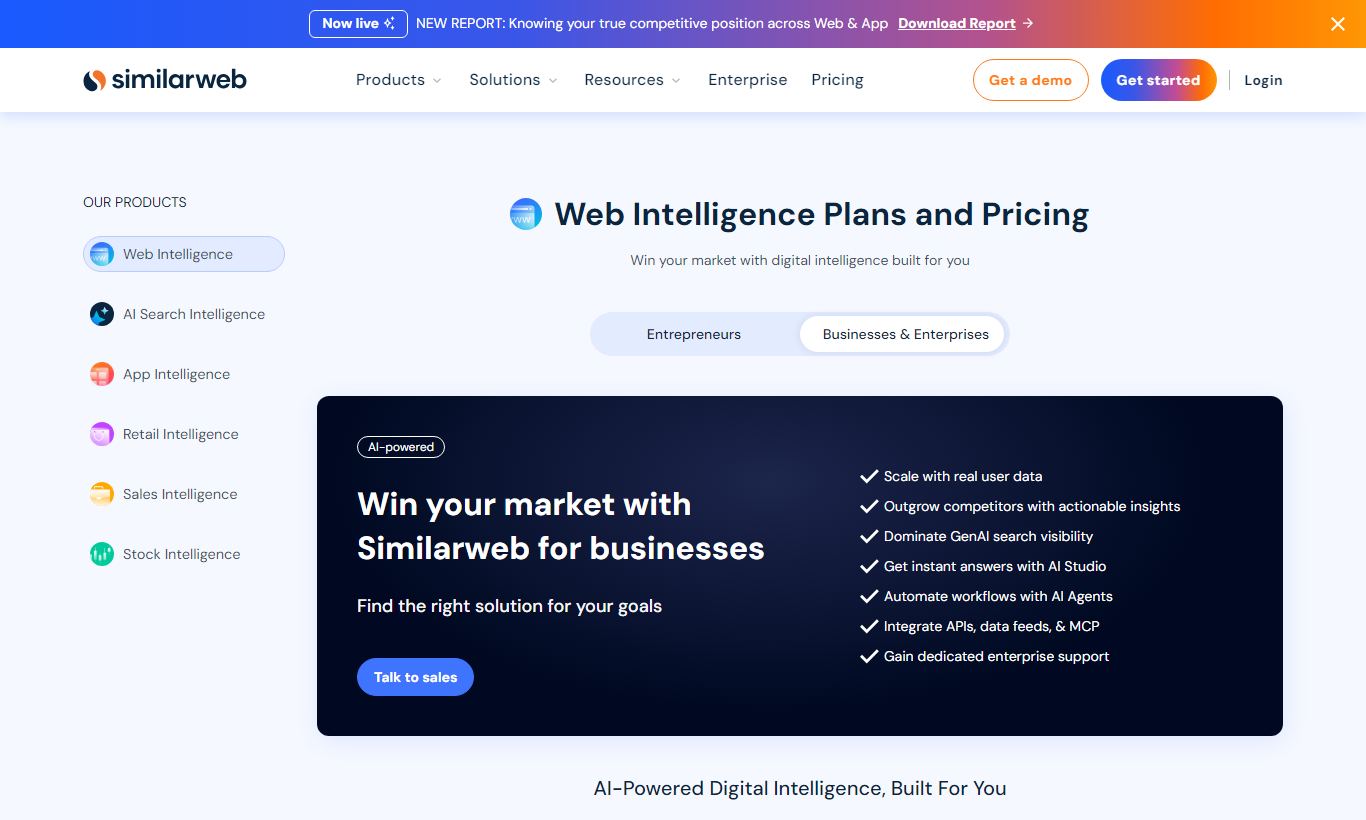
Similarweb runs on a tiered, module-based pricing model. As of 2025 to 2026, the publicly listed plans for the core Website Analysis product break down like this:
- Free Plan: No payment required. Includes 3 months of historical data, 5 results per report, 1 user seat, and limited keyword data. Fine for the occasional lookup, but it won't hold up for ongoing research work.
- Starter Plan: Listed at roughly $125/month (billed annually). Stretches history to 6 months, raises result limits to 1,000 per report, and adds 1 user seat. Suits individuals doing light competitive research.
- Professional Plan: Listed at roughly $333/month (billed annually). Includes 12 months of history, 50,000 results per report, keyword research tools, 3 user seats, and API access. Most in-house marketing teams end up recommending this tier.
- Team & Enterprise Plans: Custom pricing only, available on request. These unlock 36+ months of history, unlimited results, advanced API access, dedicated CSM support, Shopper Intelligence, App Intelligence, and SSO. Enterprise contracts typically start at $1,000+/month and climb well beyond that depending on modules and seat count.
A 7-day free trial is available for paid tiers. Annual billing is required to get the discounted rates above. Month-to-month billing carries a roughly 20 to 30% premium. The Keyword Research module and Industry Analysis features only show up from the Professional tier and above, so the Starter plan is more limited than it first looks for SEO practitioners.
What We Love
- Panel-based traffic estimates for any public website. No integration or site access required. That makes competitor analysis genuinely self-serve, and it scales across hundreds of domains at once.
- Channel-level traffic breakdown. You can see what percentage of a competitor's traffic comes from organic search, paid, or social. Most other tools can't match this level of detail.
- Industry Analysis and market share reporting. This is the only self-serve platform that lets you define a competitive set and track category-level visit share over time. It's built for executive reporting.
- Referral source intelligence for link-building and media planning. You can pull the top referring domains for any competitor in seconds. That saves hours of manual prospecting and surfaces partnership opportunities you'd otherwise miss.
- Breadth across web, app, and e-commerce. You can track a competitor's website, mobile app, and Amazon presence in one workspace, which cuts down on tool sprawl for marketing teams working across multiple channels.
Watch Out For
- Data accuracy drops sharply for smaller websites. For domains getting fewer than 50,000 monthly visits, Similarweb's estimates carry real variance and should be treated as directional, not precise. The company itself acknowledges this limitation, and it comes up often in reviews.
- The free plan is too restricted for real work. Three months of history and five results per report is enough to get a taste, but not enough to run any sustained analysis. The jump to a paid plan feels abrupt for teams trying to justify the budget.
- Keyword data is thinner than dedicated SEO tools. For deep keyword research workflows, Ahrefs and Semrush surface more granular SERP data, ranking history, and backlink intelligence. Similarweb's keyword module works best for competitive benchmarking, not pure SEO research.
- Enterprise pricing and contract terms can be opaque. Advanced features like Shopper Intelligence, App Intelligence, and extended API quotas require custom quotes, often tied to annual contracts with little flexibility. Several users report trouble downsizing mid-contract.
Who Is It Best For?
The in-house digital marketing team at a mid-market company (50 - 500 employees): If your team handles SEO, paid media, and competitive strategy, Similarweb's Professional plan gives you one platform to benchmark traffic growth, spot the channels fueling a competitor's rise, and build data-backed cases for budget allocation. The 12-month history window and keyword gap analysis are what deliver the most day-to-day value here.
A digital agency managing 10+ client accounts across multiple industries: The ability to run analysis on any public domain without client-side access is Similarweb's killer feature for agencies. You can audit a prospective client's competitive landscape before the first meeting, build quarterly review decks populated with third-party validated traffic data, and spot referral and partnership opportunities your clients haven't considered. The Team or Enterprise plan, with multiple seats and API access, pays for itself quickly in billable hours saved.
A corporate strategy or M&A analyst evaluating digital asset value: Investor and strategy teams routinely use Similarweb to check the traffic claims of acquisition targets and to size up category dynamics before entering a market. The Industry Analysis module, with its market share trend lines and category-level traffic sizing, fits this use case well. No credible self-serve alternative comes close to the same depth.
How Does It Compare?
Semrush: Semrush is Similarweb's closest all-in-one competitor, and it edges it out for pure keyword research depth, backlink analysis, and on-page SEO auditing. If your primary use case is growing your own organic rankings, Semrush's toolset is more granular. But Similarweb's traffic estimation methodology for third-party sites, particularly the channel-level breakdown, is demonstrably more accurate than Semrush's Traffic Analytics module. For competitive intelligence and market sizing, Similarweb wins. See our full Similarweb vs Semrush comparison.
Ahrefs: Ahrefs is the gold standard for backlink analysis and keyword ranking data for your own domain, and its Site Explorer gives a credible view of competitor organic keywords. Ahrefs doesn't provide the multi-channel traffic breakdown, referral traffic data, or industry market share analysis that Similarweb does. They serve different needs. Ahrefs is built for SEO depth on a specific domain, Similarweb for broad competitive intelligence across a market. Read our Similarweb vs Ahrefs breakdown for a detailed feature comparison.
Final Verdict
Similarweb is the most authoritative self-serve platform for competitive digital intelligence available today. For teams whose job includes understanding competitive traffic dynamics, category market share, and multi-channel acquisition benchmarking, it delivers insights that no other tool matches. The data isn't perfect. Smaller sites show higher variance, and the keyword research depth won't replace a dedicated SEO tool. But for what it does best, it beats everyone else.
Buy Similarweb if your team regularly asks questions about competitors' traffic, channel mix, audience, or market position and currently answers those questions with guesswork or fragmented free tools. Look elsewhere if your budget is tight, your domain gets under 50,000 monthly visits, or your primary need is backlink analysis and on-page SEO auditing. In those cases, Semrush or Ahrefs will serve you better per dollar spent.
Try Similarweb Free →FAQ
Does Similarweb have a free plan?
Yes. Similarweb offers a permanently free plan that includes up to 3 months of historical data, 5 results per report, and 1 user seat. It works for a one-off lookup, but it's too thin for ongoing competitive research.
How much does Similarweb cost per month?
Similarweb's Starter plan starts at approximately $125/month billed annually. The Professional plan runs approximately $333/month billed annually. Enterprise and Team plans are custom-quoted and typically start above $1,000/month, depending on modules and seat count.
Is Similarweb worth it for small businesses?
Generally, no. For websites receiving under 50,000 monthly visits, Similarweb's traffic estimates get shaky, and the price tag is hard to justify. Small businesses are usually better off with Semrush's entry-level plans or free tools like Google Search Console for their own-site data.
How accurate is Similarweb's data?
For high-traffic domains (50,000+ monthly visits), Similarweb's estimates typically land within 10 - 20% of verified analytics figures. Accuracy drops off for smaller sites. The channel-level breakdown (organic vs. paid vs. social) is widely regarded as the most reliable third-party source for this kind of data.
Similarweb vs Semrush, which is better for SEO?
Semrush wins on keyword research depth, backlink analysis, and on-page auditing for your own domain. Similarweb pulls ahead on competitive traffic intelligence, multi-channel benchmarking, and market share analysis. Plenty of enterprise teams run both, for different jobs.
Does Similarweb offer a free trial on paid plans?
Yes. Similarweb offers a 7-day free trial on its paid tiers, so users can try the Professional-level feature set before committing to an annual subscription.
What industries use Similarweb most?
E-commerce, financial services, media and publishing, travel, and technology are among the most common verticals. Corporate strategy, investment analysis, and digital agencies use it heavily too, especially for the Industry Analysis and market sizing features.
Is Similarweb data GDPR compliant?
Similarweb states that its data collection and processing practices comply with GDPR. The platform aggregates and anonymizes behavioral data, and it doesn't expose personally identifiable information in any of its reports. Enterprise customers can request a Data Processing Agreement (DPA) as part of their contract.

We may earn a commission when you click affiliate links. This never affects our editorial scores.
| Best for | Website traffic and analytics |
| Category | SEO Tools |
Answer a few quick questions and we'll match you to the best tool for your needs.
→ Suggest a Tool