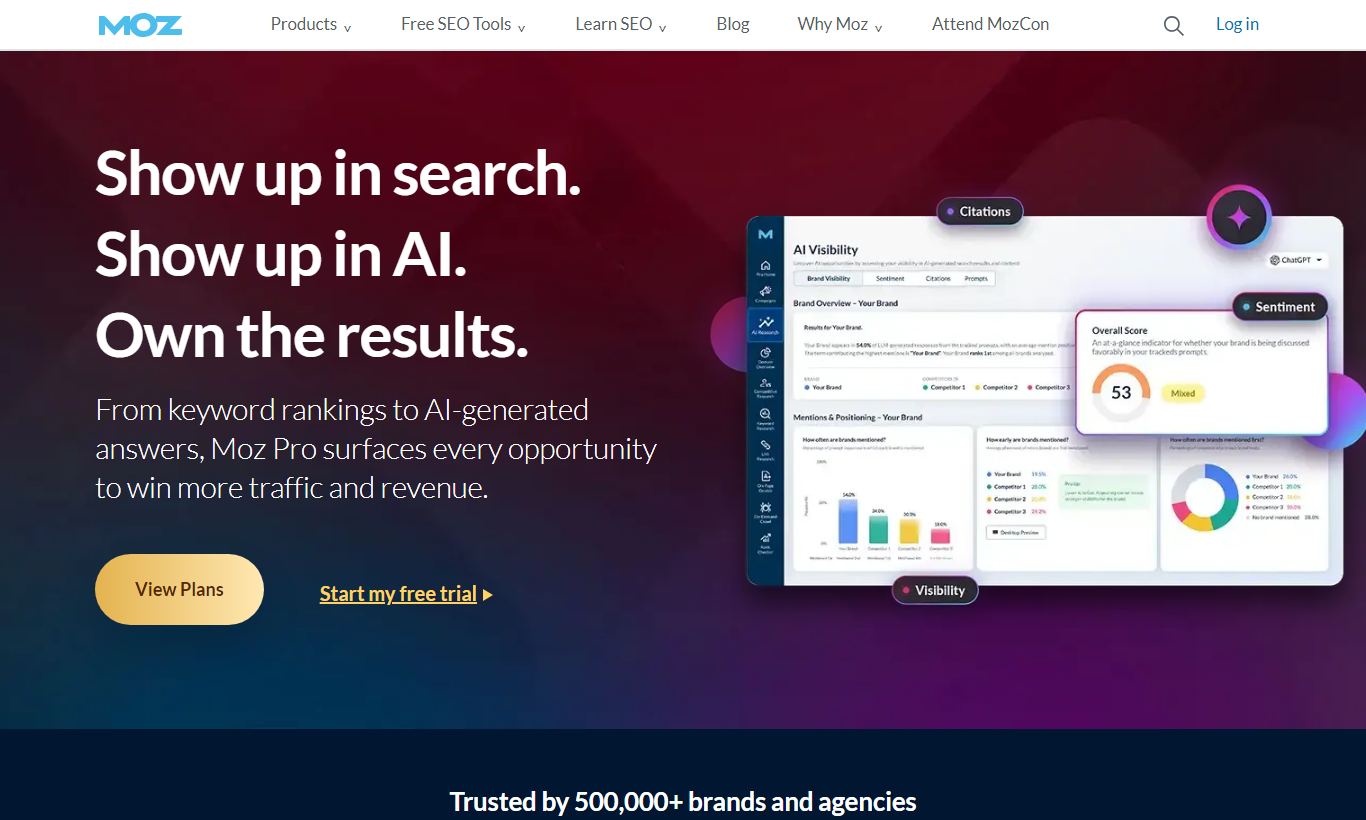
Moz Pro is a well-established SEO platform, founded in 2004, that covers keyword research, rank tracking, site auditing, and backlink analysis in one place. It's best known for its proprietary Domain Authority (DA) metric, which has become an industry-standard benchmark for link quality. Pricing starts at $49/month (billed annually), making it more affordable than Ahrefs or Semrush for budget-conscious teams. The platform suits SEO professionals, in-house marketers, and small agencies who want reliable data without a steep learning curve. Its keyword database and backlink index are smaller than top competitors, though, and advanced users doing large-scale link prospecting or competitive research may hit its limits. Teams wanting a clean, guided SEO workflow backed by 20 years of industry trust will get strong value from Moz Pro, especially with its 30-day free trial.
What we love
Watch out for
Moz Pro at a glance
What to test in your Moz Pro trial
30-day free trial with no credit card required
- Research 10 target keywords using Keyword Explorer and compare their Priority scores to your current picks
- Run a full Site Crawl on your website and verify the plain-English fixes are actionable for your team
- Set up rank tracking for 20 keywords across desktop and mobile to see if weekly updates fit your pace
- Use MozBar on competitor SERPs to spot Domain Authority patterns and verify link quality for outreach
- Audit your top 5 competitor backlink profiles and check if missing links match your own link-building gaps
- Decide on your plan before day 30 and confirm whether Moz's index size and weekly updates work for your SEO strategy
Quick Verdict
Moz Pro earns its place as one of the most approachable full-suite SEO platforms on the market. It has clean dashboards, a genuinely useful keyword explorer, and the industry-trusted Domain Authority metric built right in, giving marketers and SEO professionals a coherent workflow without weeks of onboarding. At $49/month for the entry plan, it costs a lot less than Semrush or Ahrefs, which matters for solo users and small teams.
Moz Pro isn't the deepest tool in the shed, though. Power users running large-scale link prospecting campaigns or needing real-time SERP data will eventually feel constrained by its index size and crawl limits. For most businesses, from growing e-commerce brands to boutique SEO agencies, Moz Pro is a dependable, well-rounded platform that earns its subscription fee every month.
Start Your Free Trial →What is Moz Pro?
Moz was founded in 2004 by Rand Fishkin and Gillian Muñoz in Seattle, Washington, initially as an SEO consulting blog before pivoting to software. Today, Moz Pro is the company's flagship subscription product, a cloud-based SEO platform built to help marketers research keywords, audit websites, track rankings, and analyze backlinks. It sits in the mid-market: more structured and beginner-friendly than Ahrefs, but more SEO-focused and less bloated than Semrush's sprawling feature set.
The platform has over 500,000 users globally and is particularly popular among in-house SEO teams, digital marketing agencies with 5 - 20 clients, and content-led businesses. Moz's educational content, including the MozBar Chrome extension, the Whiteboard Friday video series, and the MozCast SERP tracker, has built the brand's authority in the SEO community in a way few tool vendors have matched.
Key Features
Feature Checklist
Keyword Explorer
Moz Pro's Keyword Explorer is genuinely one of the best in its class. Beyond standard search volume and CPC data, it surfaces a "Priority" score that blends volume, difficulty, and your site's current authority to identify the best keywords to actually target. It's a practical shortcut that saves hours of manual filtering. You can build keyword lists, group them by topic cluster, and export them directly into a campaign. The tool covers over 1.25 billion keyword suggestions globally, with SERP analysis included for every query so you can see what content types are ranking and why.
Rank Tracker
The Rank Tracker in Moz Pro monitors keyword positions across Google and Bing for desktop and mobile, segmented by location down to city level. You can benchmark your rankings against up to three competitors side-by-side, which is particularly useful for agency reporting. Rankings update weekly on standard plans, and that can be a real limitation if your niche sees rapid SERP fluctuations. The visual trend graphs make it easy to correlate ranking changes with algorithm updates flagged automatically in the timeline.
Site Crawl (Site Audit)
Moz Pro's Site Crawl tool runs automated weekly audits and sorts issues by type: critical errors, warnings, and notices, each with plain-English explanations and remediation advice attached. It checks for broken links, duplicate content, missing meta tags, redirect chains, thin content flags, and more. For a mid-size site of 10,000 pages, the crawler handles it comfortably on the Medium plan. The "Crawl Comparison" feature lets you track whether issues were fixed between crawl cycles, which proves invaluable during site migrations or post-redesign clean-ups.
Link Explorer & Backlink Analysis
Link Explorer gives you access to Moz's backlink index, one of the largest available outside Ahrefs and Semrush, though notably smaller than both. You can analyse any domain's backlink profile, identify lost and gained links over time, find linking root domains, and assess link quality using Domain Authority (DA) and Page Authority (PA) scores. The Spam Score metric is particularly useful for link audit work. It helps you flag potentially toxic links before disavowing them in Google Search Console. The index freshness is a known weakness compared to competitors. Links can take longer to appear than in Ahrefs.
On-Page Optimization (Page Grader)
The On-Page Grader evaluates individual URLs against a target keyword and grades them A through F across factors like title tag usage, content length, page load speed, anchor text distribution, and semantic relevance. It generates a prioritised list of recommendations you can hand directly to a content writer or developer. This is one of Moz's most consistently praised features for content teams that need actionable, non-technical guidance without hiring a dedicated SEO strategist.
MozBar Chrome Extension
The free MozBar browser extension overlays DA, PA, and Spam Score data directly onto Google search results and any webpage you visit. Moz Pro subscribers unlock additional MozBar features including on-page element highlights, keyword difficulty overlays, and page authority comparisons. It's a lightweight but handy companion for day-to-day research, and you never have to leave your browser to use it.
Pricing
Moz Pro offers four paid tiers, all with a 30-day free trial. Some entry points don't even ask for a credit card. Annual billing saves about 20% versus paying monthly. There's no permanent free plan for Moz Pro, but the free MozBar extension and limited free searches in Keyword Explorer and Link Explorer give you a taste of the platform before you pay.
- Starter, $49/month (billed annually at ~$588/yr): 1 campaign, 50 tracked keywords, 20,000 pages crawled per campaign/week, 1 user seat. Fits solo consultants or a single-site owner.
- Standard, $99/month (billed annually at ~$1,188/yr): 3 campaigns, 300 tracked keywords, 400,000 pages crawled, 1 user seat. This is the tier most individual SEO professionals pick when they're managing a handful of clients.
- Medium, $179/month (billed annually at ~$2,148/yr): 10 campaigns, 1,500 tracked keywords, 2,000,000 pages crawled, 2 user seats. Built for growing agencies and in-house teams.
- Large, $299/month (billed annually at ~$3,588/yr): 25 campaigns, 3,000 tracked keywords, 5,000,000 pages crawled, 3 user seats. Meant for established agencies handling multiple large clients.
All plans include access to Keyword Explorer, Link Explorer, Rank Tracker, Site Crawl, On-Page Grader, and MozBar Pro. The tiers differ mainly in campaign count, tracked keywords, crawl volume, and user seats. Moz doesn't lock features behind higher tiers.
What We Love
- Domain Authority is the industry standard: Moz invented DA and PA. Clients, content briefs, and link outreach pitches across the industry cite these metrics, so your data carries instant credibility.
- Keyword Priority score cuts research time: The blended Priority metric (volume × difficulty × opportunity) surfaces actionable targets right away, so you don't have to cross-reference multiple data columns by hand.
- 30-day free trial with no credit card required: That's unusually generous for a SaaS tool at this price point. You can run a full site audit and keyword research sprint before you spend a cent.
- Plain-English issue guidance in Site Crawl: Every technical error comes with a clear explanation and a recommended fix. Marketers without deep technical SEO knowledge can put it to use right away.
- MozBar extension adds real-time SEO context: It overlays DA, PA, and Spam Score on any live SERP or webpage, so you skip the constant tab switching during research and prospecting sessions.
Watch Out For
- Weekly rank updates feel sluggish for active campaigns: Unlike Ahrefs (daily on higher plans) or Semrush, Moz Pro only refreshes keyword rankings once a week on all plans. That's a real friction point during time-sensitive campaigns or algorithm flux periods.
- Backlink index lags behind top competitors: Multiple independent studies have shown Moz's backlink index is smaller and slower to update than Ahrefs or Semrush. You may miss newly acquired links or recently lost ones for days or weeks.
- User seat limits are tight on lower plans: The Starter and Standard plans include only one user seat. Teams of even two or three people are forced to upgrade or share credentials, which is a friction point for small agencies.
- No competitor gap analysis tool: Unlike Semrush's Keyword Gap or Ahrefs' Content Gap, Moz Pro lacks a dedicated side-by-side keyword gap feature. You'll need more manual effort to spot the keywords your competitors rank for but you don't.
Who Is It Best For?
The solo SEO consultant managing 3 - 8 clients: The Standard plan at $99/month is the sweet spot. It gives you enough campaigns and tracked keywords to run a lean client portfolio without paying Semrush's agency-tier prices. The reporting exports and campaign dashboards look polished enough to hand straight to clients.
The in-house content marketing team at a B2B SaaS company: A team producing 8 - 12 pieces of content per month will get a lot out of the Keyword Explorer's Priority scoring and the On-Page Grader's real-time recommendations. The Site Crawl's weekly health checks act as a safety net for a fast-moving publishing schedule, and you won't need a dedicated technical SEO hire to keep up with them.
The marketing director at a regional e-commerce brand (50 - 500 products): Moz Pro's local rank tracking, with city-level granularity, plus its approachable interface, makes it a good fit for a marketing director who owns SEO strategy but isn't an SEO specialist by trade. The 30-day trial gives you enough time to audit the full site, baseline rankings, and confirm the ROI before you commit.
How Does It Compare?
Moz Pro vs Semrush: Semrush offers a much larger keyword database (over 25 billion keywords vs Moz's 1.25 billion), real-time rank tracking, and a broader toolset including PPC research and social media tracking. Its entry plan starts at $139.95/month though, nearly three times Moz Pro's Starter price, and the interface can overwhelm new users. Moz Pro wins on affordability and simplicity. Semrush wins on raw data depth and breadth.
Moz Pro vs Ahrefs: Ahrefs has the most frequently updated backlink index in the industry and one of the best keyword explorers for content marketers around. Its Lite plan starts at $129/month, again pricier than Moz. Ahrefs edges out Moz for link building campaigns and content gap analysis. Moz Pro is the better pick for teams that want ease of use, clear site auditing, and budget efficiency.
Final Verdict
Moz Pro is a mature, honest SEO platform that does what it promises without overselling. It won't replace Ahrefs for hardcore link builders or out-data Semrush for enterprise competitive intelligence. It doesn't try to. What it offers instead is a clean, guided workflow backed by two decades of SEO expertise, industry-standard metrics, and a pricing structure that respects smaller budgets. The 30-day free trial is one of the most generous in the category, and there's no feature gating across tiers, so even Starter users get the full toolset.
If you're an individual SEO professional, a content-led business, or an agency managing under 25 clients, Moz Pro is a strong default choice. Larger agencies or data-hungry power users should benchmark it against Ahrefs or Semrush before committing. For most teams, though, Moz Pro delivers dependable, actionable SEO data at a fair price.
Try Moz Pro Free →FAQ
How much does Moz Pro cost per month?
Moz Pro plans start at $49/month (Starter, billed annually). Other tiers are Standard at $99/month, Medium at $179/month, and Large at $299/month. Monthly billing is available at a higher rate. All plans include a 30-day free trial.
Does Moz Pro offer a free trial?
Yes. Moz Pro offers a 30-day free trial across all plans. On some entry points no credit card is required, which makes it one of the more generous trials in the SEO tools category. There's no permanent free tier for Moz Pro itself, but the MozBar Chrome extension is free.
Is Moz Pro worth it for small businesses?
For most small businesses, yes. This goes double if you produce regular content, rely on local SEO, or are actively building links. The Starter plan at $49/month covers one website well. If budget is tight, start with the free trial and check the ROI before you commit.
How does Moz Pro compare to Semrush?
Semrush has a larger keyword database, daily rank tracking, and a broader toolset, including PPC and social. But it starts at $139.95/month, nearly 3x Moz Pro's entry price. Moz Pro wins on affordability, simplicity, and Domain Authority credibility. Semrush wins on raw data volume and feature breadth.
How does Moz Pro compare to Ahrefs?
Ahrefs has a stronger, more frequently updated backlink index and is generally the pick for link building campaigns. Its Lite plan starts at $129/month. Moz Pro is cheaper, easier to use, and has better guided on-page optimization tools. For pure link research at scale, Ahrefs is the stronger choice.
What is Domain Authority and does Moz own it?
Domain Authority (DA) is a proprietary metric created by Moz that scores a website's likelihood to rank in search results on a scale of 1 to 100. Moz owns the DA metric and updates its algorithm periodically. It's used widely across the SEO industry as a proxy for site strength, though it isn't a Google ranking factor.
Can I track local keyword rankings in Moz Pro?
Yes. Moz Pro's Rank Tracker supports local rank tracking down to the city level, covering both desktop and mobile SERPs. That makes it useful for businesses targeting specific geographic markets or running multi-location SEO campaigns.
Is Moz Pro good for agencies?
Moz Pro works well for agencies managing up to 25 clients (Large plan). The campaign dashboards and reporting exports are ready for client presentations. Larger agencies managing 30+ clients will find the seat limits and campaign caps restrictive, and may need to look at enterprise alternatives or a higher-volume tool like Semrush Agency.

We may earn a commission when you click affiliate links. This never affects our editorial scores.
| Best for | SEO software and data |
| Category | SEO Tools |
Answer a few quick questions and we'll match you to the best tool for your needs.
→ Suggest a Tool