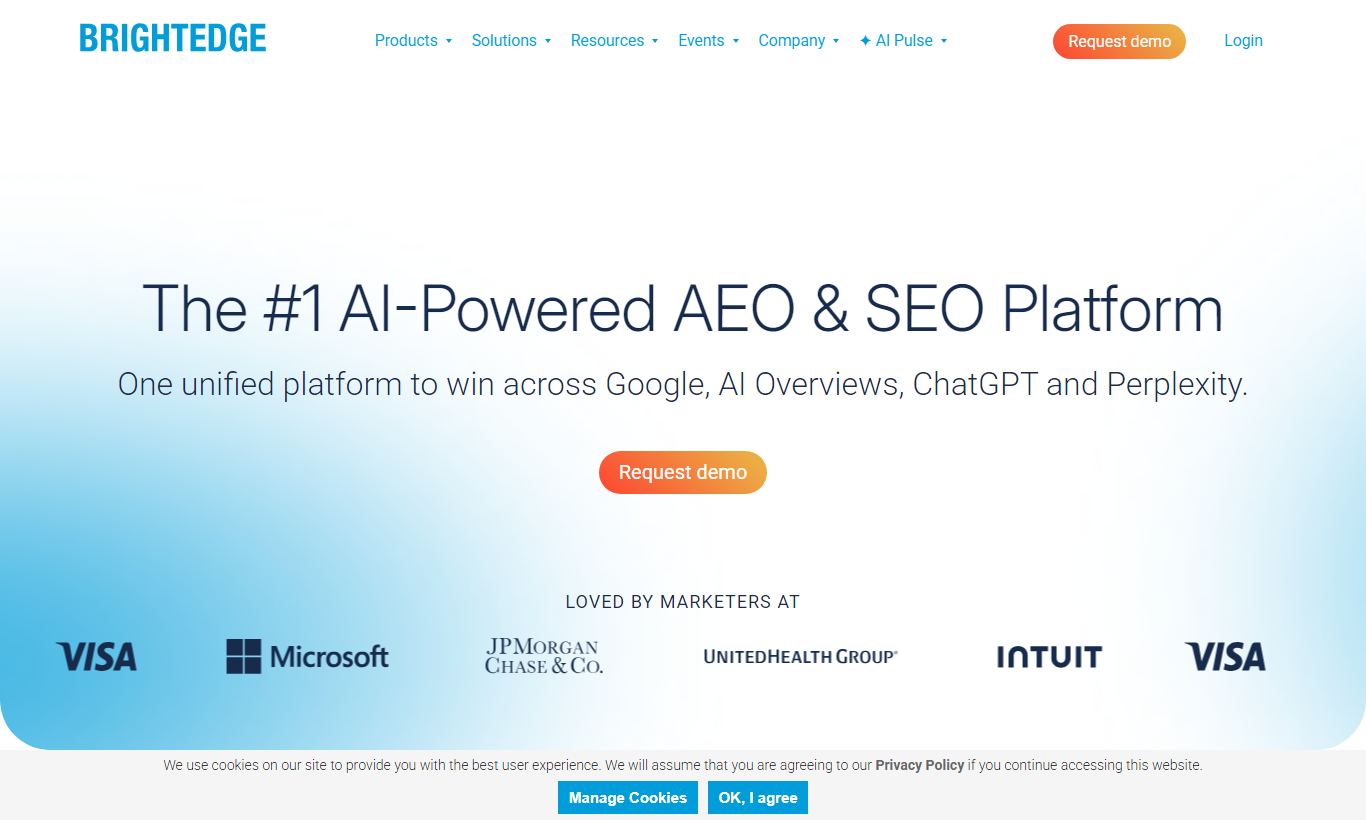
BrightEdge is an enterprise SEO and content performance platform built for some of the world's largest brands. It combines keyword research, rank tracking, content recommendations, and competitive intelligence in one AI-powered suite. Its DataCube (one of the largest proprietary SEO data repositories around) gives it a real data edge over most competitors. Still, BrightEdge is built for enterprise buyers only. Pricing is custom and undisclosed, there's no self-serve free trial, and the learning curve is steep. For mid-market and smaller teams, the cost is hard to justify. For large in-house SEO teams and agencies running Fortune 500 portfolios, though, BrightEdge delivers measurable ROI through automation, forecasting, and cross-channel attribution that few platforms can match.
What we love
Watch out for
Brightedge at a glance
What to test in your Brightedge trial
- Query DataCube for emerging keyword opportunities in your top product category against your 3 main competitors
- Run ContentIQ technical audit on your largest site section and prioritize issues by revenue impact, not severity
- Set up Share of Voice tracking across your competitor set and configure custom SOV alerts at your threshold
- Connect Salesforce or Adobe Analytics to BrightEdge and trace one keyword ranking to a closed revenue deal
- Test Autopilot AI recommendations on an existing landing page and measure the estimated ranking score improvement
Quick Verdict
BrightEdge earns its reputation as one of the most powerful SEO platforms on the market, but only if you have the team, budget, and data volume to use it properly. Its AI-driven recommendations, massive DataCube index, and automated reporting are genuinely best-in-class for enterprise accounts managing hundreds of thousands of pages and dozens of markets at once. The platform isn't casual software. It rewards companies that invest in proper onboarding, build real internal SEO expertise, and commit for the long haul.
If you're running SEO at scale, say a national retail brand, a global SaaS company, or a multi-brand media publisher, BrightEdge is one of the few platforms built to keep pace. Smaller teams, freelancers, or companies with budgets under five figures annually are better off with Semrush or Ahrefs. For everyone else running complex, high-stakes SEO programs, this is as serious as the tools get.
Start Your Free Trial →What is BrightEdge?
BrightEdge was founded in 2007 and is headquartered in Foster City, California. It's one of the oldest purpose-built enterprise SEO platforms still actively developed, and that age shows in how deep the feature set runs. The company serves over 1,700 customers globally, including brands like Microsoft, Nike, and Dell, and it sits squarely at the intersection of SEO, content marketing, and revenue attribution. Generalist digital marketing suites tend to treat SEO as one tab among many. BrightEdge was built from the ground up for search performance, and that focus shows in every layer of the product.
The platform's core differentiator is its proprietary DataCube, which continuously indexes and analyzes over a trillion pieces of web content and billions of keywords across multiple markets and languages. It's a dynamic competitive intelligence engine that surfaces real-time shifts in search demand, competitor content moves, and organic opportunity gaps. BrightEdge targets large enterprise in-house SEO teams, digital agencies managing enterprise accounts, and CMOs who need to tie organic search directly to pipeline and revenue.
Key Features
Feature Checklist
DataCube: Proprietary Keyword and Content Intelligence
The DataCube is BrightEdge's crown jewel, and it's genuinely hard to overstate how much data it holds. Updated continuously, it tracks keyword rankings across desktop and mobile for hundreds of millions of queries in dozens of markets. For an enterprise SEO team, this means you can spot demand shifts before they show up in Google Search Console, benchmark your content against specific competitors at the keyword level, and find white-space opportunities that smaller tools can't surface because they simply don't have the data volume. Here's a practical example: a retail brand launching a new product line can query the DataCube for emerging keyword clusters in that category, see exactly which competitor pages are ranking right now, and get content briefs generated automatically. All before writing a single word.
ContentIQ: Automated Technical SEO Auditing
ContentIQ is BrightEdge's site crawling and technical SEO audit engine. It can crawl enterprise-scale sites with millions of pages and flag issues across dozens of categories: broken links, duplicate content, missing metadata, Core Web Vitals violations, structured data errors, and more. What sets it apart from standalone crawlers like Screaming Frog is its ability to directly tie technical issues to ranking impact. You're not just getting a list of problems, you're getting a prioritized remediation queue ranked by revenue opportunity. For large e-commerce sites where a template-level metadata issue might affect 200,000 product pages, that prioritization saves weeks of guesswork.
Autopilot: AI-Powered Content Optimization
Autopilot is the platform's flagship AI feature. It uses machine learning to surface specific on-page optimization recommendations, recommended word counts, semantic keyword inclusions, structural changes, and in some configurations it can push approved changes directly to a CMS via integrations. For content teams producing high volumes of pages, Autopilot works as a scalable co-pilot. A writer producing a new landing page gets a real-time scoring interface showing how each edit improves the estimated ranking probability, drawing from thousands of top-ranking pages in the same category. This matters most in verticals like financial services or healthcare, where topical authority and semantic completeness aren't optional.
Share of Voice and Competitive Intelligence
BrightEdge's Share of Voice (SOV) reporting gives teams a quantified view of how much of the organic search landscape they own versus named competitors across specific keyword sets. It goes beyond simple rank tracking. It weights visibility by search volume and tracks movement across an entire competitive set at once. An in-house SEO director can run a weekly SOV report across 10 core competitors, watch for sudden visibility spikes from a rival's content push, and respond with counter-optimization in the same workflow. Custom alerts notify teams when a competitor crosses a SOV threshold you set, which matters a lot in fast-moving markets.
Data Cube X and Real-Time Research
DataCube X is BrightEdge's upgraded research layer, combining real-time SERP analysis with predictive demand modeling. Unlike traditional keyword tools that report historical monthly averages, DataCube X can surface trending keyword intent shifts as they emerge. That's especially useful for news-adjacent content, seasonal retail planning, or product categories that change fast. It also integrates directly with Google Analytics 4, Google Search Console, Adobe Analytics, and Salesforce, so organic traffic data lives inside one attribution model instead of sitting in a separate silo.
Pricing
BrightEdge doesn't publish its pricing, and that's a deliberate enterprise positioning decision. All plans get custom-quoted based on the number of tracked keywords, users, domains, and data integrations required. Based on market research and publicly reported customer experiences, entry-level annual contracts typically start around $40,000 per year for smaller enterprise deployments. Mid-tier packages for multi-domain, multi-market organizations range from $60,000 to $120,000+ per year. Large enterprise or agency accounts with extensive API access, white-label reporting, and custom data integrations can exceed $200,000 annually.
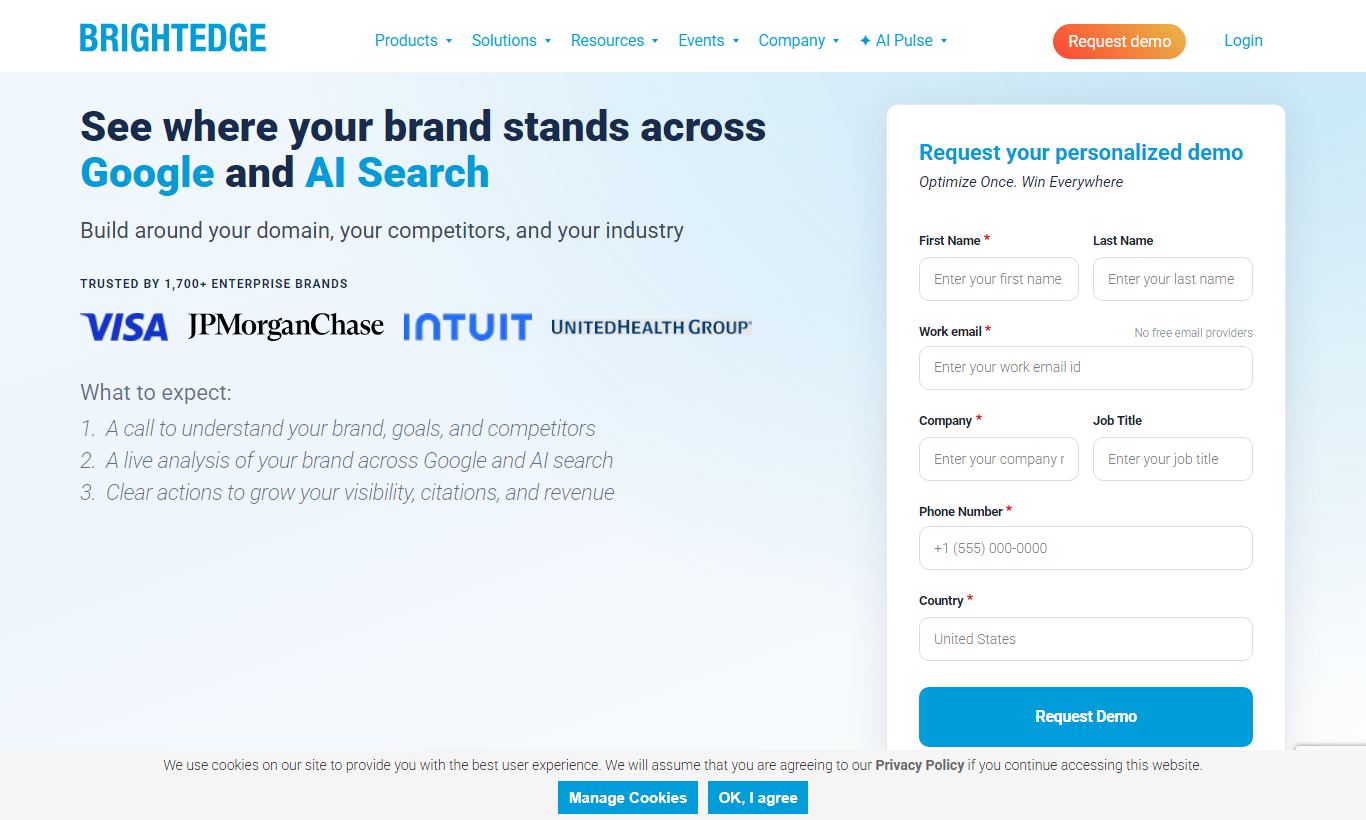
There's no free plan, no monthly billing option, and no self-serve trial. BrightEdge offers a personalized demo through its sales team, and that's the main entry point for evaluation. Prospective customers should budget for both the platform cost and a real internal time investment in onboarding, which can take 4-8 weeks to do properly. Some packages include a dedicated Customer Success Manager. Others charge for this separately.
What We Love
- DataCube scale and freshness: The continuously updated index covers trillions of content signals and gives enterprises real-time competitive intelligence you won't find in most tools.
- Revenue attribution built in: Native integrations with Salesforce and Adobe Analytics let teams tie keyword rankings directly to pipeline, MQL, and closed revenue, not just traffic.
- ContentIQ priority scoring: Technical audit findings get ranked by estimated revenue impact, not just severity. That saves enterprise teams from chasing low-value issues.
- Autopilot AI recommendations at CMS scale: You can push optimization recommendations, and approved changes, straight to enterprise CMS platforms like Adobe Experience Manager. That cuts time-to-publish significantly.
- Share of Voice tracking across full competitor sets: Custom SOV dashboards weighted by volume make it easy for SEO directors to build a strong executive narrative for board-level reporting.
Watch Out For
- No transparent pricing, no free trial: Every evaluation requires a sales conversation and a custom quote. That makes BrightEdge a poor fit for budget validation, and it frustrates procurement teams that need upfront cost estimates.
- Steep learning curve for new users: The platform's depth is also its biggest onboarding challenge. Teams without a dedicated BrightEdge admin or CSM support often find the first 90 days overwhelming. Underutilization comes up again and again in enterprise software reviews.
- Reporting UI feels dated in places: Despite ongoing investment, some sections of the reporting interface, particularly custom dashboard configuration, feel less modern than newer competitors like Conductor or seoClarity. They also take more clicks to get routine tasks done.
- Not viable for SMB or mid-market: The $40,000+ annual floor effectively excludes all but the largest in-house teams and agencies. There's no lite or starter tier, so growing companies outpace free tools but still can't justify BrightEdge's price point.
Who Is It Best For?
Large in-house enterprise SEO teams: A company like a major insurance provider or national retailer with a dedicated 5 - 15 person SEO team managing 500,000+ indexed pages across multiple domains will see immediate ROI from BrightEdge's automation, prioritization, and cross-channel attribution. The platform becomes the operating system for the entire organic program.
Digital agencies with Fortune 500 clients: Agencies running SEO for large enterprise accounts can use BrightEdge's white-label reporting, multi-domain management, and client-facing dashboards to consolidate workflow across dozens of accounts. The SOV and competitive intelligence features also help agencies win new business by showing prospects the visibility gaps in their current programs.
CMOs and VP-level stakeholders who need revenue-tied SEO reporting: BrightEdge's integration with CRM and analytics platforms makes it one of the few SEO tools that can produce a board-ready slide showing exactly how organic search contributed to quarterly revenue. A VP of Digital Marketing at a SaaS company tracking 10,000 keywords across three product lines, connected to Salesforce data, gets a genuinely defensible ROI story, not just rank charts.
How Does It Compare?
Semrush: Semrush is the go-to for SMB and mid-market SEO, offering comparable keyword research and competitive analysis starting at $139/month. It lacks BrightEdge's DataCube depth, CMS integrations, and enterprise revenue attribution, but it wins on accessibility, price, and ease of use. See our full BrightEdge vs Semrush comparison.
Conductor: Conductor (now part of WeWork's former media arm, operated independently) targets a similar enterprise audience and matches BrightEdge closely on content intelligence and technical SEO. Conductor is often cited as having a more modern UI and a slightly better collaborative workflow for content teams. BrightEdge edges ahead on raw data scale and Salesforce integration depth. See our BrightEdge vs Conductor comparison for a side-by-side breakdown.
Final Verdict
BrightEdge makes sense for one type of buyer: a large enterprise with a serious organic search program, a mature in-house team or agency partner, and an annual budget that can absorb a six-figure SaaS commitment. For those organizations, the platform's DataCube scale, revenue attribution capabilities, and AI-powered content tooling pay for themselves. This isn't something you dip into casually. It's infrastructure for an enterprise SEO machine.
For anyone outside that profile, a growing SaaS startup, a mid-market e-commerce brand, a boutique agency, the price-to-value equation breaks down fast. Semrush at $139/month or Ahrefs at $129/month will serve you better until your program scales to BrightEdge territory. But once you're ready to operate at that level, BrightEdge has few real rivals.
Try BrightEdge Free →FAQ
How much does BrightEdge cost?
BrightEdge doesn't publish pricing publicly. Every plan gets custom-quoted based on keyword volume, domains, users, and integrations. Entry-level enterprise contracts typically start around $40,000/year, mid-range packages run between $60,000 and $120,000/year, and large multi-domain deployments can exceed $200,000 annually.
Does BrightEdge offer a free trial?
No. There's no self-serve free trial and no free plan. Evaluation starts with a personalized demo through the BrightEdge sales team. There's no monthly billing option either. All contracts run annual.
Is BrightEdge worth it for small businesses?
No. A pricing floor of roughly $40,000/year rules it out for small businesses. Tools like Semrush, Ahrefs, or Mangools handle keyword research and rank tracking at a fraction of the cost, and they fit SMB budgets and team sizes much better.
BrightEdge vs Semrush: which is better?
Depends on your scale. Semrush suits SMB and mid-market teams better. It's cheaper (from $139/month), easier to learn, and covers most SEO use cases. BrightEdge wins for large enterprises that need DataCube-scale competitive intelligence, CMS automation, and Salesforce-tied revenue attribution. The two products barely compete for the same buyer.
What is BrightEdge DataCube?
DataCube is BrightEdge's proprietary SEO data repository. It continuously indexes over a trillion pieces of web content and billions of keywords across multiple markets, and it powers keyword research, competitive benchmarking, content opportunity identification, and real-time SERP monitoring inside the platform.
Does BrightEdge integrate with Google Analytics and Salesforce?
Yes. BrightEdge natively integrates with Google Analytics 4, Google Search Console, Adobe Analytics, Salesforce, and Adobe Experience Manager, among others. These integrations let teams tie organic keyword performance directly to revenue attribution and CRM pipeline data.
How long does BrightEdge onboarding take?
Most enterprise customers need 4 to 8 weeks for full onboarding, covering keyword configuration, integration setup, and dashboard customization. Larger deployments spanning multiple domains, regions, and CRM integrations can take longer. BrightEdge assigns a dedicated Customer Success Manager on most packages to support the process.
We may earn a commission when you click affiliate links. This never affects our editorial scores.
| Best for | — |
| Category | SEO Tools |
Answer a few quick questions and we'll match you to the best tool for your needs.
→ Suggest a Tool