Aha! Review 2026: Is It Worth It?
Aha! is a product development and roadmapping platform built specifically for product managers, not generic project teams. It handles the whole strategy-to-delivery process, from vision and goals through features, releases, and customer feedback. Pricing starts at $59/user/month for Aha! Roadmaps, which is a steep ask compared to tools like Jira or Asana. But the depth of roadmapping, goal-cascading, and idea management justifies the cost for dedicated product teams. A 30-day free trial is available and you don't need a credit card to start. Aha! earns a strong recommendation for mid-market and enterprise product teams that need structured strategy alignment. Solo PMs or small teams on a budget will likely find it over-engineered and overpriced. Overall rating: 4.4 out of 5.
What we love
Watch out for
Aha! at a glance
What to test in your Aha! trial
30-day free trial
- Map your company strategy to features and trace one completed feature back to its strategic goal
- Set up your idea portal and submit test ideas to see voting and customer notification workflows in action
- Build a custom pivot-table report on feature completion or release status without exporting to spreadsheet
- Create roadmaps in three views (release, initiative, team) and verify they all stay linked when you change a priority
Quick Verdict
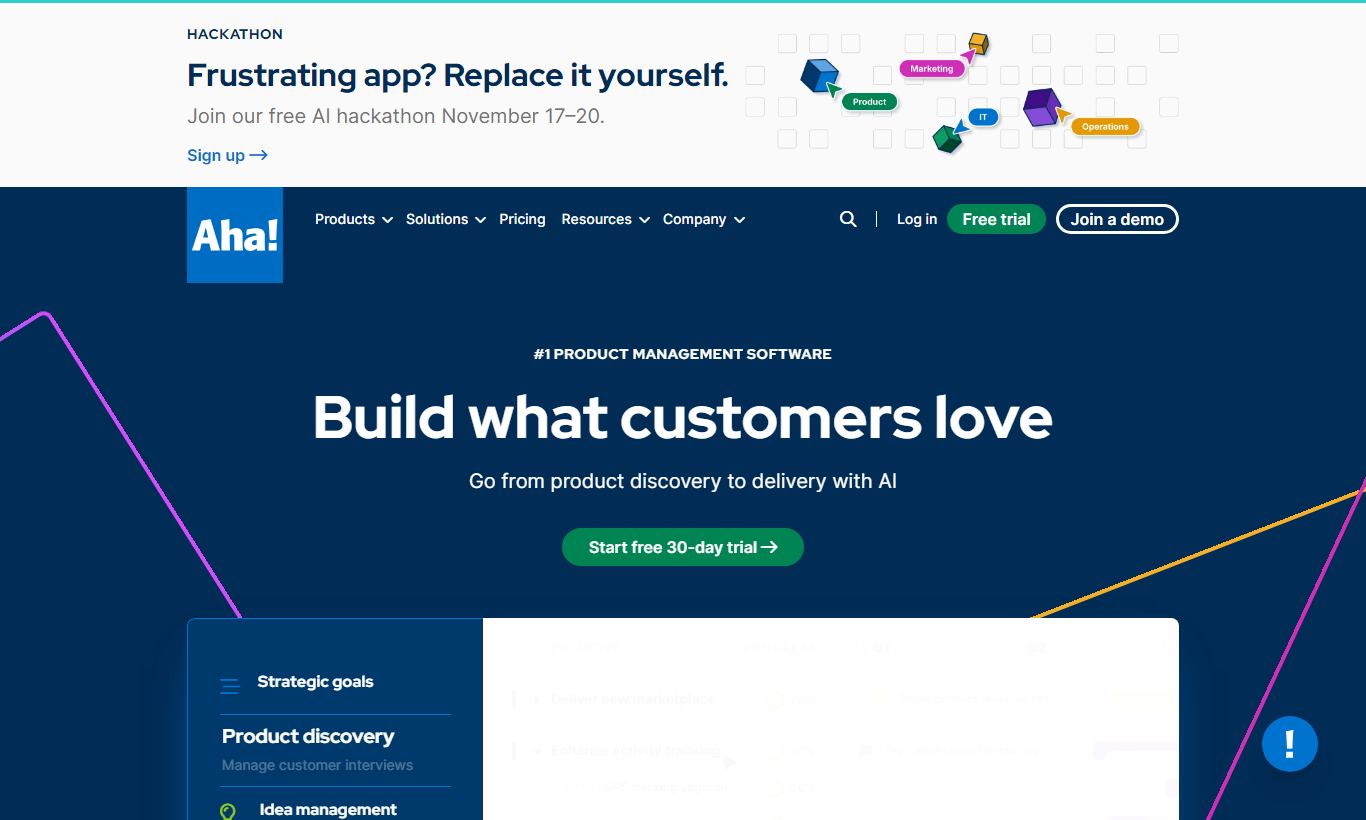
Aha! is the most fully realized product management platform on the market, and it knows it. Where tools like Jira track tasks and Asana organizes work, Aha! connects why you're building something all the way down to the sprint-level ticket. For product teams that have ever struggled to explain how a feature connects to a company objective, Aha! solves that problem better than any tool we've evaluated. Its strategy-to-delivery framework, strong roadmapping engine, and built-in idea portal put it in a category of its own.
Aha! is a serious investment, both financially and in onboarding time. At $59/user/month for the core Roadmaps product (billed annually), it's priced for teams that treat product management as a strategic discipline. If you're a two-person startup or a dev team just looking to manage sprints, you'll likely feel like you're flying a 747 to the corner store. But for a 10-50 person product organization with a real strategy to execute, Aha! earns its price tag confidently.
Start Your Free Trial →What is Aha!?
Aha! was founded in 2013 by Brian de Haaff and Chris Waters, both experienced product leaders who were frustrated by the lack of purpose-built tooling for strategic product management. Headquartered in the United States and operating as a fully remote company, Aha! has bootstrapped its way to profitability, a rare feat in SaaS, and serves over 700,000 users across more than 5,000 companies worldwide. The product suite has expanded considerably since its roadmapping-only origins and now includes Aha! Roadmaps, Aha! Ideas, Aha! Notebooks, Aha! Develop, and Aha! Create, each sold as a modular add-on or standalone product.
The platform is aimed squarely at product managers, product operations teams, and product-led organizations that need to move from high-level business strategy down to development execution without losing the thread. It isn't a general-purpose project management tool. Aha! is built for the product management discipline, plainly and without apology. That focus is both its greatest strength and its sharpest limitation for teams with broader project needs.
Key Features
Feature Checklist
Strategic Roadmapping
This is Aha!'s crown jewel. The roadmapping engine lets you build visual roadmaps by release, initiative, feature, or custom timeframe, and every item on that roadmap can be traced back to a strategic goal or business initiative. You can create a master company roadmap, then break it into product-line roadmaps, team roadmaps, and release-specific views, all linked. When a priority shifts at the company level, product managers can see the downstream impact in seconds. The drag-and-drop timeline is polished, and roadmap exports to PDF, PowerPoint, or shareable URL are genuinely presentation-ready. This isn't a Gantt chart with a pretty skin. The data model underneath is hierarchical and built for strategy, not just scheduling.
Goals and Initiatives Framework
Aha! implements a structured goal hierarchy that many teams will recognize as similar to OKRs. You define company-level goals, nest initiatives beneath them, then attach features and releases to those initiatives. Every record in the system, whether it's a feature, an epic, or a release, can display its "score" showing how well it aligns with current strategic priorities. This cascading framework is rare in project management software, and it's one of the main reasons enterprise product teams choose Aha! over alternatives. A director of product can see, at a glance, what percentage of the current quarter's build effort is supporting each strategic pillar.
Idea Management and Customer Feedback Portal
Aha! Ideas is a dedicated idea portal that can be embedded on your website or shared as a standalone URL with customers and internal stakeholders. Users submit ideas, vote on them, and leave comments. Product managers can merge duplicate ideas, score them against strategic criteria, and promote them directly into the product backlog as features with a single click. When an idea is implemented, Aha! automatically notifies every subscriber who voted for it, a small detail that closes the loop for customers and builds real trust. This isn't a bolt-on feedback widget. It's a fully featured idea management system tied directly to the roadmap.
Aha! Develop, Agile Sprint Management
Launched to give teams a fully integrated development workflow, Aha! Develop offers Scrum and Kanban boards, sprint planning, capacity tracking, and team velocity reporting. Unlike a standalone tool like Jira, features planned in Aha! Roadmaps flow directly into Aha! Develop as work records without any manual migration. For teams willing to go all-in on the Aha! ecosystem, this eliminates the painful sync problem between "the roadmap tool" and "the dev tool." Aha! Develop is priced separately ($9/user/month for developers on an annual plan) and doesn't yet match the raw power and plugin ecosystem of Jira for large engineering organizations.
Reporting and Analytics
Aha! ships with a powerful custom reporting engine that lets you build pivot tables, charts, and list reports across virtually any combination of fields in the system. You can report on feature completion rates by initiative, idea volume by source, release burn-down, and team capacity, all without exporting to a spreadsheet. Dashboards can be assembled from these reports and shared with executives via a shareable link. The reporting depth is on par with what you'd expect from a BI-adjacent tool, which is unusual for a product management platform at this tier.
Notebooks and Documentation
Aha! Notebooks is a Notion-like document editor built into the platform, letting teams write PRDs, meeting notes, and strategy documents that link directly to roadmap records. A PRD written in Notebooks can reference specific features, goals, and releases with inline links, so when a stakeholder reads the document, they can click through to the live roadmap item rather than a static reference. This keeps documentation tied to reality, which is a chronic pain point for product teams using disconnected tools.
Pricing
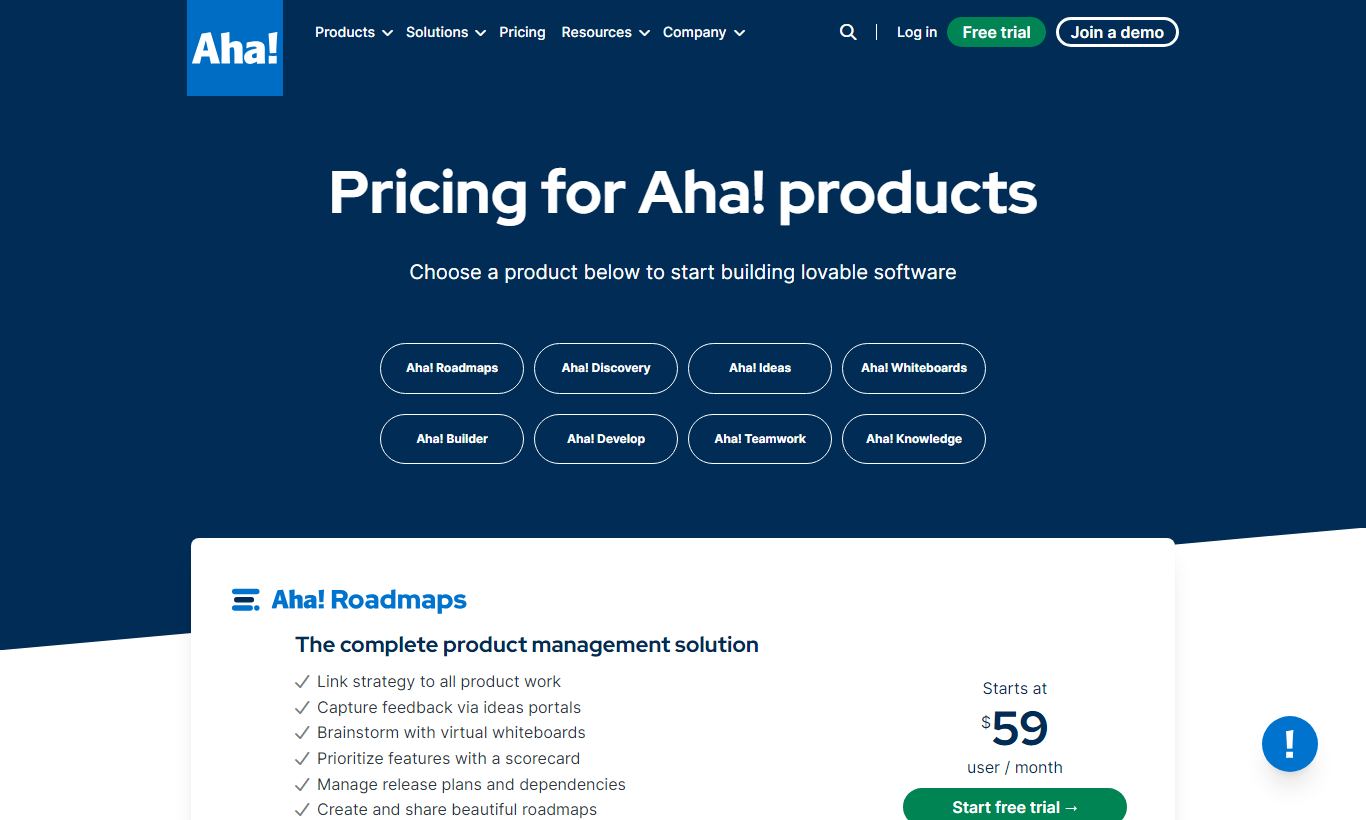
Aha! uses a modular, per-product pricing model. Each product in the suite is priced per user per month, billed annually. There's a 30-day free trial for all products and no credit card is required. Discounts are available for startups (under $1M ARR) and non-profits on request.
- Aha! Roadmaps - Starter: $59/user/month (annual). Core roadmapping, goals, releases, features, and basic reporting. Suited to smaller product teams getting structured for the first time.
- Aha! Roadmaps - Premium: $99/user/month (annual). Adds advanced custom workflows, capacity planning, advanced roadmap views, and enhanced security controls. This is the tier most established product organizations end up buying.
- Aha! Roadmaps - Enterprise: Custom pricing. Adds SSO, dedicated customer success, audit logs, and enterprise security features. Required for organizations with compliance needs.
- Aha! Ideas - Essential: $39/user/month (annual). Idea portal, voting, and basic promotion to roadmap.
- Aha! Ideas - Advanced: $59/user/month (annual). Adds idea scoring, empathy sessions, and deeper portal customization.
- Aha! Develop: $9/user/month (annual) for developers. Scrum and Kanban boards, sprint planning, and velocity reporting. Note: this pricing is specifically for development team members and requires at least one Aha! Roadmaps seat in the account.
No Aha! product has a free plan. The pricing is aimed squarely at enterprise buyers, and for a solo product manager or a 2-person startup, even the entry-level Starter tier ($59/user/month) is a real commitment. Teams should check whether the 30-day trial actually shows them the full value, since onboarding typically takes 2 to 3 weeks.
What We Love
- Goal-to-feature traceability: The ability to link any feature, epic, or release directly to a company-level strategic goal is genuinely rare. It kills the "why are we building this?" confusion that haunts roadmap reviews.
- Idea portal with automated subscriber notifications: When an idea ships, every customer who voted for it gets an automatic email. It's a trust-building loop that most competitors don't offer natively.
- Presentation-ready roadmap exports: PDF, PowerPoint, and shareable URL exports look polished enough to go straight into board-level slide decks without reformatting.
- Custom reporting engine: Build pivot tables and dashboards across features, goals, and releases without leaving the tool. It's genuinely BI-grade reporting for a product management platform.
- Bootstrapped, product-led company culture: Aha!'s own team uses Aha! to build Aha!, and it shows. The product has a coherence and depth of feature design that comes from a team that actually lives the problem they're solving.
Watch Out For
- Steep learning curve for new users: The platform covers a lot of ground, so onboarding takes real time. Multiple customers on review platforms report needing 3 - 4 weeks before their team was using it with any confidence. Factor that into your adoption plans.
- No free plan and high per-user pricing: At $59 - $99/user/month for Roadmaps alone, Aha! is one of the most expensive tools in the category. Teams with 10+ product managers will feel the cost, especially once they add Ideas and Develop seats.
- Aha! Develop still lags Jira for engineering power-users: Sprint velocity, basic Kanban and Scrum are all covered, but Jira's automation rules, plugin marketplace (3,000+ apps) and deeper workflow customization give it a real edge for large engineering organizations.
- Interface can feel dense and complex: Goals, initiatives, epics, features, requirements, releases, master features. That's a lot of objects, and teams that skip setting up a clean, agreed-upon taxonomy before they start often end up overwhelmed.
Who Is It Best For?
Mid-market product organizations (5 - 50 PMs): A company with multiple product lines, a dedicated product operations function, and a real need to connect quarterly OKRs to sprint-level delivery will get extraordinary value from Aha!. The hierarchical data model and cross-product reporting are built for exactly this kind of setup.
Enterprise product teams with a stakeholder communication burden: A VP of Product who presents roadmaps to the board every quarter and needs to show how each initiative ties to ARR growth will find Aha!'s roadmap exports and goal-alignment scoring invaluable. The alternative, rebuilding roadmap slides in PowerPoint every quarter from Jira data, is a painful time sink that Aha! gets rid of.
Product teams running customer-facing feedback programs: A SaaS company that wants to close the loop with customers on feature requests, showing them what shipped and why, will find the Aha! Ideas portal a standout capability. It's especially compelling for B2B companies where customer advisory boards and power-user communities carry outsized influence on the roadmap.
How Does It Compare?
Aha! vs Productboard: Productboard has a cleaner UI and a gentler learning curve. That makes it more accessible for smaller teams or teams that haven't nailed down their process yet. Aha!'s goal-cascading framework and custom reporting engine run deeper, though, and its Develop module gives it a full strategy-to-execution story that Productboard doesn't offer natively.
Aha! vs Jira: Jira owns engineering-led teams when it comes to sprint management and developer workflows, backed by a plugin ecosystem nothing else matches. Aha! wins clearly on the strategy and roadmapping side. Plenty of mature organizations run both: Aha! for product strategy, Jira for engineering execution, connected through the native integration that keeps records in sync between them.
Final Verdict
Aha! is the best purpose-built product management platform available in 2026 for teams that need to operate at both the strategic and execution layers at once. Its roadmapping engine, goal-alignment framework, and ideas portal have no real peers at the same depth. The tradeoffs are genuine. The price is high, the learning curve takes real time, and Aha! Develop still has ground to cover against Jira. For the right team, those tradeoffs are worth it.
If your product team regularly struggles to answer "how does this feature connect to our strategy?" in a roadmap review, Aha! is almost certainly the tool that fixes that problem. If you're a startup under 10 employees or a dev team that just needs sprint boards, you'll get better value from a lighter, cheaper tool and can revisit Aha! once you've scaled. Take the 30-day trial seriously. Set up a real initiative, a real release, and connect it to a real goal. If that workflow clicks for your team, the investment will make sense fast.
Try Aha! Free →FAQ
How much does Aha! cost per month?
Aha! Roadmaps starts at $59/user/month on the Starter plan (billed annually). The Premium plan runs $99/user/month. Aha! Ideas starts at $39/user/month, and Aha! Develop costs $9/user/month for developers. There's no free plan, but you can get a 30-day free trial on all products without entering a credit card.
Is Aha! worth the price for small teams?
For small teams (under 5 people) or early-stage startups, Aha! is probably more than you need. The per-user cost and onboarding effort make more sense once you have 5+ product managers running a real strategy-to-execution workflow. Smaller teams often get better value from Productboard or a Notion-based setup until they grow into Aha!'s scale.
Does Aha! integrate with Jira?
Yes. Aha! has a native two-way integration with Jira that syncs features, epics, and requirements between the two platforms. Product managers can work in Aha! while engineering teams work in Jira, and records stay in sync automatically. It's one of the most common integration setups among Aha! customers.
What is the difference between Aha! Roadmaps and Aha! Develop?
Aha! Roadmaps handles strategy and planning: goals, initiatives, features, and releases. Aha! Develop covers engineering execution: sprint boards, Kanban, and velocity tracking. They're sold separately but built to work together, and Develop requires at least one Roadmaps seat in the account.
Is Aha! better than Productboard?
Aha! is more powerful and feature-rich, especially for goal alignment, custom reporting, and end-to-end delivery through Aha! Develop. Productboard has a cleaner interface and a lower learning curve, which makes it more approachable for smaller or less process-mature teams. Aha! tends to be the better fit for mid-market and enterprise product organizations, while Productboard suits growth-stage teams.
Does Aha! have a free trial?
Yes. Aha! offers a 30-day free trial across all products, including Roadmaps, Ideas, Develop, Notebooks, and Create, and you don't need a credit card to start one. The trial gives you full access to the features in the plan you pick, so it's a real evaluation window, not a stripped-down demo.
What types of roadmaps can you build in Aha!?
Aha! supports timeline (Gantt-style) roadmaps, now-next-later roadmaps, Kanban-style feature boards, release-based roadmaps, and portfolio roadmaps that span multiple products. All views pull from the same underlying data, so switching between them doesn't mean rebuilding anything. You're just looking at the same records from a different angle.
We may earn a commission when you click affiliate links. This never affects our editorial scores.
| Best for | Product roadmap software |
| Category | Project Management |
Answer a few quick questions and we'll match you to the best tool for your needs.
→ Suggest a Tool