
ClickFunnels Review 2026: Is It Worth It?
ClickFunnels is a sales funnel builder built for entrepreneurs, course creators, and online businesses who want to turn visitors into paying customers without hiring a developer. It bundles landing page creation, email automation, checkout pages, order bumps, upsells, and membership sites into one platform. The Basic plan starts at $97/month (or $81/month billed annually), and there's a 14-day free trial to test it out. ClickFunnels is strong at walking buyers through structured conversion sequences, but the pricing runs steep next to newer alternatives, and parts of the interface feel dated. Digital product sellers, coaches, and info-marketers who want a proven, all-in-one funnel system will get the most out of it. Anyone trying to stitch together separate tools instead loses that advantage. High-volume funnels with upsell sequences see measurable ROI here. Budget-conscious beginners or teams that need deep CRM features should look elsewhere.
What we love
Watch out for
ClickFunnels at a glance
What to test in your ClickFunnels trial
14-day free trial
- Build a complete funnel from template and configure a one-click upsell on the checkout page
- Set up an automated email sequence triggered by a purchase, including a post-purchase email and follow-up
- Create an order bump offer and test it on a sample checkout page with real product details
- Import or add your email list and test the split testing feature with two page variants
- Set up a basic membership course with gated content and drip-release schedule if offering digital products
Quick Verdict
ClickFunnels earns its place as the category-defining funnel builder for a reason: it packages landing pages, checkout flows, one-click upsells, order bumps, email follow-up sequences, and membership portals into a single platform. For a digital course creator launching a $497 program or an e-commerce operator running a supplement funnel, having every conversion step managed in one dashboard, with templates already tested on millions of visitors, saves weeks of integration work. It also solves the problem of stitching together separate tools that leak customers between steps.
ClickFunnels isn't cheap, though, and it has real limitations depending on your use case. The Basic plan at $97/month caps you at 20 funnels and 100 pages, which feels tight for an agency or anyone running multiple product lines. The interface works fine, but it doesn't match the visual polish of newer drag-and-drop builders. If you're a solo operator with a clear funnel strategy and a product priced high enough to justify the monthly fee, ClickFunnels delivers. If you're still validating your offer, the cost may outpace your revenue for several months.
Start Your Free Trial →What is ClickFunnels?
ClickFunnels was founded in 2014 by Russell Brunson and Todd Dickerson in Boise, Idaho. What started as a tool for Brunson's own marketing funnels grew into one of the most recognisable names in online marketing software, reportedly surpassing $100 million in annual recurring revenue within a few years of launch. The platform is aimed squarely at entrepreneurs, coaches, consultants, course creators, and direct-response marketers. These are people who care more about conversion rates than pixel-perfect design. ClickFunnels 2.0, launched in late 2022, was a significant rebuild of the core platform. It added a revamped page editor, blog functionality, an improved e-commerce suite, and a CRM called Customer Center.
The product's philosophy is deliberately opinionated. Rather than giving you a blank canvas, it walks you through funnel types (opt-in funnels, webinar funnels, product launch funnels, and so on) and provides pre-built templates for each stage. This makes it faster to launch but less flexible if your conversion flow doesn't fit its mental model. It competes most directly with Kartra, Kajabi, and Leadpages, sitting in the middle ground between pure landing-page tools and full-blown marketing clouds.
Key Features
Feature Checklist
Funnel Builder & Page Editor
The core of ClickFunnels is its step-based funnel builder. You pick a funnel type, say a "2-Step Tripwire" or a "Video Sales Letter Funnel," and the platform builds every required page in sequence: opt-in, sales page, order form, upsell, downsell, and thank-you page. Each page is edited with a drag-and-drop builder that works on rows and columns. You can add headline blocks, countdown timers, video embeds, testimonial carousels, and progress bars without touching code. The editor in ClickFunnels 2.0 is noticeably faster than the original, though it still runs on a section/row/element hierarchy that can feel rigid if you're used to free-form builders like Webflow or the newer Framer. For speed-to-launch on proven funnel structures, this constraint works in your favor. Fewer choices means faster execution.
Order Bumps, Upsells & Downsells
This is where ClickFunnels earns its keep. Adding an order bump, a checkbox offer displayed on the checkout page, takes about 60 seconds to configure. One-click upsells and downsells are built into the funnel flow natively. After a customer completes a purchase, they're shown a next offer that can be accepted with a single click, with no re-entering card details. For a business selling a $97 core product, a well-configured upsell sequence can realistically increase average order value by 30 to 60%. Other platforms offer these features too, but none make them as fast to implement or as tightly woven into the checkout experience.
Email Automation (Follow-Up Funnels)
ClickFunnels includes a built-in email marketing tool called Follow-Up Funnels. You can create broadcast emails, set up automated sequences triggered by funnel actions (say, purchased product A but not product B), and segment contacts by tags. The functionality covers the fundamentals well: timed sequences, action-based triggers, open and click tracking. But it doesn't come close to the sophistication of dedicated tools like ActiveCampaign or Klaviyo. If you're running basic nurture sequences and post-purchase flows, Follow-Up Funnels does the job. If you need advanced conditional branching, lead scoring, or deep e-commerce event tracking, you'll likely need to bring in an external ESP.
Membership Sites & Course Delivery
ClickFunnels 2.0 includes a dedicated membership site feature that lets you host gated content, structure it into courses with modules and lessons, and drip-release content on a schedule. Access is granted automatically when a contact purchases through a funnel, which removes the manual work of managing access by hand. The student experience is functional but not luxurious. It lacks the polished UI that platforms like Kajabi or Thinkific provide. For a business where the course supports the main offer rather than being the flagship product, it works well. Dedicated course creators after a premium learner experience may find it underwhelming.
A/B Split Testing & Analytics
Every page in a funnel can be split-tested against a variant with configurable traffic splits. ClickFunnels tracks opt-in rates, page conversion rates, revenue per visitor, and earnings per click at each funnel step, exactly the metrics a direct-response marketer needs to optimise. The funnel stats dashboard is clean and easy to act on. What it lacks is session recording, heatmaps, or cohort analysis, so most serious optimisers will add Hotjar or Clarity alongside the native analytics. The A/B testing engine itself is reliable and straightforward to set up.
CRM & Customer Center
Introduced in ClickFunnels 2.0, the Customer Center is a lightweight CRM that stores contact profiles, purchase history, active memberships, and funnel activity in one place. You can view a contact's full timeline: what pages they visited, what they bought, and which emails they received. It won't replace a full CRM like HubSpot or Salesforce, but for a solo operator or small team managing their own customers, it often removes the need for a separate contact database.
Pricing
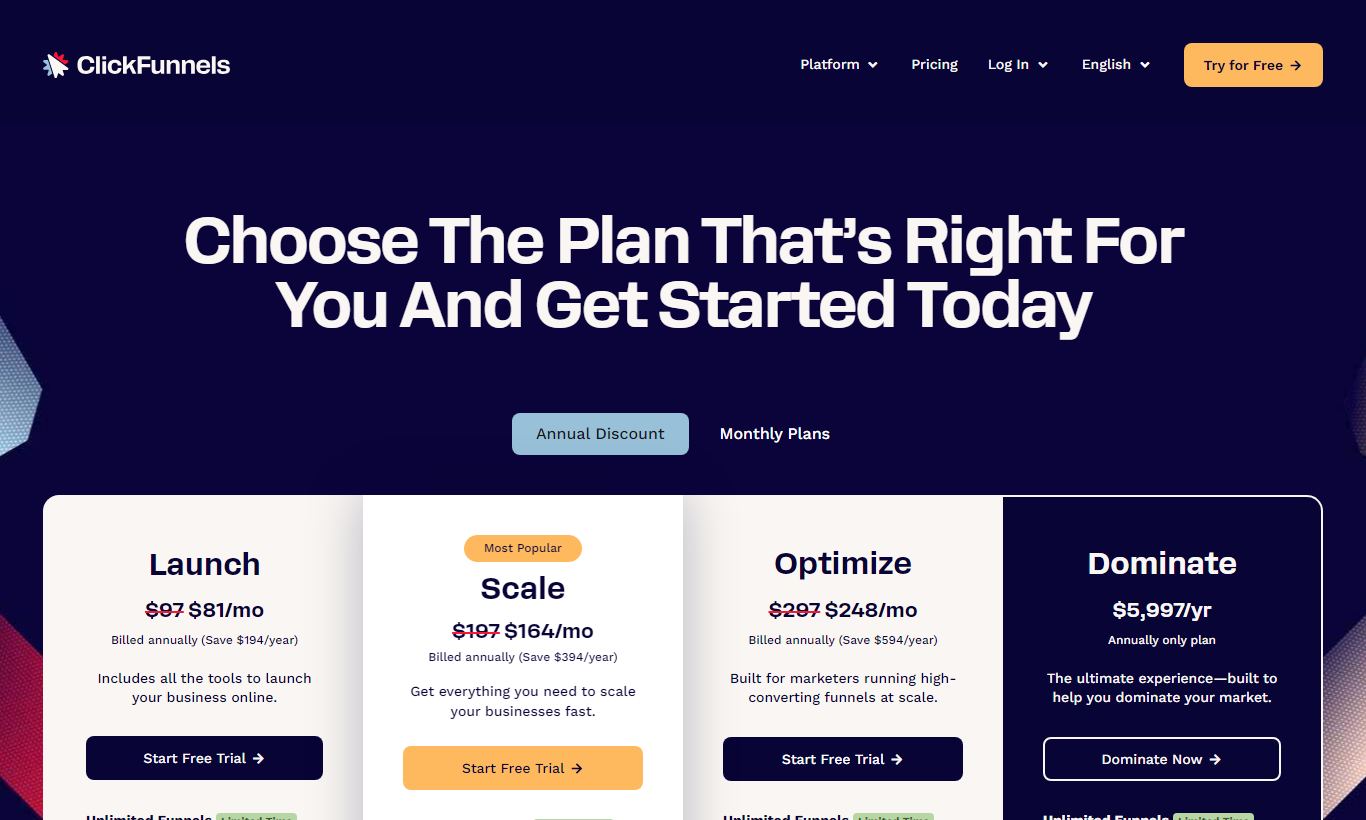
ClickFunnels offers three plans, all with a 14-day free trial. Prices below are monthly when billed annually; month-to-month pricing is higher.
- Basic - $81/month (billed annually) / $97/month (monthly): 1 website, 20 funnels, 100 pages, 1 admin user, 1 domain, up to 10,000 contacts. Includes the funnel builder, page editor, basic email sequences, and checkout pages. No Follow-Up Funnels broadcast email on this tier.
- Pro - $248/month (billed annually) / $297/month (monthly): 1 website, 100 funnels, unlimited pages, 5 admin users, 3 domains, up to 25,000 contacts. Adds Follow-Up Funnels, affiliate management (Backpack), and priority support. This is the plan that makes sense for most full-time operators.
- Funnel Hacker - $497/month (billed annually) / $497/month (monthly): 3 websites, unlimited funnels and pages, 15 admin users, 9 domains, up to 200,000 contacts. Built for agencies, large info-businesses, or operators running multiple brands. Includes all features plus VIP phone support.
The jump from Basic to Pro is steep: $167 a month extra. Follow-Up Funnels (broadcast email) sits locked behind the Pro tier, which is a real problem if you're a solo creator on a tight budget. There's no free plan, but the 14-day trial gives you enough time to build and test a full funnel.
What We Love
- One-click upsells are native and frictionless: Post-purchase upsell pages don't need customers to re-enter payment details, and setting up an entire upsell/downsell chain takes under 20 minutes for a new product.
- The funnel template library covers proven conversion structures: Over 100 pre-built templates, organised by goal (lead gen, webinar, product launch, tripwire), give you a starting point you can deploy in minutes.
- Checkout and payment integration is tightly unified: Stripe and PayPal connect natively. Order bumps, subscription billing, and payment plans are all configurable at the product level, no third-party checkout tools needed.
- Step-by-step analytics show exactly where funnels leak: Conversion rate per funnel step shows up in a clean waterfall view, so it's obvious which page deserves optimisation effort first.
- Membership site access gets provisioned automatically on purchase: Buying a product through a ClickFunnels checkout grants course or membership access instantly, cutting out manual onboarding steps or Zapier workarounds.
Watch Out For
- Basic plan's 20-funnel cap is restrictive for anyone running multiple offers: Agencies or multi-product businesses hit this ceiling fast, then face a near-tripling of monthly cost to move to Pro. That cliff edge is the single most common complaint from users.
- The page editor lacks true free-form design flexibility: If you need pixel-precise layouts or complex responsive behaviour, ClickFunnels' section/row/element system will frustrate you. It's built for speed, not creative control.
- Email automation trails dedicated ESPs by a wide margin: Follow-Up Funnels has no lead scoring, no advanced conditional logic, and no native SMS. Growth-stage businesses routinely end up adding ActiveCampaign or Klaviyo anyway, which undercuts the whole "all-in-one" pitch.
- Customer support quality drops off below the Pro tier: Multiple verified reviews on G2 and Trustpilot cite slow ticket response times and unhelpful canned replies on the Basic plan. VIP support is locked behind the $497 Funnel Hacker tier.
Who Is It Best For?
The digital course creator or coach selling a flagship program at $297+: If you've got a proven offer and run webinar funnels, application funnels, or challenge funnels, ClickFunnels' pre-built structures and checkout logic will cut your launch timeline dramatically. The order bump and upsell features alone can justify the monthly fee even with modest conversions.
The direct-response e-commerce operator selling physical or supplement products: A business running a "free-plus-shipping" or low-ticket tripwire funnel followed by a subscription upsell is exactly the use case ClickFunnels was built around. The funnel-step analytics make optimizing CPAs for paid traffic (Meta, YouTube) far more actionable than a standard Shopify store paired with Google Analytics.
The mid-size marketing agency managing 3 - 8 client funnels: On the Funnel Hacker plan, the three-website allocation and 15 admin users let a small agency manage multiple client accounts under one subscription. The affiliate management tool, Backpack, also lets agencies offer clients a ready-made referral program without buying extra software.
How Does It Compare?
Kartra: Kartra's equivalent all-in-one plan ($119/month) includes a more capable email automation engine with behavioural tagging and a built-in helpdesk. That makes it a better fit for businesses with longer, relationship-driven sales cycles. ClickFunnels wins on funnel speed-to-launch and the quality of its upsell checkout flow. See our full ClickFunnels vs Kartra breakdown for a feature-by-feature comparison.
Leadpages: Leadpages starts at $37/month and excels at standalone landing page creation with a more flexible drag-and-drop editor. It doesn't natively support multi-step funnel flows, order bumps, or membership sites, though. You'll need integrations for everything ClickFunnels handles out of the box. For teams that just need high-converting lead-capture pages and are already using Stripe plus an ESP, Leadpages costs a lot less to run. See ClickFunnels vs Leadpages for more detail.
Final Verdict
ClickFunnels is still the most complete, purpose-built funnel platform you'll find in 2026. It's opinionated by design (it assumes you're selling something with a clear conversion path), and within that assumption it executes exceptionally well. The upsell infrastructure, funnel analytics, and checkout experience set the bar that newer tools are still trying to match. The 2.0 rebuild fixed the speed and stability complaints that dogged the original platform.
Where it falls short is value at the entry level. $97/month with a 20-funnel cap and no broadcast email is a tough ask for anyone still building an audience. If you're generating $3,000/month or more from your funnel, the math works fine. If you're still growing into that revenue, the cost doesn't match the value yet, and lighter alternatives make more sense. For everyone else, established digital product sellers, supplement brands, and agencies running active funnel portfolios, ClickFunnels at the Pro tier is a smart, well-justified investment.
Try ClickFunnels Free →FAQ
How much does ClickFunnels cost per month?
ClickFunnels offers three plans: Basic at $97/month ($81/month billed annually), Pro at $297/month ($248/month billed annually), and Funnel Hacker at $497/month. Every plan comes with a 14-day free trial. Some promotional offers don't even require a credit card at signup.
Is there a free plan for ClickFunnels?
No, ClickFunnels doesn't offer a permanent free plan. You get a 14-day free trial with full access to whatever plan you pick, which is usually enough time to build and test a complete funnel.
Is ClickFunnels worth it for beginners?
It can be, if you already have a validated offer and enough revenue coming in to cover the $97/month fee. If you're still testing product-market fit, the cost can outpace what you're earning. Beginners with a clear digital product and a budget for paid traffic tend to see the fastest return.
How does ClickFunnels compare to Kajabi?
Kajabi suits course creators who want a premium student experience, community features, and a polished course portal. ClickFunnels is stronger for direct-response conversion flows: order bumps, upsells, multi-step funnels. Many businesses run ClickFunnels for the front-end sales funnel and Kajabi for course delivery. ClickFunnels 2.0 has closed some of that gap with its own built-in membership features.
Can ClickFunnels replace an email marketing tool?
For basic sequences and broadcast emails on the Pro plan and above, yes. For advanced automation like lead scoring, conditional branching, deep e-commerce event tracking, or SMS, no. Most power users pair ClickFunnels with a dedicated ESP like ActiveCampaign or Klaviyo.
What payment processors does ClickFunnels support?
ClickFunnels integrates natively with Stripe and PayPal for one-time payments, subscriptions, and payment plans, and it also supports NMI and Authorize.net. Stripe is the most feature-complete of the group, handling order bumps, subscription management, and automatic failed-payment recovery.
Does ClickFunnels 2.0 include a CRM?
Yes. ClickFunnels 2.0 added a Customer Center that stores contact profiles, purchase history, funnel activity, and membership access in one place. It works as a lightweight CRM for small teams, but it won't replace HubSpot or Salesforce in a complex B2B sales operation.
Is ClickFunnels good for e-commerce?
It works well for direct-response e-commerce, especially single-product or small-catalogue physical goods sold through paid traffic funnels with upsell sequences. It's not built to manage large product catalogues, inventory, or complex shipping rules. For that, Shopify paired with a funnel tool like CartHook or ReConvert is usually the better fit.
We may earn a commission when you click affiliate links. This never affects our editorial scores.
| Best for | Sales funnel builder |
| Category | Marketing Automation |
Answer a few quick questions and we'll match you to the best tool for your needs.
→ Suggest a Tool