
Activepieces Review 2026: Is It Worth It?
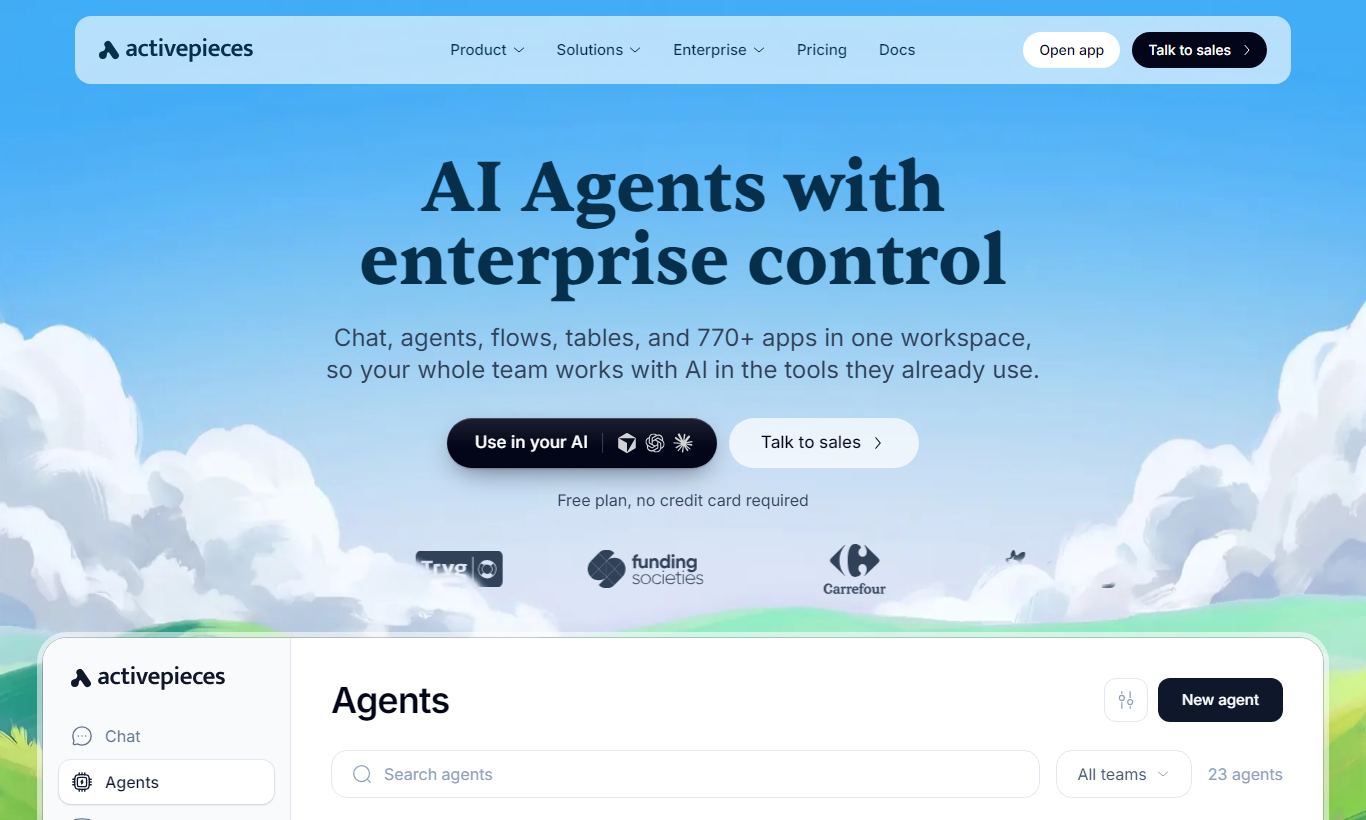
Activepieces is an open-source marketing automation and workflow platform that lets teams connect apps, automate repetitive tasks, and build multi-step flows without writing code. It goes head to head with Zapier and Make, but sets itself apart with a transparent open-source model, self-hosting options, and a fast-growing library of over 200 pre-built connectors called "pieces." Pricing starts free for up to 1,000 tasks a month on the cloud plan, and paid tiers scale up from $9/month. Startups, lean marketing teams, and developers who want automation without vendor lock-in will get real value here. Larger enterprises after deep CRM-native automation or heavy phone support might find it limiting. It earns a strong recommendation for cost-conscious teams willing to put in a bit of setup time in exchange for flexibility and control.
What we love
Watch out for
Activepieces at a glance
What to test in your Activepieces trial
Free plan
- Build a 3-step marketing flow (trigger, enrichment, CRM action) using the visual builder without code
- Test the AI Copilot by describing a workflow in plain English and deploy the generated flow
- Connect two of your existing tools (CRM, email platform, spreadsheet) using the pieces library
- Write a custom JavaScript transformation in a Code step to clean or format real data from your workflow
- Check if your niche tools are available as pieces or if you need HTTP workarounds to connect them
- Decide before the first paid plan bill whether the 1,000 tasks/month limit works for your team or if you need paid tiers
Quick Verdict
Activepieces is a genuinely compelling automation platform, and it punches well above its price point. Whether you're on the free cloud tier or self-hosting on your own infrastructure, you get a visual flow builder, a growing library of over 200 integrations, and an open-source codebase you can audit, fork, or extend yourself. For marketing teams tired of paying Zapier's steep per-task premiums, it's an immediately attractive alternative.
The platform isn't perfect. The connector library, while impressive for its age, still has gaps compared to Zapier's 6,000+ integrations, and enterprise support tiers carry a premium price tag. But for most small-to-mid-sized marketing operations, Activepieces delivers reliable, scalable automation at a fraction of the cost. If you're evaluating automation tools in 2026, it deserves a spot on your shortlist.
Start Your Free Trial →What is Activepieces?
Activepieces was founded in 2022 by Mohamed Abdulaziz and Ashraf Samhouri, two engineers with a clear goal: build the most developer-friendly, open-source alternative to Zapier. The company runs remotely with a distributed team, and it released its core platform under the MIT license. That means anyone can inspect the source code, contribute connectors, or self-host the entire stack. This kind of transparency is rare in the automation space, and it's driven fast community adoption on GitHub, where the project has racked up tens of thousands of stars.
The platform serves two overlapping audiences: non-technical marketers who need drag-and-drop workflow automation, and developers or IT teams who want the control of open-source software without giving up usability. It sits in the no-code/low-code automation category alongside Zapier, Make (formerly Integromat), and n8n. Its mix of a polished UI and genuine open-source licensing gives it a distinct spot in the market, one that appeals to growth-stage companies and privacy-conscious enterprises alike.
Key Features
Feature Checklist
Visual Flow Builder
The centrepiece of Activepieces is its drag-and-drop flow builder. You build automations, called "flows," by chaining trigger steps and action steps together on an infinite canvas. Each step snaps cleanly into place. The interface surfaces data from previous steps through a point-and-click variable picker, so you never have to type JSON paths by hand. A marketing manager could build a flow that triggers when a new lead fills out a Typeform, enriches the contact data via Clearbit, adds the lead to a HubSpot pipeline, and sends a personalised Slack notification to the sales rep. All of that, in under 15 minutes, no code required.
Branching logic runs through a dedicated "Router" step that evaluates conditions and splits execution down different paths. That makes it easy to build conditional nurture sequences: send one follow-up email if the lead is from a target account, a different one if they're not.
Pieces (Connector Library)
Integrations in Activepieces are called "pieces," and the library now covers more than 200 connectors spanning the most popular marketing, sales, and productivity apps. Key pieces include Salesforce, HubSpot, Mailchimp, ActiveCampaign, Google Sheets, Airtable, Slack, Discord, OpenAI, Notion, Shopify, WooCommerce, and many more. What sets this apart from closed platforms is the open contribution model. Any developer can build and publish a new piece using Activepieces' TypeScript SDK, and the community adds new connectors every week. If a piece you need doesn't exist yet, you can build it yourself, or use the HTTP piece to call any REST API directly.
AI-Powered Automation Copilot
Activepieces introduced an AI Copilot feature that lets you describe a workflow in plain English and get back a suggested flow structure. Type something like "When a new subscriber joins my Mailchimp list, wait 1 hour, then send a welcome email via Gmail and log it in Google Sheets," and the copilot scaffolds the steps for you. It's not magic. You still review and configure each step, but it cuts the time from idea to deployed automation significantly, especially for users new to the platform. The copilot also helps write JavaScript expressions inside steps for users who need custom data transformations.
Self-Hosting and Data Privacy
One of Activepieces' strongest selling points is its self-hosting option. Teams with strict data residency requirements, common in healthcare, finance, and EU-based companies navigating GDPR, can deploy the entire platform on their own cloud infrastructure using Docker Compose or Kubernetes. The self-hosted version is fully featured, including the flow builder, all community pieces, and execution logs. There's no crippled "community edition." You get the same product. That's a stark contrast to n8n, which locks certain enterprise features behind a commercial licence.
Multi-Step Loops and Code Steps
For power users, Activepieces supports loop iterations over arrays (useful for processing lists of contacts or orders) and native Code steps where you can run custom JavaScript or TypeScript logic inline within a flow. That makes it possible to handle complex data transformations, parsing webhook payloads, calculating lead scores, formatting dates for different CRM field types, without needing an external serverless function. Marketing operations teams with a resident developer will find this especially useful for building solid, production-grade workflows.
Pricing
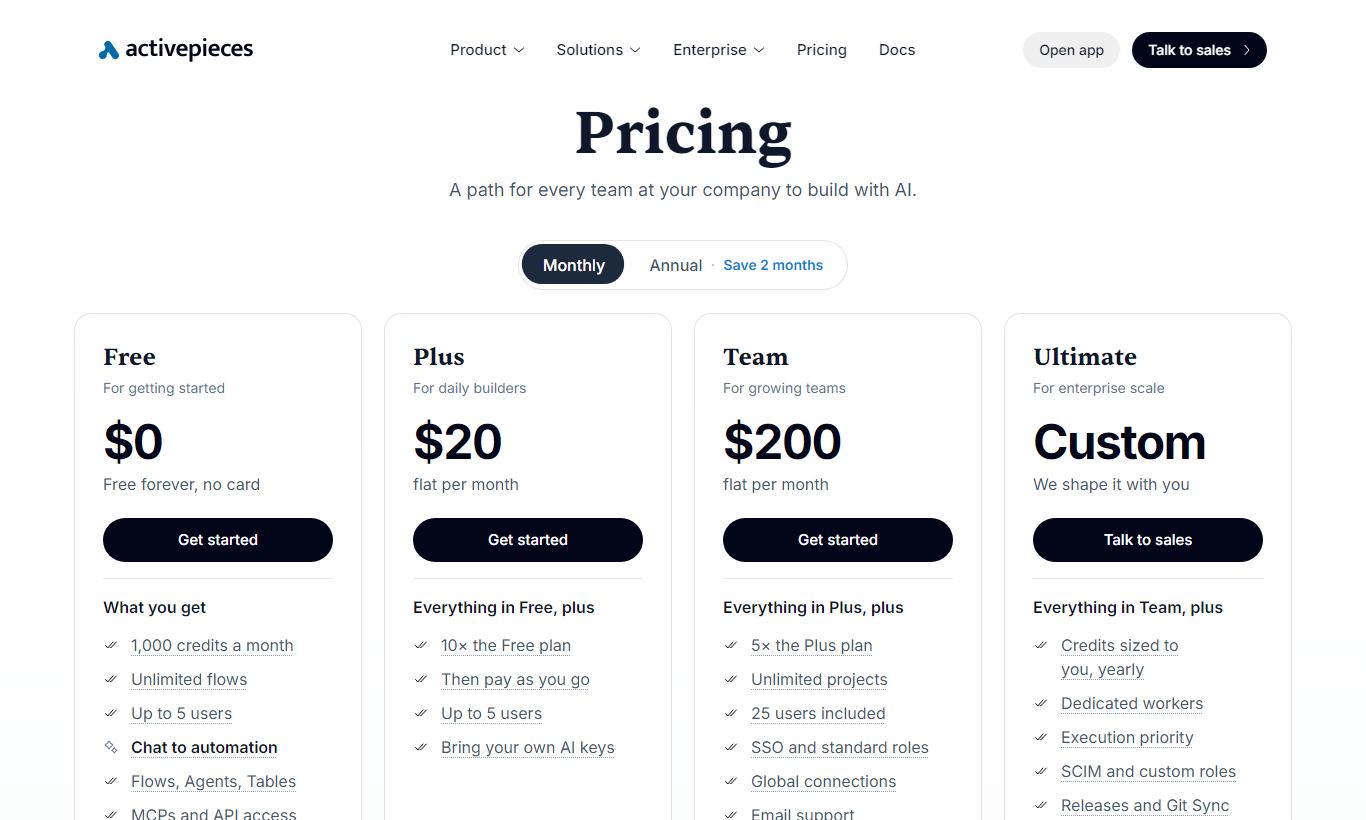
Activepieces keeps its pricing simple. The free tier is genuinely usable, and the lower paid plans don't hit you with surprise usage fees.
Free Plan - $0/month: Includes 1,000 tasks per month, unlimited flows, 5 active flows simultaneously, and access to all community pieces. There's no time limit on the free plan. It's a permanent tier, not a trial. Good fit for freelancers or individuals testing the platform.
Starter Plan - $9/month (billed annually) or approximately $12/month billed monthly: Raises the task limit to 10,000 tasks per month, allows unlimited active flows, includes priority email support, and adds advanced flow features like multi-step routers and loop steps. This tier is the sweet spot for small marketing teams running a modest number of automations.
Pro Plan - $49/month (billed annually): Offers 50,000 tasks per month, team collaboration features including multi-user workspaces and role-based permissions, version history for flows, and access to premium pieces. Built for growing teams managing multiple campaigns and client accounts.
Platform/Enterprise Plan - Custom pricing: Aimed at agencies and enterprises needing white-labelling, SSO, dedicated support SLAs, custom task volume, and on-premise deployment assistance. You'll need to contact sales for a quote. Self-hosting under the open-source licence stays free indefinitely for technical teams comfortable managing their own infrastructure.
There's no free trial as such. The free plan effectively works as one, and no credit card is required at sign-up. Annual billing saves roughly 20-25% across paid tiers.
What We Love
- True open-source transparency: The MIT-licensed codebase on GitHub means you can audit every line, self-host without feature restrictions, and never face vendor lock-in. That's a rare commitment in the automation space, and it's genuinely valuable.
- AI Copilot for fast flow creation: The natural-language flow generator cuts setup time, especially if you're building your first automations. Scaffolding a 5-step flow takes seconds, not minutes.
- Generous permanent free tier: You get 1,000 tasks per month with unlimited flows and no credit card required. That's one of the most accessible entry points in the category. Zapier's free plan caps you at just 100 tasks.
- Custom Code steps with JavaScript/TypeScript: Inline code execution inside flows lets developers handle complex transformations without reaching for external services. Logic stays centralised and easy to audit.
- Active community-driven piece development: New connectors get contributed weekly through the open SDK. The library grows fast enough that gaps you hit today are often filled within months of being requested.
Watch Out For
- Connector library still has notable gaps: With 200+ pieces versus Zapier's 6,000+, niche or legacy tools (certain regional payment processors, specialist HR platforms, or older marketing stacks) may not have a native piece yet. You'll need HTTP workarounds to fill the gap.
- No built-in CRM or email sending: Unlike HubSpot or ActiveCampaign, Activepieces is a pure automation layer. It expects you to bring your own CRM and email tool, which adds setup work for teams starting from scratch.
- Enterprise support requires a custom contract: Businesses that need dedicated account management, phone support, or SLA guarantees have to negotiate an enterprise plan. The self-serve tiers only offer email and community support, a frequent complaint in user forums.
- Self-hosting demands real technical skill: Docker deployment is well documented, but keeping a self-hosted instance updated, backed up, and secured is an ongoing DevOps job. Non-technical teams shouldn't underestimate the work involved.
Who Is It Best For?
The lean startup marketing team (2 - 10 people): A Series A company running HubSpot, Notion, Slack, and Stripe can use Activepieces to automate its entire lead-to-close notification system, trial onboarding sequences, and revenue reporting, all on the $49/month Pro plan. The task volume covers several thousand monthly leads without strain. The multi-user workspace keeps the whole team aligned on which automations are live.
The developer or marketing ops specialist at a mid-market company: Someone managing 50+ automation workflows who's outgrown Zapier's pricing (where 50,000 tasks can cost $299+/month) will find Activepieces far more cost-efficient. The Code step and HTTP piece mean they can handle any integration without compromise. Self-hosting gives their security team the data residency assurances it needs.
The digital agency building automations for multiple clients: An agency managing 10 to 20 client accounts can use the Platform/Enterprise plan to white-label the interface, create isolated workspaces per client, and bill automation-as-a-service as a premium offering. The open-source licence means no per-seat fees eat into margin.
How Does It Compare?
Zapier: Zapier is still the gold standard for integration breadth with 6,000+ apps, and its onboarding is the most polished in the category. But its per-task pricing gets punishing at scale. 50,000 tasks costs $299/month versus Activepieces' $49/month. If your connector needs are covered by Activepieces' 200+ pieces, switching saves real money. See our full Activepieces vs Zapier comparison for a detailed breakdown.
Make (formerly Integromat): Make offers a similarly visual, node-based builder and a competitive free tier, but its interface has a steeper learning curve and there's no open-source option. Activepieces' self-hosting and Code step flexibility give it an edge for technical teams. Make counters with more mature scenario history and error-handling features, which operations professionals who need granular debugging will appreciate. Read our Activepieces vs Make comparison for more detail.
Final Verdict
Activepieces has matured fast for a platform that's only a few years old. It delivers a polished no-code flow builder, a connector library that keeps growing, real AI assistance, and a genuinely unique open-source foundation, all at pricing that makes Zapier's equivalent tiers hard to justify. For cost-conscious marketing teams, ops professionals, and developer-leaning power users, it's an easy recommendation.
It does have gaps. Integration breadth for niche tools, no native CRM or email capabilities, and limited self-serve enterprise support are real considerations. Teams deeply embedded in an ecosystem with a lot of obscure integrations, or those wanting an all-in-one marketing suite rather than a pure automation layer, should check their specific connector needs before committing. But for most B2B and B2C marketing operations running standard stacks, Activepieces delivers real value, and it'll only get stronger as its community grows.
Try Activepieces Free →FAQ
Is Activepieces really free?
Yes. Activepieces has a permanent free plan with 1,000 tasks per month, unlimited flows, and access to every community piece. No credit card needed. There's no time limit either. It's a free tier, not a trial. You can also self-host the open-source version on your own servers, free, with no task caps imposed by the licence.
How much does Activepieces cost?
Pricing starts at $0/month (free tier, 1,000 tasks), then $9/month for Starter (10,000 tasks, billed annually), then $49/month for Pro (50,000 tasks, team features, billed annually). Enterprise and white-label plans come at custom pricing. Annual billing saves roughly 20-25% compared to paying monthly.
Is Activepieces better than Zapier?
If your automation needs fit within Activepieces' 200+ connectors, it's a lot cheaper than Zapier. 50,000 tasks costs $49/month on Activepieces versus $299/month on Zapier. Zapier still wins on integration breadth, with 6,000+ apps, and it has a more established ecosystem. Activepieces wins on price, open-source transparency, and the flexibility to self-host.
Can I self-host Activepieces?
Yes. Activepieces is MIT-licensed open-source software, and you can deploy it on your own infrastructure using Docker Compose or Kubernetes. The self-hosted version is fully featured, with no artificial limitations, which makes it a solid fit for teams with GDPR, HIPAA, or other data residency requirements.
Is Activepieces worth it for small businesses?
Yes, especially for small businesses already using mainstream tools like HubSpot, Mailchimp, Slack, Google Workspace, or Shopify. The free and Starter plans cover most small business automation needs for a fraction of what competitors charge. The main trade-off: niche integrations may not exist yet as native pieces.
Does Activepieces require coding knowledge?
No coding is needed for most use cases. The visual flow builder is built for non-technical users. That said, optional Code steps (JavaScript/TypeScript) and an HTTP piece are there for developers who need custom logic or want to hook into undocumented APIs.
How does Activepieces compare to Make (Integromat)?
Both platforms offer visual, node-based builders and competitive pricing. Activepieces has the edge in open-source transparency, self-hosting, and a simpler onboarding process. Make offers more mature error-handling, a longer track record, and slightly more connectors. Technical teams that prioritise data control tend to prefer Activepieces. Operations professionals who need advanced debugging tools often prefer Make.
What marketing tools does Activepieces integrate with?
Activepieces natively integrates with HubSpot, Salesforce, Mailchimp, ActiveCampaign, Klaviyo, Typeform, Google Ads, Facebook Lead Ads, Airtable, Notion, Slack, Shopify, WooCommerce, and 200+ more. If a tool doesn't have a native piece, the HTTP connector lets you plug into any REST API.
We may earn a commission when you click affiliate links. This never affects our editorial scores.
| Best for | — |
| Category | Marketing Automation |
Answer a few quick questions and we'll match you to the best tool for your needs.
→ Suggest a Tool