
ActiveCampaign Review 2026: Is It Worth It?
ActiveCampaign is a marketing automation and CRM platform built for small and mid-sized businesses that have outgrown basic email tools like Mailchimp. Its visual automation builder, deep segmentation, and built-in CRM set it apart from simpler competitors. Plans start at $15/month (Starter), with a 14-day free trial available. The platform shines for businesses that need multi-step nurture sequences, lead scoring, and sales pipeline management in one place. It does carry a steeper learning curve than most entry-level tools, and costs can climb fast as your contact list grows. If you're a growing e-commerce brand, SaaS company, or B2B service provider ready to invest in serious automation, ActiveCampaign delivers strong value. Casual senders or very small lists may find it overkill.
What we love
Watch out for
ActiveCampaign at a glance
What to test in your ActiveCampaign trial
14-day free trial
- Build a multi-step automation with branching logic using one of the 850+ recipe templates
- Set up lead scoring rules with point values for key actions like email opens and page visits
- Create a segmented email campaign using behavioral site tracking and custom fields
- Connect your CRM deals to a contact record and watch marketing engagement data sync in real-time
- Export campaign and automation reports to verify open rates and segment performance match your goals
- Decide if the learning curve and feature set justify upgrading before your trial ends or first charge
Quick Verdict
ActiveCampaign has earned its reputation as the gold standard for small-business marketing automation, but only if you're ready to actually use it. It's not a tool you set up in 20 minutes and walk away from. The platform rewards businesses willing to invest time in building multi-branch automation workflows, lead scoring models, and tightly segmented lists. Once those systems are in place, the payoff is real: higher email deliverability, better lead qualification, and a sales team that only gets pinged when a prospect is genuinely warm.
If you're a solo founder or micro-business sending a monthly newsletter, this is probably more platform than you need. But for a growing SaaS company nurturing trial users, an e-commerce brand automating post-purchase sequences, or a B2B agency managing clients through a visual sales pipeline, ActiveCampaign is one of the most complete platforms you'll find at its price point. The 14-day free trial gives you enough room to build a real workflow and judge it for yourself.
Start Your Free Trial →What is ActiveCampaign?
ActiveCampaign was founded in 2003 in Chicago and has grown to serve over 180,000 businesses in 170+ countries. It started as an email marketing tool and evolved steadily into a full marketing automation and CRM platform. Today it holds a distinct spot in the market: more powerful than entry-level tools like Mailchimp or Brevo, but more accessible (and cheaper) than enterprise platforms like Marketo or Pardot. The company targets SMBs and mid-market teams, typically 2 to 200 employees, that need enterprise-grade automation logic without enterprise-grade complexity or pricing.
The platform combines email marketing, marketing automation, a built-in sales CRM, landing pages, and SMS messaging under one roof. That combination is the whole point. Instead of stitching together five separate tools, you can run a single ActiveCampaign account to manage the entire customer lifecycle, from first opt-in to closed deal to post-purchase loyalty sequence.
Key Features
Feature Checklist
Visual Automation Builder
This is ActiveCampaign's strongest asset, and it's the feature that consistently separates it from simpler platforms. The drag-and-drop automation builder lets you create multi-branch, conditional workflows that respond to real customer behavior, not just time delays. For example, an e-commerce brand can build an automation that sends a welcome email immediately after signup, waits 24 hours, checks whether the contact has made a purchase, and then branches: buyers get a cross-sell sequence, non-buyers get a discount offer. Every action, condition, and wait step shows up as a visible block on a zoomable canvas. You can build automations with 50+ steps without losing track of the logic.
The "Automations Marketplace" offers 850+ pre-built automation recipes. You can import a complete abandoned cart sequence, SaaS trial nurture flow, or event follow-up series and adapt it in minutes rather than building from scratch.
Email Segmentation and Personalization
ActiveCampaign's segmentation engine is exceptionally granular. Contacts can be filtered and grouped by any combination of tags, custom fields, geographic data, website activity (via the built-in site tracking script), purchase history, email engagement, and CRM deal stage. A B2B SaaS company, for instance, can create a segment of contacts who visited the pricing page at least twice in the last 7 days but haven't started a trial, then trigger a targeted automation specifically for that high-intent group. Conditional content blocks inside emails let you show different copy or offers to different segments within a single send. That cuts down on the need to build dozens of duplicate campaigns.
Built-in CRM and Sales Pipelines
Many email-first platforms bolt on a CRM as an afterthought. ActiveCampaign's Deals CRM is genuinely functional. You get visual Kanban-style pipelines, deal scoring, task automation, and win probability tracking. A sales rep can see exactly which marketing emails a prospect opened, which pages they visited, and what lead score they've accumulated, all within the deal record. Automations can move deals between pipeline stages automatically based on contact behavior. A lead can get promoted to "Demo Scheduled" the moment they click a calendar booking link. This two-way flow between marketing and sales data is one of the platform's strongest differentiators.
Lead Scoring
Lead scoring in ActiveCampaign is rule-based and fully customizable. You assign positive or negative point values to any trackable action: opening an email (+2), clicking a pricing page link (+10), unsubscribing from a list (−20), visiting the careers page (−5, probably not a buyer). Score thresholds trigger automations, so when a contact crosses 50 points, a sales rep can be automatically assigned, a Slack notification sent, and a personalized "ready to talk?" email dispatched. This alone can change how a company qualifies leads, replacing manual SDR triage with a systematic, data-driven workflow.
Reporting and Analytics
Standard reporting covers open rates, click rates, unsubscribes, bounces, and revenue attribution per campaign. The Automation Reports dashboard shows how many contacts entered each automation, where they dropped off, and how individual steps perform. That's essential for diagnosing a leaky nurture funnel. Higher-tier plans unlock advanced reporting including conversion tracking, goal completions within automations, and split-testing (A/B) reports across entire sequences rather than just individual emails. One genuine limitation: the out-of-the-box dashboards, while useful, aren't as visually rich or customizable as dedicated BI tools. Heavy analytics users may want to pipe data to Looker Studio via one of the native integrations.
Pricing
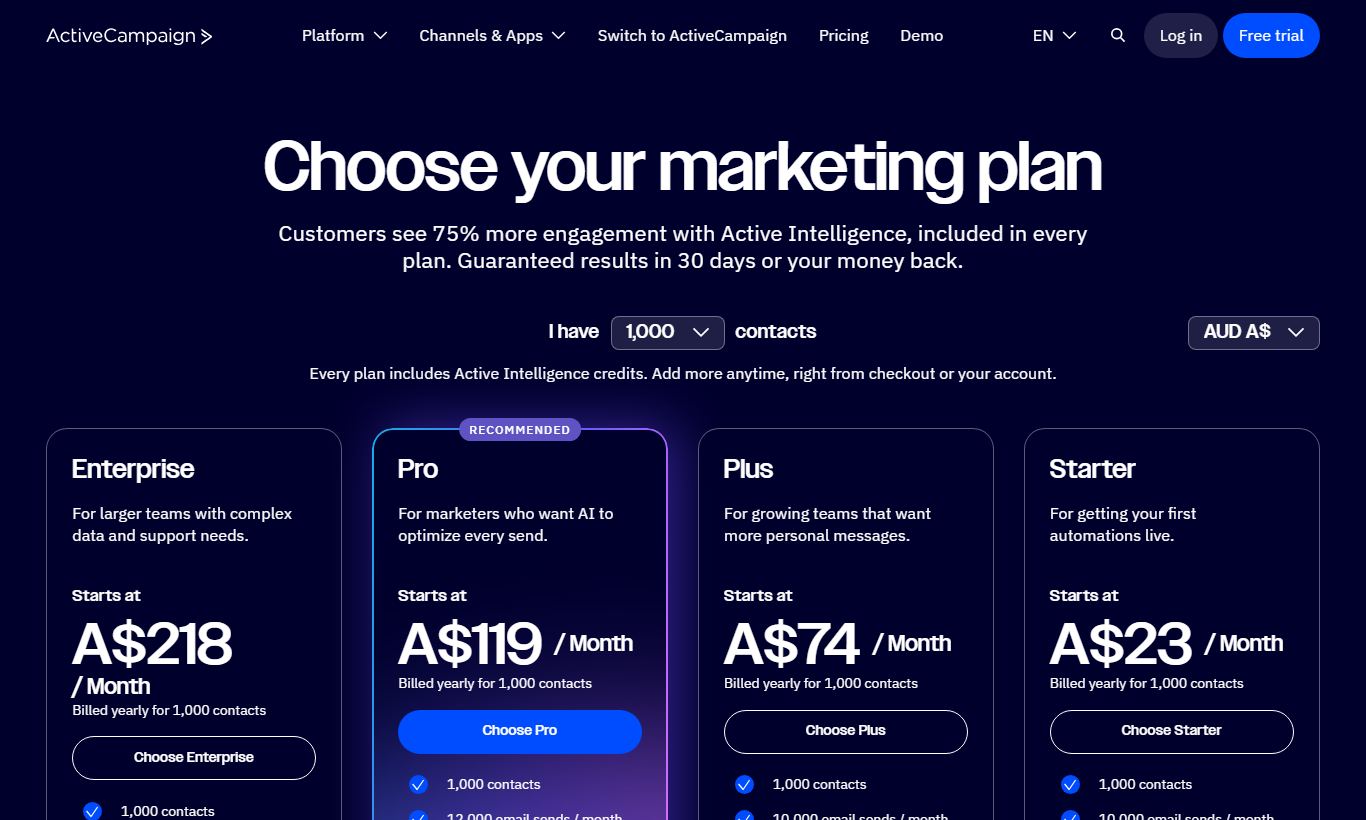
ActiveCampaign pricing is contact-based, so costs scale as your list grows. All prices below reflect the 1,000-contact tier billed annually. Monthly billing costs roughly 20% more. A 14-day free trial is available on all plans, and you don't need a credit card to start one.
- Starter - $15/month (billed annually): Email marketing, marketing automation, 1 user, 10x contact email sends per month, basic reporting, 900+ automation templates, inline forms. Good for solo operators getting started with automation.
- Plus - $49/month (billed annually): Everything in Starter, plus the Deals CRM, landing pages, Facebook Custom Audiences, lead scoring, SMS marketing, conditional content, and 3 users. This is the tier where the platform really opens up. Most growing businesses should start here.
- Pro - $79/month (billed annually): Everything in Plus, plus predictive sending (AI-powered send-time optimization), Salesforce integration, site messaging, attribution reporting, conversion tracking, and 5 users. Good fit for teams that want AI-assisted optimization and richer revenue attribution.
- Enterprise - Custom pricing: Everything in Pro, plus custom reporting, a dedicated account rep, custom domain mail servers, onboarding assistance, and unlimited users. Built for companies with 50,000+ contacts and compliance needs.
At 10,000 contacts, Plus runs approximately $149/month, still competitive against HubSpot Marketing Hub Starter, which charges $45/month but offers far more limited automation. The contact-based pricing model keeps costs predictable, but it can catch teams off guard when their list grows fast. Run an annual audit to suppress unengaged contacts and keep costs in check.
What We Love
- Automation builder depth: Multi-branch, condition-based workflows with 850+ pre-built recipes mean you can build complex customer sequences without any developer help.
- Behavioral site tracking: The site tracking pixel captures page visits and feeds them straight into segmentation and automation triggers. No third-party integration needed.
- Native CRM with two-way data flow: Marketing engagement data (email opens, link clicks, scores) shows up directly on deal records, so sales reps get full context before every outreach.
- Predictive sending (Pro+): AI-powered send-time optimization looks at each contact's historical open patterns and delivers emails at their personal best time. This measurably improves open rates on large lists.
- Deliverability performance: ActiveCampaign consistently scores above 90% in third-party inbox placement tests. That's backed by a dedicated deliverability team and strict enforcement of list hygiene.
Watch Out For
- Steep initial learning curve: The automation builder is powerful but not something you'll master on day one. Budget 5-10 hours before you're building with any confidence, and that's a real problem if you're a solo operator with no time to spare.
- Cost escalation at scale: Moving from 1,000 to 25,000 contacts on the Plus plan jumps from $49/month to roughly $199/month annually. Fast-growing businesses that haven't budgeted for this will feel it.
- Landing page builder is limited: The native landing page tool works, but it falls short of dedicated builders like Unbounce or even HubSpot when it comes to template quality, mobile responsiveness controls, and A/B testing depth.
- Reporting lacks visual customization: Standard dashboards can't be rearranged or custom-built without exporting the data first. If your team lives in analytics, you'll find the native dashboards frustrating next to Klaviyo's reporting suite or a connected BI tool.
Who Is It Best For?
The growing SaaS company (10 - 100 employees): A SaaS business with a free trial funnel needs to nurture new signups based on in-app behavior, onboarding milestones, and feature adoption. ActiveCampaign's automation recipes include purpose-built SaaS trial sequences, and the lead scoring model integrates neatly with webhook-triggered events from the product. The Deals CRM means the sales team works the same platform as the marketing team. There's no Salesforce tax for early-stage companies.
The e-commerce brand using Shopify or WooCommerce: With native Shopify and WooCommerce integrations, ActiveCampaign can trigger post-purchase thank-you sequences, abandoned cart recovery emails, and replenishment reminders based on actual order data. A direct-to-consumer brand selling supplements, for instance, can automate a 90-day replenishment nudge based on average product consumption cycles, with no custom development required.
The B2B agency or consultancy managing multiple clients: Agencies on the Plus or Pro plans can create separate pipelines for different client accounts, build reusable automation templates, and manage contact segmentation with custom fields per client vertical. The white-label and client management features aren't as deep as a dedicated agency platform. Still, the combination of automation and CRM in one login makes ActiveCampaign a practical operational hub for boutique agencies up to about 50 clients.
How Does It Compare?
Klaviyo: Klaviyo is the stronger choice for pure e-commerce brands, especially ones deep in Shopify's ecosystem. It has better revenue attribution and product-specific segmentation. But it has no native CRM, and it gets a lot more expensive at higher contact tiers. See our full ActiveCampaign vs Klaviyo comparison for a head-to-head breakdown.
HubSpot Marketing Hub: HubSpot offers a wider platform ecosystem (CMS, service hub, operations hub) and a cleaner UI. But Marketing Hub's automation at comparable price points is noticeably thinner. You need the Professional tier ($800/month) to get the workflow depth ActiveCampaign delivers at $49/month. For teams not already tied into the HubSpot ecosystem, ActiveCampaign wins on automation value per dollar. Full breakdown in our ActiveCampaign vs HubSpot comparison.
Final Verdict
ActiveCampaign is the closest thing to a complete marketing-and-sales engine available at the SMB price point. Its automation builder is genuinely best-in-class for businesses under 500 employees, its CRM integration works far better than most email-first competitors, and its deliverability track record is strong. The platform does demand investment: time to learn it, budget that scales with list size, and real thinking about what you actually want to automate. Businesses that make that investment will likely find it becomes the operational backbone of their entire customer acquisition and retention engine.
If you're evaluating it against HubSpot for automation depth, ActiveCampaign wins below the $800/month threshold. If you're an e-commerce-only brand on Shopify, Klaviyo may serve you marginally better. For everyone else, SaaS, B2B services, agencies, content businesses, ActiveCampaign is the most capable platform at its price. The 14-day free trial gives you enough time to know whether it fits your workflow.
Try ActiveCampaign Free →FAQ
How much does ActiveCampaign cost per month?
ActiveCampaign starts at $15/month for the Starter plan (1,000 contacts, billed annually). The most popular Plus plan is $49/month at the same contact tier. Pro is $79/month, and Enterprise uses custom pricing. All prices scale with contact list size.
Does ActiveCampaign have a free plan?
ActiveCampaign doesn't offer a permanent free plan, but it does provide a 14-day free trial with no credit card required. The trial gives full access to the platform, so you can build and test real automations before you commit to anything.
Is ActiveCampaign better than Mailchimp?
For marketing automation depth, yes. ActiveCampaign is significantly more powerful than Mailchimp. Mailchimp is easier to start with and has a free tier, but its automation logic is limited to simple linear sequences. ActiveCampaign's multi-branch, condition-based builder handles complex customer journeys that Mailchimp can't replicate.
Is ActiveCampaign good for e-commerce?
Yes, particularly for Shopify and WooCommerce stores. Native integrations support abandoned cart emails, post-purchase sequences, and replenishment automations using real order data. Klaviyo's e-commerce-native analytics and revenue attribution may still edge it out for large DTC brands with large, complicated product catalogues.
What's the difference between ActiveCampaign Plus and Pro?
Plus ($49/month) adds the CRM, landing pages, lead scoring, SMS, and conditional content on top of Starter. Pro ($79/month) adds predictive send-time AI, Salesforce integration, site messaging, and full attribution reporting. For most SMBs, Plus covers the core needs. Pro makes sense once you're fine-tuning a mature automation programme.
Does ActiveCampaign integrate with Shopify?
Yes. ActiveCampaign has a native Shopify integration that syncs order history, product data, and customer lifecycle events directly into your contact records and automation triggers. This enables abandoned cart recovery, post-purchase upsells, and win-back sequences without any custom coding.
Is ActiveCampaign worth it for small businesses?
For small businesses that actively use automation, things like onboarding sequences, nurture flows, and lead scoring, ActiveCampaign offers strong value starting at $15 to $49/month. For businesses that only need occasional batch email newsletters, simpler tools like Mailchimp or Brevo will cost less and take less setup. The return depends entirely on how much of the automation capability you actually put to work.
How does ActiveCampaign's CRM compare to HubSpot CRM?
HubSpot's free CRM is more feature-rich as a standalone sales tool, with better reporting, sequences, and a larger app ecosystem. ActiveCampaign's CRM, though, is deeply integrated with its marketing automation. Contact behavior data flows directly into deal records in a way that requires expensive HubSpot tiers to match. For teams that need marketing and sales working in one tight loop, ActiveCampaign's CRM punches above its price.
We may earn a commission when you click affiliate links. This never affects our editorial scores.
| Best for | Email marketing and automation |
| Category | Marketing Automation |
Answer a few quick questions and we'll match you to the best tool for your needs.
→ Suggest a Tool