
Kartra Review 2026: Is It Worth It?
Kartra is an all-in-one marketing platform built for online entrepreneurs, coaches, course creators, and digital product sellers who want landing pages, sales funnels, email marketing, membership sites, and checkout under one roof. Starting at $119/month (billed annually), it replaces a stack of 5 to 8 separate tools. Kartra earns its price tag for businesses generating consistent revenue from digital products or services, thanks to its mature funnel builder, built-in affiliate management, and behavioral email automation. It's overkill for simple websites, though, and its page builder feels dated compared to newer alternatives. If you're running an online business doing $3K+/month and juggling too many tools, Kartra is a serious contender worth the 14-day free trial.
What we love
Watch out for
Kartra at a glance
What to test in your Kartra trial
14-day free trial for $1
- Build a complete sales funnel with conditional logic: product page, checkout, upsell, and email sequences
- Set up behavioral email triggers based on video watch time, page visits, and purchase history with your real offer
- Create a multi-tier membership site with drip-scheduled content to test member experience
- Configure one-click order bumps and upsells on a real checkout to verify conversion flow works
- Add 5 to 10 affiliates to the built-in portal and test commission tracking and payout setup
- Decide whether the page builder's dated interface and 2-4 week learning curve fit your timeline before the trial ends
Quick Verdict
Kartra is one of the most complete all-in-one marketing platforms available for digital entrepreneurs. It combines landing pages, sales funnels, email automation, video hosting, membership sites, affiliate management, and native checkout into a single ecosystem, and it does most of those things well. For an online business owner who is currently paying for ClickFunnels, ActiveCampaign, Teachable, ThriveCart, and iDevAffiliate separately, consolidating into Kartra at $229/month (Growth plan) is a financially smart move. You'll save money, cut out the integration headaches, and get a unified data layer that makes behavioral automation far more powerful.
The platform has trade-offs. Its page builder lacks the polish of newer competitors, contact limits on the Starter plan are restrictive, and there's no organic SEO toolkit at all. But if you sell digital products, coaching packages, or online courses and want a reliable, proven stack that doesn't need a developer to maintain, Kartra delivers. A 14-day trial for $1 lets you stress-test the whole platform before you commit.
Start Your Free Trial →What is Kartra?
Kartra was founded in 2018 by Genesis Digital, the same company behind WebinarJam and EverWebinar. It was built to solve a specific problem for online business owners: the sprawling, expensive, often poorly integrated collection of SaaS tools needed to launch and scale a digital product business. Today, Kartra powers tens of thousands of businesses across coaching, consulting, e-learning, SaaS, and agency niches. Its market position sits between ClickFunnels (funnel-focused, lighter on email and memberships) and a full marketing suite like HubSpot (powerful, but priced and built for enterprise). Kartra's sweet spot is the $5K - $100K/month online business that needs serious automation but doesn't have an enterprise budget or a dedicated ops team.
The platform is hosted, so there's no installation or maintenance to deal with. It processes payments natively via Stripe and PayPal, and stores all your contact, behavioral, and transaction data in one place. That unified data model is what makes Kartra's strongest feature possible: automations that respond to exactly how a specific lead has interacted with your pages, emails, videos, and products.
Key Features
Feature Checklist
Sales Funnel Builder
Kartra's funnel builder, called Kartra Funnels, lets you map a customer's entire path visually on a canvas. You drag in pages, emails, checkouts, and membership access steps, then connect them with conditional logic. For example: "If a lead buys Product A, send Email Sequence 3 and grant Membership Tier 2. If they don't buy within 48 hours, trigger the abandoned cart sequence." The result is a live, executable campaign map, not just a diagram. For a business running a webinar-to-offer funnel, this removes the need for Zapier to wire six separate tools together. Everything executes natively, and the analytics panel shows conversion rates at every step of the map, so you can pinpoint exactly where leads drop off.
Email Automation & Behavioral Triggers
Kartra's email engine goes beyond standard drip sequences. Because it owns your page data, video data, and purchase data, it can trigger automations based on genuinely specific behaviors. Say a lead watched 75% of your sales video but didn't click the buy button. Kartra can fire a follow-up sequence built specifically for near-converts. Or a customer bought Product A three months ago and hasn't logged into their membership in 30 days. That triggers a re-engagement email with a coupon for Product B. These behavioral triggers are set up through a visual automation builder with if/then branching, delays, tagging, and sequence enrollment. Broadcast emails support dynamic content blocks that personalise copy based on tags, so segmented campaigns work without exporting lists.
Membership Site Builder
Kartra Memberships lets you build multi-tier course portals directly inside the platform. No Teachable, Kajabi, or Thinkific account needed. You can structure content into categories, modules, and lessons, and schedule drip release of content over days or weeks after purchase. Each membership tier ties to a specific product or subscription plan, so access management runs automatically. The member experience is clean if not flashy: progress bars, comment sections, and a file download library are all included. For a coach delivering a 12-week program or a course creator selling a self-paced curriculum, this cuts a $100 to $200 a month line item from the budget.
Checkout, Order Bumps & Upsells
One of Kartra's strongest modules is its checkout system. Order forms support one-click order bumps (an add-on offer shown at checkout) and post-purchase one-click upsells that fire on a dedicated page right after the initial transaction. Subscription billing, payment plans, and trial offers are all configurable natively via Stripe or PayPal, with no third-party cart tool required. For a business selling a $497 course with a $97 workbook bump and a $997 mastermind upsell, this funnel can be built, tracked, and optimised entirely within Kartra. That's the kind of setup that would previously have needed ThriveCart or SamCart plus custom integrations.
Affiliate Management
Kartra's built-in affiliate portal is a genuine differentiator. You can recruit affiliates, set flat-fee or percentage commissions, build multi-tier (two-level) structures, set cookie duration, and give affiliates a branded portal to access their links, creative assets, and real-time earnings data. Payouts run inside Kartra and can be triggered automatically. For a business with even 20 to 30 active affiliates, this replaces a dedicated tool like Tapfiliate or Post Affiliate Pro, which would typically cost $70 to $150 a month. The affiliate module comes included from the Growth plan upward.
Pricing
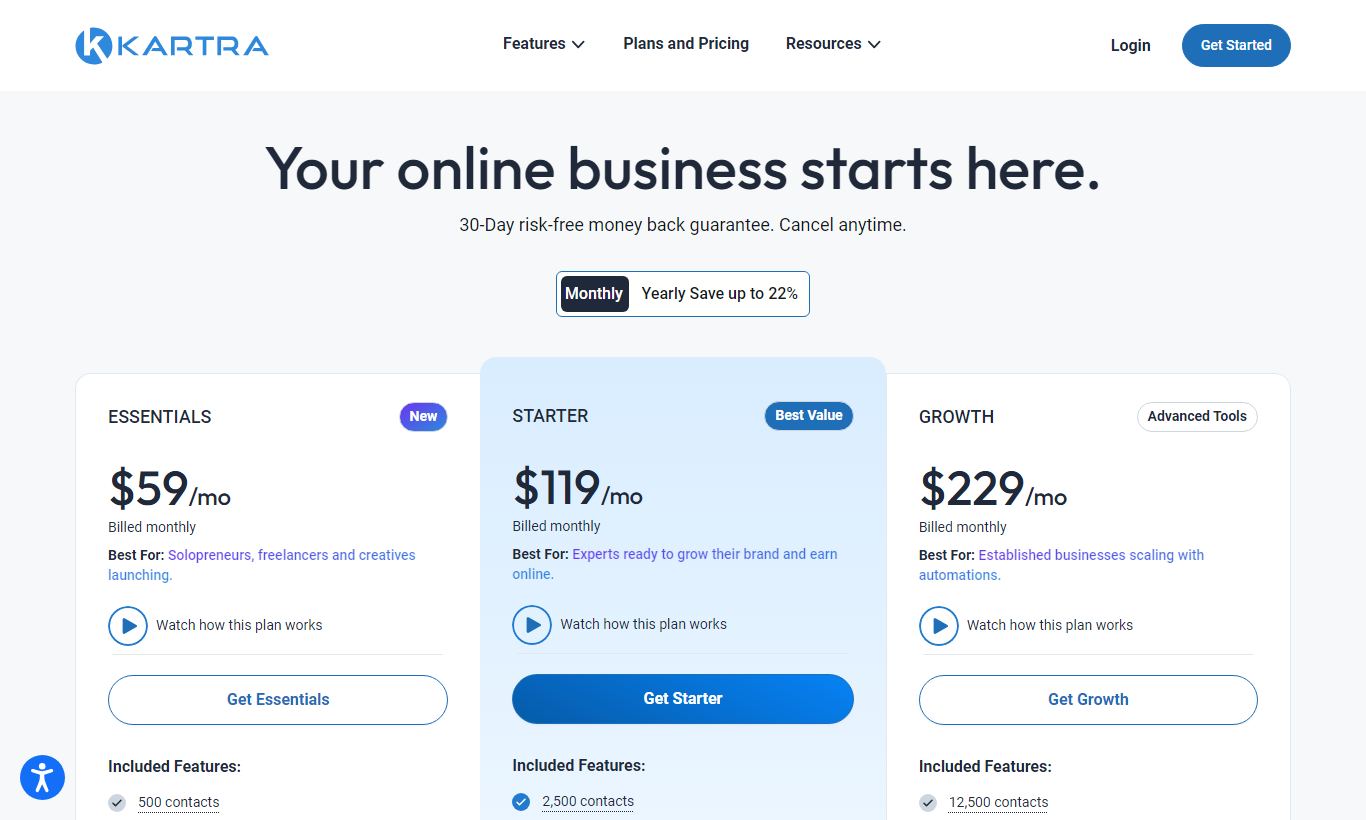
Kartra offers three main plans, and every tier comes with a 14-day trial for $1.
- Starter, $119/month (or $149/month billed monthly): covers 2,500 contacts, 15,000 emails a month, 100 pages, 50 hosted videos, 20 products, 2 membership sites, and 1 custom domain. It works for validating a new offer or running a single funnel, but you'll hit the contact and email limits fast. Affiliate management isn't included.
- Growth, $229/month (or $299/month billed monthly): gives you 12,500 contacts, 125,000 emails a month, unlimited pages, videos, products, and memberships, 3 custom domains, full affiliate management, and webinar hosting for up to 300 attendees. This is where Kartra's all-in-one pitch actually pays off, and it's the plan most growing businesses should start with.
- Professional, $549/month (or $699/month billed monthly): scales to 25,000 contacts, 250,000 emails a month, 5 custom domains, and webinars for 1,000 attendees. Built for high-volume businesses with large email lists or companies managing multiple brands.
All plans include unlimited bandwidth, Kartra's helpdesk tool, calendar scheduling, and the full funnel and automation builder. There's no permanent free plan, but the $1 trial gives full platform access for 14 days with no feature restrictions. That's a genuinely useful window to test everything out.
What We Love
- Affiliate management is genuinely built in: Custom commission tiers, a branded affiliate portal, and automated payout management replace standalone affiliate tools costing $70 - $150/month.
- Behavioral email triggers fire on real actions: Automations respond to video watch percentage, page visits, purchase history, and membership activity, not just email opens and clicks.
- One-click upsells and order bumps require zero third-party tools: The native checkout handles subscription billing, trials, and multi-step offer sequences from start to finish.
- Done-for-you campaigns can be cloned in minutes: Kartra Marketplace offers pre-built funnel campaigns (pages, emails, sequences) that experienced marketers share and sell, which cuts setup time by a wide margin.
- Membership drip scheduling is granular: Content can be released on a day-by-day schedule post-enrollment, with multiple access tiers tied to different products or subscription levels.
Watch Out For
- The page builder is showing its age: It works, but Kartra's editor doesn't have the fluid drag-and-drop feel you get with ClickFunnels 2.0 or Leadpages. Custom layout work can feel clunky, and template design quality swings from decent to rough. If visual polish matters to you, you'll notice the friction.
- Starter plan limits will bite you faster than you think: 2,500 contacts and 15,000 emails a month sounds fine until you run one real lead-gen campaign. Plenty of users hit the ceiling within 3 to 6 months and end up upgrading or paying overage fees.
- No SEO or blogging infrastructure: Kartra pages don't get indexed well organically, there's no native blog module, and meta-tag controls are thin. If content marketing or SEO plays any part in how you acquire customers, you'll need a separate website to sit alongside Kartra.
- Steep initial learning curve: The platform's range is also its problem. New users say in community forums and reviews that it takes 2 to 4 weeks to get comfortable navigating all the modules and figuring out how they connect. Budget time for onboarding before you go live.
Who Is It Best For?
The course creator or coach earning $3K - $30K/month: Say you're a business owner selling a $997 signature program, a $47/month membership, and a $2,500 high-ticket offer. You need checkout, membership, email, and affiliate tools working together. Kartra handles all four under one login, one invoice, and one data model. This is the user Kartra was built for, and the depth of those specific modules proves it.
The digital agency managing multiple client funnels: Kartra's Agency feature (Growth and above) lets you manage sub-accounts for clients from a master dashboard, white-label the experience, and sell pre-built Kartra campaigns as part of your service offering. If you're running 5 to 15 client funnel builds per year, the Growth plan will cost less than licensing separate tools for each client.
The webinar-based business running live and evergreen offers: Kartra integrates natively with WebinarJam and EverWebinar (same parent company). That means a business running weekly live webinars or automated evergreen webinars can connect registrant data, attendance behaviour, and purchase activity directly into Kartra's automation engine. From there, it can trigger follow-up sequences based on whether someone attended, left early, or watched the replay.
How Does It Compare?
ClickFunnels 2.0: ClickFunnels' 2.0 platform has a more modern page builder and a growing course feature. Its email automation isn't as behaviorally sophisticated as Kartra's, though, and its affiliate management needs a separate tool at lower tiers. Kartra wins on depth for established digital businesses. ClickFunnels may feel easier to start on. See our full Kartra vs ClickFunnels breakdown.
Kajabi: Kajabi is a closer comparison for course creators. It has a better content experience and a stronger brand in the creator economy, with native blogging and podcast hosting that Kartra lacks. Kajabi's affiliate management is more limited, though, and its checkout customisation is less flexible. For funnel sophistication and affiliate operations, Kartra has the edge. Read our Kartra vs Kajabi comparison for a full feature breakdown.
Final Verdict
Kartra earns a strong recommendation for digital entrepreneurs who are ready to consolidate a scattered tool stack into one system. If you're paying separately for a funnel builder, email marketing platform, course hosting, checkout software, and affiliate management, and those tools don't talk to each other reliably, Kartra will likely pay for itself in both dollars and hours within the first 60 days. The Growth plan at $229/month is the right entry point for anyone running a real business rather than just testing an idea.
Still, Kartra isn't the right choice if you're pre-revenue and still validating, if SEO and blogging are core to your acquisition strategy, or if you need a world-class visual design experience for your pages. In those cases, a leaner tool like Leadpages combined with ConvertKit may serve you better at a lower cost. But for the established digital business operator who wants automation that actually reflects how their customers behave, Kartra is one of the most capable platforms in the market at this price point.
Try Kartra Free →FAQ
How much does Kartra cost per month?
Kartra starts at $119/month (billed annually) for the Starter plan, $229/month for Growth, and $549/month for Professional. Monthly billing costs more: $149, $299, and $699 respectively. All plans include a 14-day trial for $1.
Does Kartra have a free plan?
No, Kartra doesn't offer a permanent free plan. All plans include a 14-day $1 trial with full access to every feature, so you can test it out before committing to a paid subscription.
Is Kartra worth it for small businesses?
Kartra makes sense for small businesses actively selling digital products, courses, or services and currently paying for several separate tools. If you're pre-revenue or still testing your offer, the $119/month Starter plan will feel expensive. For businesses generating consistent income from online offers, the money saved by consolidating tools adds up fast.
How does Kartra compare to ClickFunnels?
Kartra has deeper email automation, built-in affiliate management, and stronger membership site features than ClickFunnels. ClickFunnels has a more modern page builder and a larger community. ClickFunnels 2.0 is competitive, but Kartra generally suits businesses that need sophisticated behavioral automation and a built-in affiliate program.
Can Kartra replace Kajabi?
For course creators who care most about funnel building and affiliate marketing, Kartra can replace Kajabi. Kajabi has better native blogging, podcast hosting, and a more polished student experience, though. If community and content marketing matter to you, Kajabi may still have the edge. If checkout flexibility and affiliate control are priorities, Kartra wins out.
Does Kartra include email marketing?
Yes. Kartra includes a full email marketing suite with broadcast emails, automated sequences, behavioral triggers, dynamic content, and list segmentation via tags. The Starter plan allows 15,000 emails/month. Growth allows 125,000/month, and Professional allows 250,000/month.
What payment processors does Kartra support?
Kartra natively supports Stripe and PayPal for payment processing. It handles one-time purchases, subscriptions, payment plans, and trial offers. There's no native support for other processors like Braintree or Square, though third-party integrations via API are possible.
Is Kartra good for affiliate marketing?
Yes. Kartra's built-in affiliate management system is one of its strongest features. It supports custom commission rates, two-tier affiliate structures, custom cookie durations, a branded affiliate portal, and automated payout management. It's available on the Growth and Professional plans and removes the need for a separate affiliate tracking tool.
We may earn a commission when you click affiliate links. This never affects our editorial scores.
| Best for | All-in-one online business platform |
| Category | Landing Pages & Funnels |
Answer a few quick questions and we'll match you to the best tool for your needs.
→ Suggest a Tool