
Deel Review 2026: Is It Worth It?
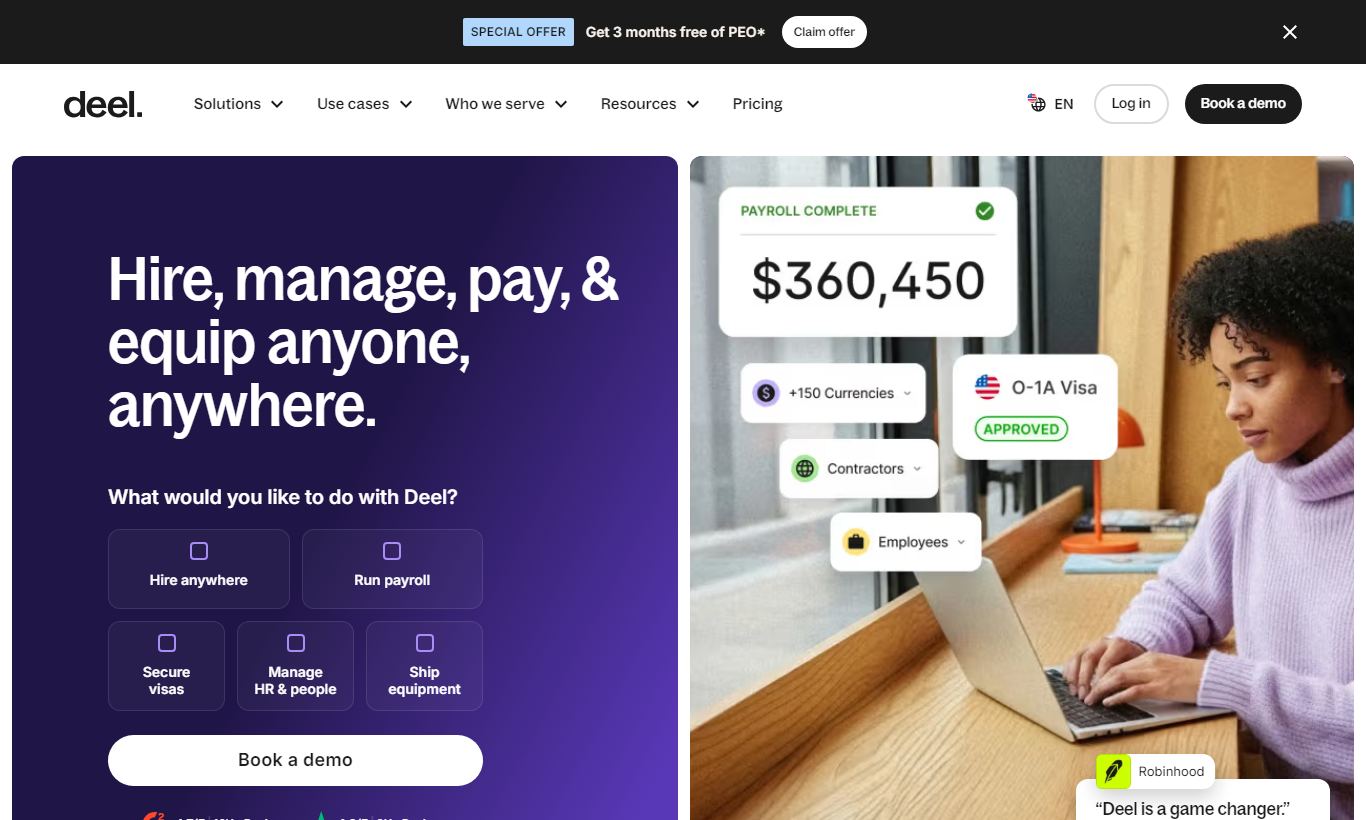
Deel is a global HR and payroll platform built for companies hiring across borders. It covers contractor management, employer of record (EOR) services, and direct employee payroll in 150+ countries. Founded in 2019, it has quickly become one of the most capable platforms for businesses scaling internationally. Deel handles compliance-heavy hiring well, with locally compliant contracts, automatic tax filings, and built-in IP protection. Pricing starts at $49/month per contractor and $599/month per EOR employee, so it's a premium product suited to companies with real global ambitions. Smaller businesses managing a handful of domestic workers will find it expensive and more than they need. For mid-market and enterprise teams running distributed workforces across multiple jurisdictions, though, Deel's legal coverage, payment flexibility, and self-serve onboarding make it one of the strongest choices available in 2026.
What we love
Watch out for
Deel at a glance
What to test in your Deel trial
- Set up Deel HR for your team and invite 10+ employees to test the org chart, time-off management, and approval workflows
- Create a compliant contractor agreement in one of your hiring countries and review the misclassification risk assessment
- Test contractor self-serve onboarding by sending the portal link to one real or test contractor and time the full setup
- Configure a payment withdrawal method that contractors in your target countries actually use and verify payout options
- Decide if Deel's feature set and pricing fit your hiring plans before the free Deel HR tier no longer meets your needs
Quick Verdict
Deel earns its place as a top-tier global HR platform by doing something genuinely difficult well: making international hiring legally safe and operationally simple. Whether you're onboarding a freelancer in Brazil, running payroll for a full-time employee in Germany through an Employer of Record arrangement, or managing equity grants across a 200-person distributed team, Deel handles the compliance layer so your HR team doesn't have to become experts in 150 different labor codes. It isn't cheap, and it's not the right tool for every business. But for companies growing across borders, the cost of getting international employment wrong far exceeds what Deel charges.
The platform has matured a lot since its 2019 launch. The addition of Deel HR (a free HRIS layer), background checks, immigration support, and an equipment provisioning service means it now competes as a full workforce management suite, not just a payroll tool. If your team spans more than three countries, or you're planning to hire globally in the next 12 months, Deel deserves serious consideration.
Start Your Free Trial →What is Deel?
Deel was founded in 2019 by Alex Bouaziz and Shuo Wang. It came out of Y Combinator, then raised over $650 million in funding and hit unicorn status in under two years. The platform was built around one persistent problem: hiring someone in another country is complicated, slow, and legally risky if you get it wrong. Deel's answer was to bundle locally compliant contracts, in-country legal entities, payroll processing, and tax documentation into a single SaaS platform that companies of any size can use. Its customers range from a 10-person startup bringing on its first international contractor to a 5,000-person enterprise running payroll across dozens of countries.
Today Deel operates in 150+ countries, maintains its own legal entities in dozens of jurisdictions for EOR services, and processes billions of dollars in payments each year. It competes with Rippling, Remote, and Papaya Global, but stands apart through its country coverage, payment flexibility (it supports 15+ withdrawal methods, including crypto), and a self-serve onboarding experience that's genuinely polished. Smaller contracts don't need a lengthy sales engagement to get started.
Key Features
Feature Checklist
Employer of Record (EOR)
Deel's EOR service is its flagship capability, full stop. When a company wants to hire a full-time employee in a country where it has no legal entity, say a software engineer in the Netherlands, Deel acts as the legal employer on record. It handles local employment contracts, mandatory benefits, social contributions, termination procedures, and payroll tax filings. Deel uses its own wholly-owned entities in most countries rather than relying on third-party local partners, which cuts the risk of inconsistent service quality. A company can onboard a new EOR employee in as little as a few days, compared to the months it would take to incorporate a local subsidiary.
Global Contractor Management
For companies working with independent contractors internationally, Deel generates locally compliant contractor agreements, collects tax forms (W-8, W-9, and local equivalents), and handles payments in 120+ currencies. The platform's misclassification risk assessment tool flags when a contractor's working pattern resembles an employment relationship under local law. That's a genuinely useful guardrail, and one many finance teams don't think about until they get a legal notice. Contractors get a self-serve portal to submit invoices, choose their payment method, and access documents, which cuts the admin burden on HR.
Global Payroll
For companies that already have legal entities abroad, Deel's Global Payroll product integrates directly with those entities to run in-country payroll. It supports payroll in 90+ countries, syncing with local tax authorities and producing payslips in the local language and currency. The product integrates with major accounting platforms including QuickBooks, Xero, and NetSuite, pushing journal entries automatically after each payroll run. Multi-entity companies can manage all payrolls from a single dashboard, with a consolidated view of total employment costs across regions.
Deel HR (Free HRIS)
In 2023, Deel launched Deel HR, a free core HRIS layer available to any company, even those not using Deel's paid payroll or EOR services. It covers employee records, org charts, time-off management, approval workflows, and onboarding checklists. It's not as deep as a dedicated HRIS like BambooHR or Workday, but for companies already using Deel for payroll, having people data, documents, and org structure in one system is a real operational win. The free tier makes it a sensible starting point for early-stage companies that want a single source of truth for their team.
Compliance and Legal Tooling
Deel builds compliance directly into every workflow. Contracts are auto-generated using jurisdiction-specific templates reviewed by local legal counsel. IP assignment clauses, non-compete enforceability, and notice period requirements are handled automatically based on the worker's country. The platform also offers a dedicated immigration service (Deel Immigration) to manage visa sponsorship and work permit applications, plus a background check add-on that integrates with Veriff and other verification providers. None of this is bolted on as an afterthought. It's woven into the core onboarding flow, which makes it easy for HR teams without legal expertise to stay compliant.
Payments and Withdrawal Flexibility
Deel supports payouts to workers in 120+ currencies via bank transfer, PayPal, Payoneer, Wise, Coinbase (crypto), and Revolut, among others. Workers choose their preferred method and can switch at any time. This flexibility is a genuine differentiator. Competitors like Remote offer fewer withdrawal options. Deel also offers an optional Deel Card (a Visa debit card) that workers can use to spend their earnings immediately without a bank transfer delay. For contractors in countries with unreliable banking infrastructure, this is a real quality-of-life feature.
Pricing
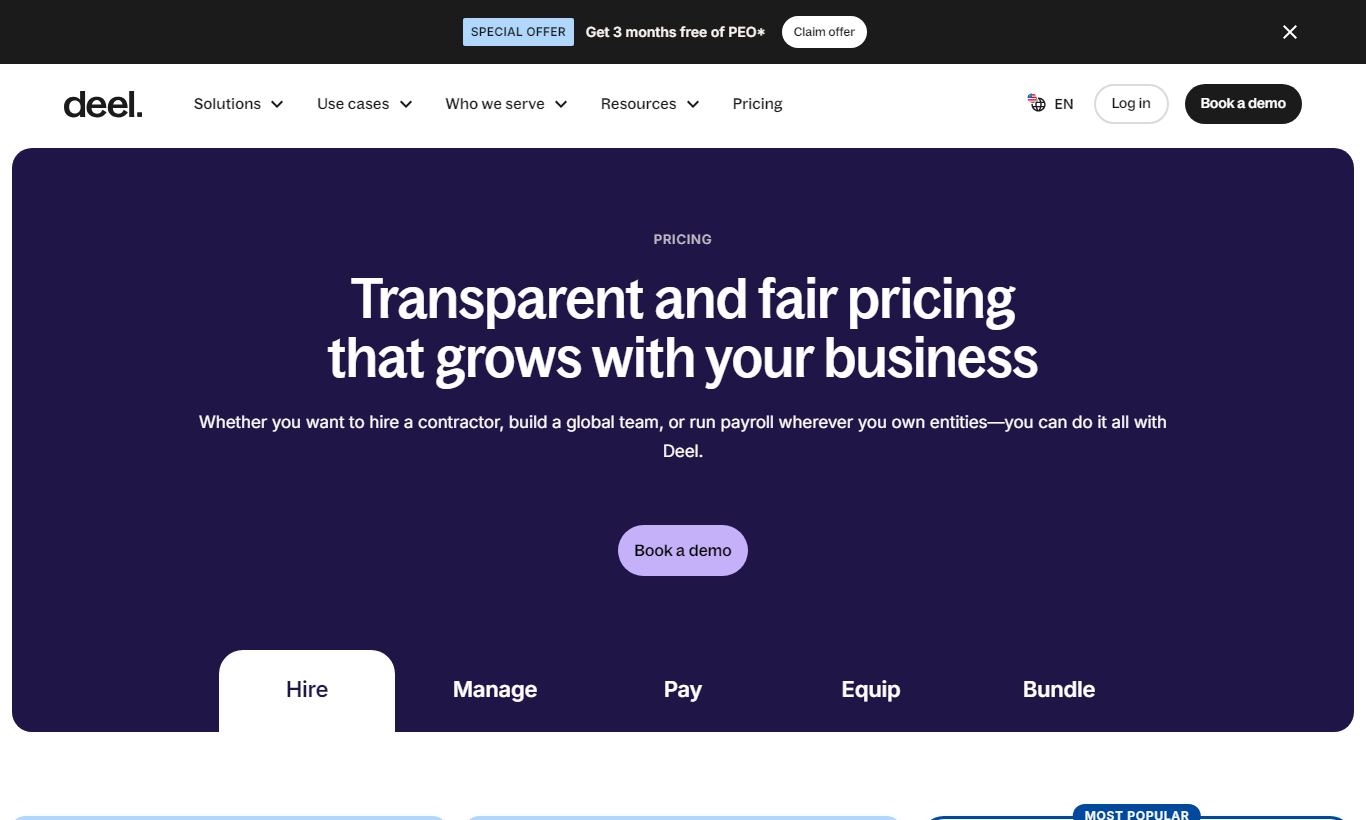
Deel publishes its pricing openly, which is a nice change in a category where most competitors make you sit through a demo call just to get a number. Here's the full breakdown as of 2026:
- Deel HR: Free forever for up to 200 employees. Covers core HRIS, org charts, time-off, and document storage.
- Contractor Management: $49/month per contractor. Includes compliant contracts, invoicing, payment processing, and tax form collection.
- Employer of Record (EOR): $599/month per employee. Includes full local employment, benefits administration, payroll, and compliance.
- Global Payroll: Custom pricing based on headcount and countries. Typically quoted per-employee per-month for companies with existing entities.
- Deel Engage (HR add-ons): Starts at $20/month per employee. Covers performance management, learning & development, and engagement surveys.
- Immigration services: Priced per case, with country-specific variation. Consult Deel directly for quotes.
There's no free trial for paid tiers, but Deel HR is genuinely free and makes a solid starting point. Annual billing discounts are available on some tiers. Deel's sales team typically offers 10 - 15% savings for annual EOR commitments at scale. For high-volume contractor setups (50+ contractors), Deel also negotiates volume discounts.
What We Love
- Owned legal entities in 100+ countries. Deel doesn't lean on a patchwork of local partners for most EOR services, so compliance quality stays more consistent than with many rivals.
- 15+ payment withdrawal methods including crypto and Deel Card. Workers in emerging markets get real flexibility to receive funds in a way that fits their banking reality.
- Misclassification risk detection built into contractor onboarding. It flags patterns that could expose the company to reclassification liability before that turns into a legal problem.
- Deel HR is free up to 200 employees. A fully functional HRIS at no cost gives early-stage companies a real operational foundation without needing a separate tool budget.
- Self-serve onboarding for contractors in under 30 minutes. No sales call required for contractor plans. Companies can sign up, create a contract, and start payment entirely on their own.
Watch Out For
- EOR pricing at $599/employee/month becomes costly at scale. A team of 20 EOR employees runs $143,760/year in platform fees alone, and that's meaningful even for well-funded companies. Competitors like Remote charge $599 too, but model the total cost before you commit.
- Customer support quality is inconsistent at lower tiers. A common complaint in user reviews is that support response times slow down significantly outside business hours, and complex compliance questions sometimes get bounced through multiple agents before resolution.
- Global Payroll requires a separate scoping call and custom pricing. Unlike the contractor and EOR plans, the Global Payroll product isn't fully self-serve, and that slows down evaluation for finance teams who want quick cost comparisons.
- Not ideal for domestic-only US or UK companies. If all your hiring is within one country and you just need standard payroll plus HR, Deel is overkill for your needs. Gusto (US) or Moorepay (UK) will serve you better at lower cost.
Who Is It Best For?
The remote-first startup scaling internationally: Picture a 30-person SaaS company headquartered in the US that's hired engineers in Poland, designers in Colombia, and a sales rep in Singapore, but has no legal entities in any of those countries. Deel's EOR service lets them employ all three compliantly without setting up locally, while Deel HR keeps everyone's records in one system. This is where Deel fits best.
The mid-market company with a growing contractor network: A marketing agency working with 40 to 80 freelancers across 20 countries needs compliant contracts, automated invoicing, and reliable mass payouts in local currencies. At $49/month per active contractor, Deel replaces a messy mix of DocuSign, Wise transfers, and spreadsheet tracking with one platform you can actually audit.
The enterprise HR team managing multi-country payroll consolidation: A 500-person company with established entities in 8 countries running payroll on 4 different local systems wants a single dashboard and consolidated reporting. Deel's Global Payroll product, with its NetSuite and Workday integrations, was built for exactly this kind of consolidation. It does require a custom scoping engagement to get running, though.
How Does It Compare?
Deel vs. Remote: Remote is Deel's closest direct competitor and matches it on EOR pricing ($599/employee/month). Remote often gets praised for slightly more transparent support SLAs and a strong equity management tool, but Deel edges ahead on country coverage, payment flexibility, and the depth of its contractor management product. See our detailed Deel vs Remote breakdown for a full feature matrix.
Deel vs. Rippling: Rippling takes a different approach. It's a unified workforce platform that spans HR, IT, and finance, with global payroll as one module among many. Rippling is the stronger choice if you want device management, app provisioning, and HR in one system, and your hiring is primarily US-based with some international exposure. For companies where international compliance is the main challenge, Deel's deeper EOR coverage wins. Compare both in our Deel vs Rippling guide.
Final Verdict
Deel is not the cheapest HR platform on the market, and it's not trying to be. It's a compliance-first global workforce platform for companies that have accepted the reality that hiring across borders requires serious infrastructure. Weigh Deel's fees against the alternative, local legal counsel, entity incorporation, local payroll software, and the risk of a misclassification lawsuit, and the platform's pricing gets much easier to justify. The free Deel HR tier and transparent contractor pricing lower the barrier to entry. The self-serve experience is polished enough that small teams can get started without a lengthy procurement process.
The weaknesses are real. Support consistency needs improvement, Global Payroll pricing is frustratingly opaque, and domestic-only companies have no business paying Deel's rates when simpler tools exist. But for the distributed, internationally-minded company Deel was built for, it's still one of the most capable, legally sound platforms available in 2026.
Try Deel Free →FAQ
How much does Deel cost per month?
Deel charges $49/month per contractor for contractor management, and $599/month per employee for Employer of Record (EOR) services. Deel HR (core HRIS) is free for up to 200 employees. Global Payroll pricing is custom, based on headcount and countries.
Does Deel offer a free trial?
No time-limited free trial exists for Deel's paid tiers. Deel HR, the core HRIS module, is permanently free for up to 200 employees, though, and you can set it up without a credit card. That's a genuine no-cost starting point for teams.
Is Deel worth it for small businesses?
It's worth it for small businesses hiring internationally, even ones with a small headcount. A 10-person startup with contractors in 5 countries gets real compliance value at $49/contractor/month. If all your hiring is domestic, though, Deel's pricing is hard to justify next to tools like Gusto or BambooHR.
How does Deel compare to Remote?
Deel and Remote both charge $599/month per EOR employee. Deel has broader country coverage, more payment withdrawal options, and a stronger contractor management product. Remote is often cited as having cleaner support workflows and a better equity management tool. For most international hiring use cases, Deel comes out as the slightly more capable platform.
Can Deel handle payroll for full-time employees?
Yes. Deel handles payroll for full-time employees two ways: through its Employer of Record service, where Deel is the legal employer, and through its Global Payroll product, where your company already has a legal entity and Deel runs payroll within it. Both cover tax filings, payslips, and statutory benefits.
Is Deel compliant with local labor laws?
Deel maintains locally compliant employment contracts and payroll processes across 150+ countries. For EOR services, it uses its own legal entities rather than third-party partners in most markets, and local legal counsel reviews all contracts. That gives it one of the stronger compliance track records in the category. No platform removes all legal risk, though.
What payment methods does Deel support for contractors?
Deel supports 15+ withdrawal methods, including bank transfer, PayPal, Payoneer, Wise, Revolut, Coinbase (cryptocurrency), and the Deel Visa debit card. Payments can be made in 120+ currencies. This range of options is one of Deel's standout features for contractors in emerging markets.
Does Deel work for US-based companies hiring US employees?
Deel does offer US payroll capabilities, but it isn't built or priced for companies hiring exclusively within the US. Domestic-focused US businesses will find better value and more relevant features with tools like Gusto, Rippling, or ADP Run. Deel earns its keep when at least part of your workforce is international.
We may earn a commission when you click affiliate links. This never affects our editorial scores.
| Best for | — |
| Category | HR Software |
Answer a few quick questions and we'll match you to the best tool for your needs.
→ Suggest a Tool