
Omnisend Review 2026: Is It Worth It?
Omnisend is an email and SMS marketing automation platform built specifically for ecommerce brands. It combines email campaigns, SMS, push notifications, and advanced segmentation into one workflow-driven platform. The Free plan supports up to 250 contacts and 500 emails a month, which makes it accessible for early-stage stores, and paid plans start at $16/month. Omnisend's pre-built automation workflows (abandoned cart, welcome series, order confirmation) rank among the most ecommerce-specific you'll find in its price range. Tight integrations with Shopify, WooCommerce, and BigCommerce make it a strong default choice for direct-to-consumer brands. It's not the best fit for B2B or service businesses, and advanced A/B testing stays limited on lower tiers. Ecommerce teams looking for a unified owned-channel marketing stack, without enterprise-level complexity or cost, will find plenty to like here.
What we love
Watch out for
Omnisend at a glance
What to test in your Omnisend trial
Free plan
- Activate an abandoned cart workflow in under 10 minutes and test the pre-written copy
- Build a segment using purchase history and CLV prediction, then send a test campaign to it
- Create a multi-channel automation combining email, SMS, and push notifications in one workflow
- Use the Product Picker to add 3 products to an email campaign and verify images and prices populate
- Test SMS sends to your own number in all 209 supported countries if you ship internationally
- Decide before your first paid bill whether Omnisend's ecommerce focus and segmentation fit your business model
Quick Verdict
Omnisend is one of the few email marketing platforms genuinely designed around how ecommerce businesses operate, not just email blasts with a shopping cart icon bolted on. Its automation library, native SMS channel, and deep integrations with Shopify, WooCommerce, and BigCommerce make it the most coherent owned-channel marketing stack available under $60/month for most small-to-mid-sized online stores. The pre-built workflows save serious setup time, and the segmentation engine is sophisticated enough that growing brands won't outgrow it quickly.
Omnisend isn't perfect for everyone, though. If you run a SaaS company, a professional services firm, or a B2B operation, the ecommerce-centric framing will feel like a mismatch. And if you need deep multivariate testing or extensive custom reporting, you'll likely bump into the platform's ceiling. But for the DTC brand owner, Shopify merchant, or omnichannel retailer who wants email, SMS, and push notifications working together, Omnisend delivers exceptional value.
Start Your Free Trial →What is Omnisend?
Founded in 2014 (originally as Soundest), Omnisend rebranded in 2017 to reflect its expansion beyond email into a true omnichannel marketing platform. Headquartered in London with a significant engineering presence in Vilnius, Lithuania, the company now serves over 125,000 brands in more than 130 countries. Its core market is ecommerce, specifically direct-to-consumer brands running on Shopify, WooCommerce, BigCommerce, or similar platforms. Omnisend sits between entry-level tools like Mailchimp (still not truly ecommerce-native) and enterprise platforms like Klaviyo. It competes directly on price and feature depth for the $1M - $50M annual revenue ecommerce segment.
The product's philosophy is simple. Email and SMS should work together, triggered by real purchase behavior, and setting that up shouldn't require a developer or a dedicated marketing ops hire. That philosophy drives every product decision, from the drag-and-drop email builder to the one-click abandoned cart workflow that takes under five minutes to activate.
Key Features
Feature Checklist
Email Campaign Builder
Omnisend's drag-and-drop email editor is clean and fast. It ships with over 250 responsive templates organised by campaign type: welcome emails, seasonal promotions, product announcements, and post-purchase flows. The standout element is the Product Picker. Connect your store, search your product catalog, and drop a product block directly into your email with the image, price, and link auto-populated. For stores running frequent promotional campaigns, this alone cuts email production time by 30 to 40% compared to platforms where you manually paste product images and copy URLs. You can also insert dynamic discount codes (unique per recipient) without leaving the editor. That's a genuine help when running personalised flash sales without coupon abuse.
Marketing Automation Workflows
This is where Omnisend earns its place in a serious ecommerce stack. The automation builder uses a visual, branching workflow canvas. Triggers include ecommerce events (cart abandoned, order placed, order shipped, product browsed, order cancelled) as well as contact-based events (list subscribed, date anniversary, custom event). Omnisend ships with 20+ pre-built workflow templates including abandoned cart (single and multi-step), welcome series, post-purchase upsell, win-back, and browse abandonment. Each workflow can mix channels. An abandoned cart sequence, for example, might send an email after 1 hour, an SMS after 12 hours, and a push notification after 24 hours, all from a single workflow canvas. Conditional splits let you branch logic based on purchase history, engagement level, or cart value, so your highest-value customers get a different message than first-timers.
SMS Marketing
Omnisend's SMS is a first-class citizen, not an add-on afterthought. You can send SMS campaigns and include SMS steps inside automation workflows from the same interface, with no need to switch tools or manage separate lists. SMS is available in 209 countries, with US-based brands able to send from a dedicated number (toll-free or shortcode). Compliance features are baked in: opt-in consent is tracked, TCPA/GDPR flags are automatic, and opt-out keywords (STOP, CANCEL, UNSUBSCRIBE) are handled without manual configuration. Pricing for SMS is usage-based and billed separately from your email plan, starting at roughly $0.015 per SMS in the US. One limitation worth flagging: MMS (picture messages) isn't supported, which rules out rich media SMS campaigns.
Segmentation and Targeting
Omnisend's segmentation engine is one of its strongest features. Segments can be built using any combination of contact properties, campaign engagement data, and ecommerce behavior, including purchase history, total spend, product category purchased, number of orders, days since last purchase, and predicted customer lifetime value. You can build a segment like "bought from the 'running shoes' category at least twice in the last 90 days but hasn't opened an email in 30 days" in under two minutes. Segments update in real time and can be used for both campaign sends and as automation triggers or filters. This level of behavioral segmentation is typically locked behind Klaviyo or ActiveCampaign pricing. Getting it at Omnisend's price point is a genuine competitive advantage.
Web Push Notifications and Signup Forms
Beyond email and SMS, Omnisend includes web push notifications as a third owned channel. Push notifications can be used in standalone campaigns or built into automation workflows alongside email and SMS. The subscriber opt-in is handled via a browser prompt, and you can segment push subscribers by behavior just as you would email contacts. For signup forms, Omnisend offers popups, teasers, landing pages, and a spin-to-win wheel (a gamified opt-in that tends to convert 3 to 5 times better than static popups for impulse-heavy ecommerce categories). Form targeting rules let you trigger displays based on exit intent, time on page, page URL, or device type.
Reporting and Analytics
Omnisend's reporting covers the essentials well: open rates, click rates, unsubscribes, bounce rates, and, importantly for ecommerce, revenue attributed per campaign and per automation. The automation performance dashboard breaks down each workflow step individually so you can spot where contacts drop off. One gap worth noting: advanced custom report building isn't available. You can filter and sort the built-in reports, but you can't create custom dashboards or export raw data into your own BI layout. For most growing brands, this is fine. For data-driven teams who live in Looker or Tableau, it may be a friction point.
Pricing
Omnisend's pricing is contact-based for email and usage-based for SMS, with three email plan tiers:
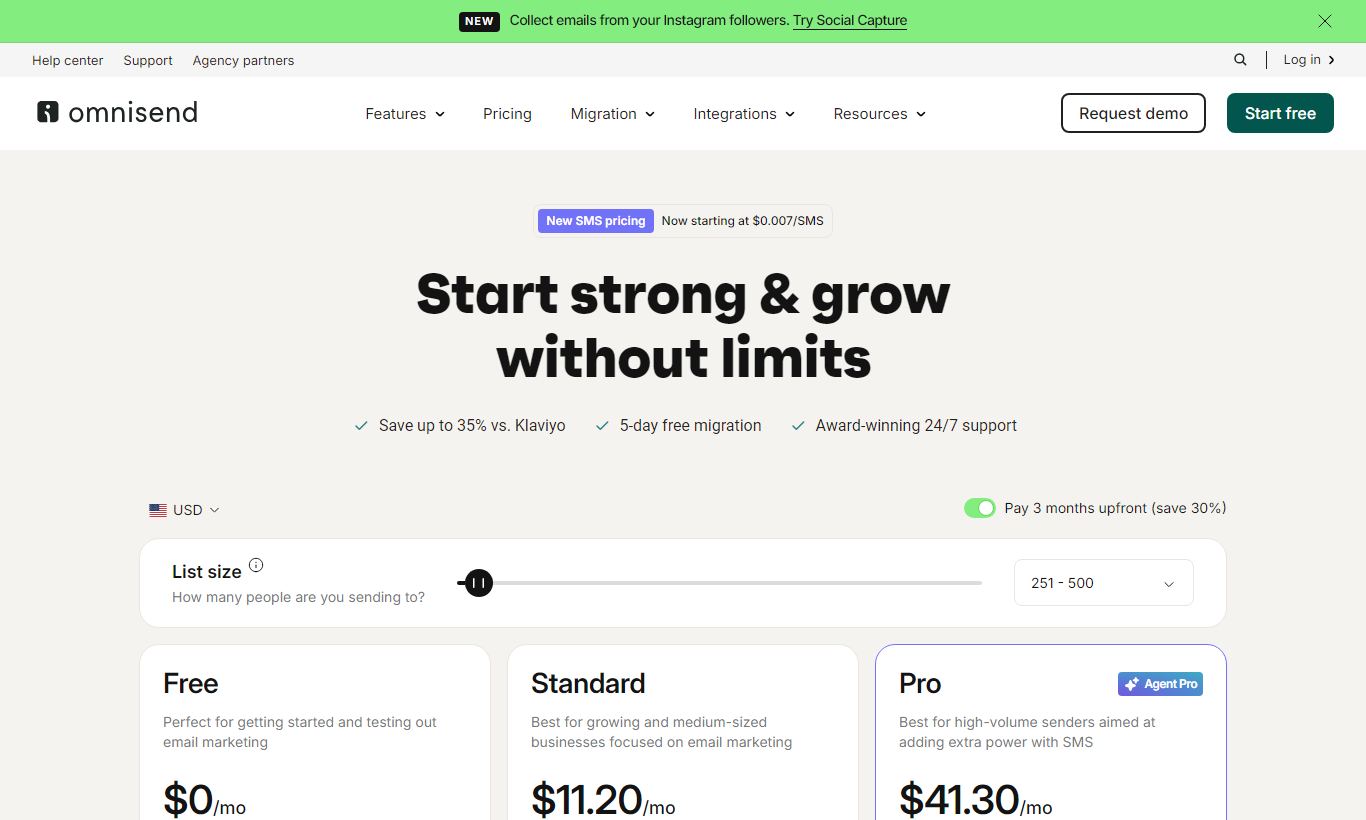
- Free: $0/month. Up to 250 contacts, 500 emails/month, 60 SMS credits/month, 500 web push notifications. All automation workflows are available, which is rare among free tiers. Branded email footer included.
- Standard: From $16/month (billed monthly) for 500 contacts, and it scales with list size. Includes unlimited emails, 24/7 email and chat support, and removes the Omnisend branding. At 5,000 contacts, Standard runs about $65/month.
- Pro: From $59/month for 500 contacts. Adds unlimited SMS sends (credits still apply), advanced reporting, up to 15 seats, and priority support. At 5,000 contacts, Pro runs about $125/month.
Annual billing cuts each paid plan by roughly 20%. There's no free trial in the traditional sense. The Free plan is permanent and functional enough to let you evaluate the product thoroughly before upgrading. SMS credits are purchased separately or bundled in the Pro plan. Omnisend doesn't charge per seat on the Standard plan (up to 3 users) and only caps seats on the Pro tier, which is generous compared to competitors that charge for every additional user.
What We Love
- Pre-built ecommerce automation workflows. Abandoned cart, welcome series, browse abandonment, and post-purchase flows are ready to activate in under 10 minutes, complete with copy suggestions.
- Unified email + SMS + push in one workflow canvas. You can build true omnichannel sequences without toggling between tools or managing separate contact lists.
- Product Picker and dynamic discount code blocks. Drag real product data directly into email campaigns, and generate unique per-recipient discount codes without a third-party tool.
- Behavioral segmentation at an accessible price point. Purchase history, CLV prediction, and category-level filtering come on all paid plans, not just enterprise tiers.
- A genuinely useful free plan. Full automation access on the free tier lets new stores build and test workflows before they commit to a paid subscription.
Watch Out For
- No MMS support. SMS is text-only, so brands that rely heavily on visual product images in text messages will find this limiting compared to competitors like Attentive or Postscript.
- Limited custom reporting. The built-in dashboards cover standard metrics well, but there's no custom report builder or raw data export for BI tool integration. That's a real gap for analytics-heavy teams.
- A/B testing is basic. You can split-test subject lines and sender names in campaigns, but multivariate testing and automation split-testing are restricted or unavailable on lower tiers.
- Not built for non-ecommerce use cases. B2B companies, SaaS businesses, and service providers will find the contact model, template library, and automation triggers awkwardly ecommerce-centric, with little flexibility for lead-nurture or trial-to-paid sequences.
Who Is It Best For?
The Shopify merchant doing $200K - $5M/year in revenue. This is Omnisend's sweet spot. You've got enough order volume to make behavioral automation meaningful, a growing contact list that justifies SMS alongside email, and a need for owned-channel revenue that doesn't depend entirely on paid Meta and Google ads. The Shopify integration syncs in real time, historical order data imports on setup, and you can have a functioning abandoned cart flow live within the hour.
The bootstrapped DTC brand just launching its store. The free plan's full automation access is unusually generous. A founder can build their welcome series and abandoned cart sequence before they've made their first sale, and upgrade only when their contact count demands it. This removes the "I'll set up email automation later" trap that kills many early-stage stores' retention metrics.
The ecommerce marketing manager at a mid-market retailer running multiple channels. If you're managing email, SMS, and push for a brand doing 5,000+ orders a month, Omnisend's unified workflow canvas and real-time behavioral segments give you the control to run sophisticated, personalised campaigns without needing a dedicated marketing ops engineer to maintain them. The Pro plan's reporting is sufficient for weekly performance reviews, and the multi-seat access supports a small team.
How Does It Compare?
Klaviyo is the most direct competitor, and for large ecommerce brands it's probably the more powerful platform. It has deeper predictive analytics, more granular A/B testing, and a larger ecosystem of integrations. But Klaviyo costs significantly more (the equivalent contact tier typically runs 2 - 3× Omnisend's Standard price), and it has a steeper learning curve. For brands under $5M revenue, Omnisend delivers 80% of Klaviyo's capability at 40% of the cost. See our full Omnisend vs Klaviyo breakdown for a detailed tier-by-tier comparison.
Mailchimp is still the name most merchants encounter first, but its ecommerce automation is notably less mature. The abandoned cart and browse abandonment workflows require more manual configuration, and its ecommerce segmentation lacks the purchase-behavior depth Omnisend offers. Mailchimp's strength lies in its content tools and brand familiarity for non-ecommerce businesses. For a store on Shopify, Omnisend is the stronger default. Read our Omnisend vs Mailchimp comparison for a full feature and pricing breakdown.
Final Verdict
Omnisend pulled off something genuinely hard. It built a platform simple enough for a first-time store owner to run on day one, and still capable enough for a growing DTC brand with an actual marketing team. The automation workflows are the most ecommerce-specific you'll find in its price range, the combined email, SMS, and push model works cleanly, and the free plan is honest. It gives you enough to actually test the product before you spend a dollar.
The limits are real, but they're narrow. If you need MMS, deep custom reporting, or you're running a business that isn't ecommerce, look elsewhere. But if you're building or scaling an online store and want one platform to handle your owned-channel marketing without hiring a specialist or paying Klaviyo prices, Omnisend is the strongest option out there in 2026.
Try Omnisend Free →FAQ
How much does Omnisend cost per month?
Omnisend offers a permanent Free plan (up to 250 contacts, 500 emails/month). Paid plans start at $16/month (Standard) and $59/month (Pro) for up to 500 contacts, scaling with list size. Annual billing saves roughly 20%.
Does Omnisend have a free plan or free trial?
Yes. Omnisend has a permanently free plan that includes all automation workflows, 500 emails/month, 60 SMS credits, and 500 web push notifications. There's no time-limited trial. The free plan runs indefinitely, with contact and send limits attached.
Is Omnisend better than Klaviyo?
For most ecommerce brands under $5M annual revenue, Omnisend offers comparable core functionality at a much lower cost. Klaviyo has deeper predictive analytics, more advanced A/B testing, and a bigger integration library. Those advantages matter most for high-volume brands with dedicated marketing analysts.
Is Omnisend better than Mailchimp for ecommerce?
Yes, for ecommerce specifically. Omnisend's abandoned cart, browse abandonment, and post-purchase automation workflows are more capable out of the box. Its ecommerce segmentation (purchase history, CLV, category-level filtering) is also more advanced than Mailchimp's for online stores.
Does Omnisend work with Shopify?
Yes. Omnisend has a native, real-time Shopify integration. It syncs contacts, orders, and product data automatically, and historical order data imports on setup. You can find it directly in the Shopify App Store.
Is Omnisend worth it for small businesses?
For small ecommerce businesses, yes. The free plan covers early-stage needs, and the Standard plan at $16/month provides full email automation at a competitive price. Non-ecommerce small businesses may find the platform's ecommerce focus a poor fit for their workflows.
What channels does Omnisend support?
Omnisend supports email, SMS (in 209 countries), web push notifications, and signup forms including gamified spin-to-win popups. You can combine all channels in a single automation workflow.
Does Omnisend support GDPR compliance?
Yes. Omnisend includes built-in GDPR and TCPA compliance tools: consent tracking on all signup forms, automatic opt-out handling for SMS (STOP keywords), data export and deletion tools for contact records, and a double opt-in option for email subscribers.
We may earn a commission when you click affiliate links. This never affects our editorial scores.
| Best for | — |
| Category | — |
Answer a few quick questions and we'll match you to the best tool for your needs.
→ Suggest a Tool