Shopify is the most complete hosted ecommerce platform you can buy in 2026. It handles storefront design, inventory, payments, and shipping in one place, so you're not stitching together five different tools. Plans start at $29/month (Basic) and scale to $299/month (Advanced), with Shopify Plus available for enterprise merchants at $2,300/month. There's a 3-day free trial, and the first month runs $1. Solo entrepreneurs use it. So do fast-growing DTC brands and omnichannel retailers. Its app ecosystem (8,000+ apps), native POS hardware, and built-in payment processor put it ahead of most competitors. The catch: transaction fees hit you if you skip Shopify Payments, and costs climb fast once you start adding apps. For most merchants selling online, Shopify earns its price tag.
What we love
Watch out for
Shopify at a glance

What to test in your Shopify trial
3-day free trial
- Build a storefront using the drag-and-drop theme editor to see if you can get a polished look without coding
- Import your product catalog via CSV and test inventory tracking across multiple locations if you have them
- Create a discount code and run a small test sale to verify the checkout flow and Shop Pay speed
- Connect one sales channel like Facebook or Instagram Shop to see real-time inventory sync in action
Quick Verdict
Shopify is the default choice for a reason. After evaluating dozens of ecommerce platforms, it's still the most capable all-in-one solution for merchants who want to launch fast, scale with confidence, and sell everywhere: online, in-store, and across social channels. Onboarding is genuinely smooth for a first-timer, and the platform runs deep enough that you rarely outgrow it until you hit serious enterprise scale. At $29/month (billed annually on the Basic plan), it's priced within reach for new merchants. The real cost of a mature store climbs higher once you factor in apps and possibly Shopify Payments fees.
Shopify isn't perfect. Transaction fees for merchants who prefer alternative payment gateways are a persistent annoyance. The native content tools won't satisfy brands running editorial-heavy stores. And costs add up fast as your operational needs grow. Still, for most product-based businesses, whether you're dropshipping your first 10 SKUs or running a 10,000-product catalog, Shopify earns its spot at the top of the market. Start Your Free Trial →
What is Shopify?
Shopify was founded in 2006 in Ottawa, Canada by Tobias Lütke, Daniel Weinand, and Scott Lake after Lütke found existing ecommerce software too limiting for his snowboard shop. Today it powers over 4.6 million businesses across 175 countries and processes hundreds of billions of dollars in gross merchandise volume annually. It's a fully hosted Software-as-a-Service platform, so you never touch server infrastructure. Shopify handles security, uptime, performance, and PCI compliance for you.
The platform serves product-based businesses of any size. That includes a solo maker selling handmade goods on Etsy who wants their own branded storefront, a fast-growing direct-to-consumer brand juggling multiple sales channels, and an omnichannel retailer running physical locations alongside a wholesale business. Shopify sits firmly in the mainstream. It isn't the cheapest option out there. Wix and Squarespace undercut it for micro-stores. It also isn't the most customizable choice at enterprise scale, since Magento and Adobe Commerce offer deeper technical flexibility. But Shopify hits a wide sweet spot in the middle.
Key Features
Feature Checklist
Storefront Design and Theme Editor
Shopify's Online Store 2.0 theme architecture gives merchants a drag-and-drop editor that needs zero coding knowledge for most customizations. The theme store offers over 100 themes. About 12 are free, and the rest are premium, priced between $100 and $400 as a one-time purchase. The Dawn theme (free) is fast, mobile-first, and good enough for most stores right out of the box. Merchants who want to go deeper can use Shopify's Liquid templating language and custom CSS/JavaScript, so developers can build nearly anything. The editor supports sections and blocks that can be rearranged on any page, not just the homepage. That's a real upgrade from older versions that locked page structures in place.
Inventory and Product Management
Shopify handles product catalogs ranging from a single product to hundreds of thousands of SKUs. You can define up to 3 product options (size, color, material) with up to 100 variant combinations per product. That limit frustrates apparel merchants with complex matrices, though third-party apps like Infinite Options extend it. Inventory tracking works across multiple locations. Warehouses, retail stores, and fulfillment partners can all be assigned stock and tracked in real time. Bulk CSV imports and exports make catalog migration manageable, and native barcode scanning support through the mobile app speeds up receiving and stocktaking in physical locations.
Shopify Payments and Checkout
Shopify's native payment processor, Shopify Payments (powered by Stripe), is one of its strongest selling points. It supports all major credit and debit cards, Shop Pay (Shopify's accelerated checkout), Apple Pay, Google Pay, and buy-now-pay-later options through Shop Pay Installments. Using Shopify Payments eliminates the transaction fees (0.5% to 2%) that apply when you use a third-party gateway like PayPal or Stripe directly. The checkout itself is well optimized. Shopify claims Shop Pay converts 15% better than a standard guest checkout, thanks to one-tap autofill for returning customers. Checkout customization (fonts, colors, logo) is available on all plans. Deeper logic changes like custom fields or conditional upsells require Shopify Plus's Script Editor or checkout extensibility APIs.
Multi-Channel Selling
One of Shopify's most practical advantages is its native integration with every major sales channel. You can sell on Facebook and Instagram Shops, TikTok Shop, Google Shopping, Amazon, eBay, Pinterest, and Walmart Marketplace, all managed from the same Shopify admin. Inventory syncs in real time across channels, so overselling rarely happens. The Shopify POS (Point of Sale) app and compatible hardware (card readers from $49, the POS Go device at $399, and the Shopify POS Terminal) let brick-and-mortar merchants run retail operations from the same back end as their online store. Staff permissions, end-of-day reports, and customer profiles all unify across channels, which is genuinely useful for a boutique with one physical location and a growing online presence.
Analytics and Reporting
Shopify's analytics dashboard gives all merchants access to live sales data, traffic sources, and conversion rates. Basic plan merchants get pre-built reports covering sales, customers, and acquisition. The $79/month Shopify plan unlocks professional reports including retention analysis and cohort reporting. Advanced and Plus merchants get the custom report builder, which lets you slice data by product, channel, geography, and date range without exporting to a spreadsheet. Merchants who need deeper business intelligence can connect Shopify natively to Google Analytics 4 and Klaviyo, plus tools like Triple Whale or Northbeam for multi-touch attribution. The native analytics won't replace a dedicated BI tool for a data-heavy team, but they're more than enough for most growing stores.
Pricing
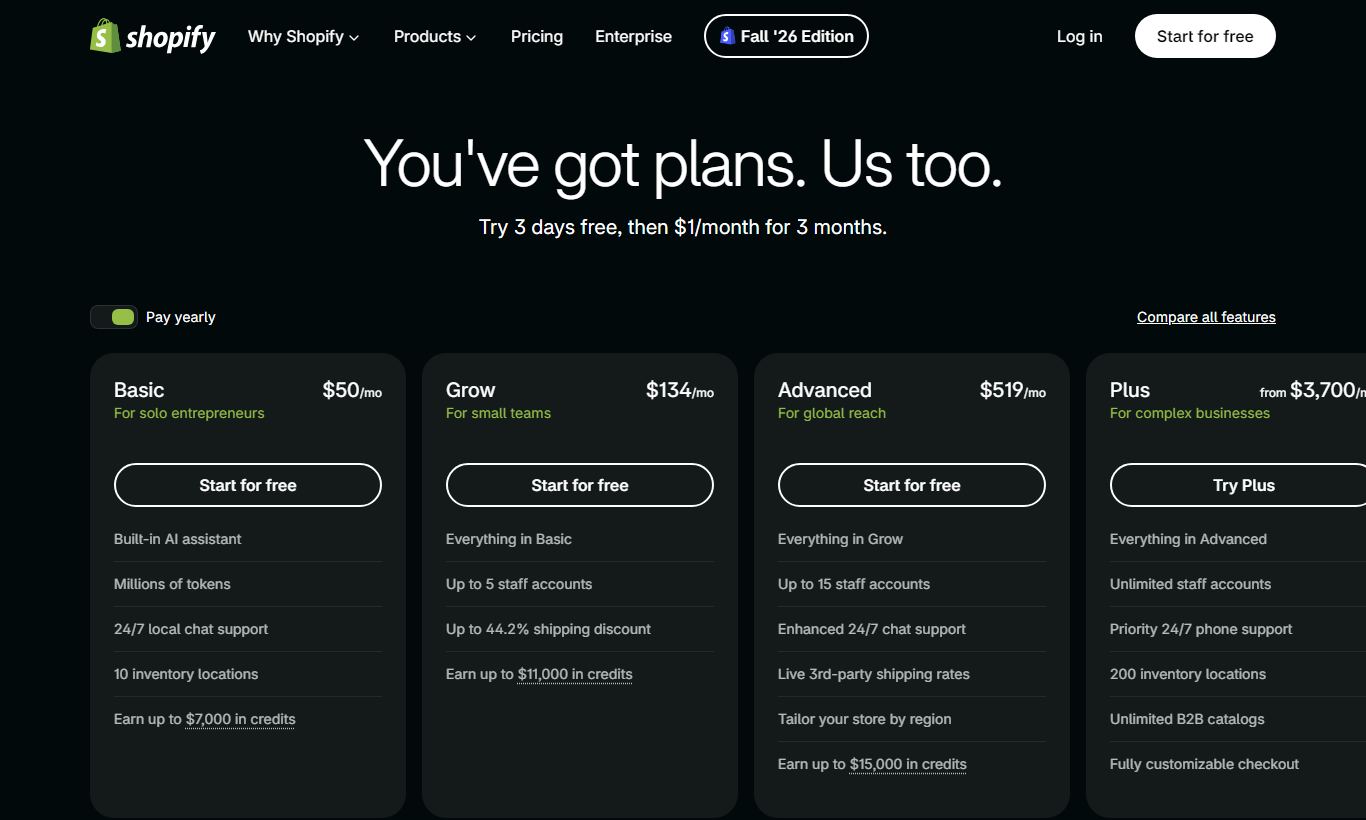
Shopify offers a 3-day free trial with no credit card required, followed by a promotional first month for $1. After that, plans run as follows on monthly billing: Basic at $39/month, Shopify at $105/month, and Advanced at $399/month. Annual billing drops these to $29, $79, and $299 per month respectively. That's roughly a 25% saving, and it adds up fast over a year. Shopify Plus starts at $2,300/month for stores under $800k in monthly GMV, then shifts to a 0.25% revenue share model above that threshold.
The transaction fee structure matters here. Use Shopify Payments and no transaction fees apply on any plan. Use any other gateway and you'll pay 2% (Basic), 1% (Shopify), or 0.5% (Advanced) per transaction, on top of whatever the gateway itself charges. Take a store doing $50,000/month through PayPal on the Basic plan: that's an extra $1,000/month, easily more than the cost of upgrading to the Advanced plan. There's no free plan, which is a real gap compared to WooCommerce or Wix, though the $1 first month works as an extended trial for most new merchants.
What We Love
- Shopify Payments integration: Accepting cards, Shop Pay, Apple Pay, and BNPL out of the box with zero transaction fees saves most merchants real money and hassle.
- App ecosystem depth: With 8,000+ apps in the Shopify App Store, nearly every gap in native functionality (subscription billing, loyalty points, advanced upsell flows, custom reviews) can be filled with a vetted third-party integration.
- Unified POS and ecommerce backend: Managing online and in-store inventory, customers, and reporting from a single admin kills the double-entry and reconciliation headaches that plague omnichannel retailers.
- Shopify Markets for international selling: Built-in tools for currency conversion, local payment methods, translated storefronts, and duties/import tax calculation make cross-border selling genuinely accessible without custom development.
- Reliability and uptime: Shopify's infrastructure handles massive traffic spikes, Black Friday flash sales, and product drops without store owners touching any server configuration. The platform routinely handles millions of concurrent sessions.
Watch Out For
- Transaction fee penalty for third-party gateways: The 0.5% to 2% transaction fee for non-Shopify Payments users is a real, ongoing cost that catches many merchants off guard, especially those in regions where Shopify Payments isn't available.
- App cost creep: The base plan price doesn't tell you much about your total cost. A typical growing store commonly adds $150 to $300/month or more in apps for email marketing, reviews, subscriptions, and advanced shipping. Those costs rarely show up in budget planning.
- Weak native blogging and content tools: Shopify's built-in blog is functional but basic. No native SEO schema for articles, no table of contents, no content scheduling. Brands that lean heavily on content marketing will hit its limits fast and may need a headless or hybrid setup.
- 100-variant limit per product: Merchants in fashion, footwear, or any category with complex product options (multiple sizes, colors, and widths at once) will hit the 100-variant ceiling and have to pay for a workaround app. That adds cost and complexity.
Who Is It Best For?
The DTC brand scaling from $10k to $500k/month: A direct-to-consumer founder who started on Etsy or Amazon and wants to own the customer relationship will find Shopify's mix of flexible theming, email marketing integrations (Klaviyo, Omnisend), and conversion-optimized checkout ideal. The Shopify plan at $79/month gives them professional reporting, gift cards, and reasonable transaction fees as volume grows.
The brick-and-mortar retailer adding ecommerce: A boutique clothing store or specialty food retailer with an existing physical location wants to expand online without running two separate systems. Shopify POS syncs inventory, customer data, and gift cards between the till and the online store natively. No other platform replicates that at this price point.
The multi-channel product brand: A consumer goods brand selling on its own site, Amazon, TikTok Shop, and wholesale to retailers, all at the same time. Shopify's channel integrations, Shopify Collective (for wholesale partnerships between Shopify merchants), and the B2B features on Plus make it a credible hub for complex multi-channel operations. You won't need enterprise middleware to pull it off.
How Does It Compare?
Shopify's two most common comparisons are WooCommerce and BigCommerce. Shopify vs WooCommerce: WooCommerce is free to install and offers unlimited product variants and deeper content flexibility through WordPress. But the total cost of ownership (hosting, security, plugins, developer maintenance) often matches or beats Shopify for a comparable feature set, and you carry the infrastructure burden yourself. WooCommerce wins for content-heavy stores or developers who want maximum control. Shopify wins for merchants who want reliability without technical overhead.
Shopify vs BigCommerce: BigCommerce charges no transaction fees regardless of your payment gateway. That's a real advantage for merchants who can't or won't use Shopify Payments. BigCommerce also has no variant limits and stronger native B2B features on lower-tier plans. Still, Shopify's app ecosystem, POS offering, and brand recognition give it a wider network of integrations and better third-party support. BigCommerce is worth a serious look for catalog-heavy businesses or merchants in regions where Shopify Payments isn't supported.
Final Verdict
Shopify is the right platform for most product-based businesses launching or growing in 2026. It combines ease of use, reliable infrastructure, native payment processing, and an app ecosystem no competitor matches, so you can build a serious ecommerce operation without a development team. Pricing is competitive at the entry level and scales predictably. Still, merchants need to plan honestly for app costs and understand what the transaction fees actually mean before committing.
Shopify does fall short in places. Native content marketing is weak, complex product variants get awkward, and merchants who skip Shopify Payments face real transaction fees on every sale. These aren't edge cases. They're genuine limitations. If your business model depends on a strong content strategy, or your payment geography rules out Shopify Payments, take a serious look at BigCommerce or a WooCommerce build. For everyone else, Shopify is the safest, most capable default choice on the market today. Try Shopify Free →
FAQ
How much does Shopify cost per month?
Shopify plans start at $29/month (Basic, billed annually) or $39/month on a month-to-month basis. The mid-tier Shopify plan runs $79/month annually ($105 month-to-month), and Advanced costs $299/month annually ($399 month-to-month). Shopify Plus starts at $2,300/month. You can try it free for 3 days, then get your first month for $1.
Does Shopify charge transaction fees?
Yes, but only if you use a third-party payment gateway. Fees run 2% on Basic, 1% on the Shopify plan, and 0.5% on Advanced. Switch to Shopify Payments, the platform's built-in processor, and these fees disappear completely. Shopify Payments works in the US, UK, Canada, Australia, and roughly 20 other countries.
Is Shopify worth it for a small business?
For most small product-based businesses, yes. The Basic plan at $29/month (annual) covers everything needed to launch a professional online store: SSL, abandoned cart recovery, discount codes, and unlimited products. The catch is that essential apps for email marketing, reviews, and upsells add to your monthly cost. Budget $60 to $100/month beyond the base plan for a fully functional store.
How does Shopify compare to WooCommerce?
Shopify is hosted and fully managed. You pay a monthly subscription and never touch servers or security settings. WooCommerce is a free WordPress plugin, but you pay separately for hosting, security, and plugins, and the total often ends up comparable to Shopify's pricing. Shopify suits merchants who want reliability without technical hassle. WooCommerce suits developers or content-heavy businesses that want maximum control and flexibility.
Can Shopify handle large product catalogs?
Yes. Shopify supports unlimited products on all paid plans and handles catalogs running into hundreds of thousands of SKUs. One real limitation is the 100-variant cap per product. A shirt in 10 sizes and 10 colors already hits that ceiling, which creates problems for fashion and apparel merchants. Apps like Infinite Options or Bold Product Options can get around this limit for an added monthly fee.
Does Shopify have a free plan?
No, there's no permanent free plan. You get a 3-day free trial with no credit card required, followed by a promotional first month for $1. That gives most new merchants over 30 days to build and test a store before paying full price.
Is Shopify good for selling internationally?
Yes. Shopify Markets, included on every plan, lets merchants sell in multiple currencies, display local pricing, and set market-specific rules for pricing and product visibility. It also supports translated storefronts through third-party apps or Shopify's own Translate & Adapt tool, and it can calculate duties and import taxes automatically at checkout for overseas buyers. That last feature alone cuts down cart abandonment from international customers.

We may earn a commission when you click affiliate links. This never affects our editorial scores.
| Best for | eCommerce for all sizes |
| Category | eCommerce |
Answer a few quick questions and we'll match you to the best tool for your needs.
→ Suggest a Tool