
Linnworks Review 2026: Is It Worth It?
Linnworks is a multichannel order and inventory management platform built for growing ecommerce businesses that sell across multiple channels, including Amazon, eBay, Shopify, and dozens more. It centralizes stock levels, automates order routing, and syncs inventory in real time to stop overselling. Founded in 2009, it works best for mid-market retailers processing hundreds to thousands of orders a month who've outgrown basic channel-native tools. Pricing is quote-based, which shuts out very small sellers, but the range of integrations and depth of automation make the cost worthwhile for the right buyer. It scores a strong 4.3 out of 5 overall, standing out especially in features and integrations, though onboarding complexity and unclear pricing keep it from a perfect score.
What we love
Watch out for
Linnworks at a glance
What to test in your Linnworks trial
14-day free trial
- Connect all your sales channels and verify inventory syncs to each in real time
- Set up order routing rules for your warehouse and carriers without coding
- Test batch shipping label printing with your actual carrier accounts
- Create purchase order rules for your top 3 suppliers and trigger a reorder
- Export channel performance reports and confirm the data matches your records
- Decide if the setup complexity and onboarding timeline work for your team before the trial ends
Quick Verdict
Linnworks is one of the most capable multichannel inventory and order management platforms for ecommerce businesses operating at scale. If you're selling on three or more channels, say Amazon, eBay, and your own Shopify store, and spending hours each week manually reconciling stock levels or re-entering orders, Linnworks is built for exactly that problem. It consolidates everything into a single operations hub: one place to manage stock, route orders, print shipping labels, and report on channel performance.
It isn't cheap, and it isn't simple to set up. Businesses processing fewer than 500 orders per month will likely find the investment hard to justify, and the lack of transparent public pricing means you'll need to sit through a sales conversation before you know what you'll actually pay. For the right buyer, a growing multichannel retailer or a 3PL operator, it's a serious platform with real ROI potential.
Start Your Free Trial →What is Linnworks?
Linnworks was founded in 2009 and is headquartered in the United States, with deep roots in the UK ecommerce market. Over the past 15 years it has grown into a full commerce operations platform serving thousands of merchants worldwide. The company positions itself squarely at the mid-market: businesses that have outgrown spreadsheets and basic channel tools but aren't yet large enough to justify a full ERP implementation. Its core promise is simple: connect all your sales channels to one backend so your inventory, orders, and shipping stay in sync.
The platform is popular among Amazon and eBay power sellers, Shopify merchants with complex fulfilment needs, and wholesale distributors managing both B2C and B2B order flows. Linnworks also serves third-party logistics (3PL) providers who need to manage inventory on behalf of multiple clients. With over 100 native integrations and a well-documented API, it fits comfortably into the wider ecommerce stack alongside accounting tools, warehouse management systems, and shipping carriers.
Key Features
Feature Checklist
Multichannel Inventory Sync
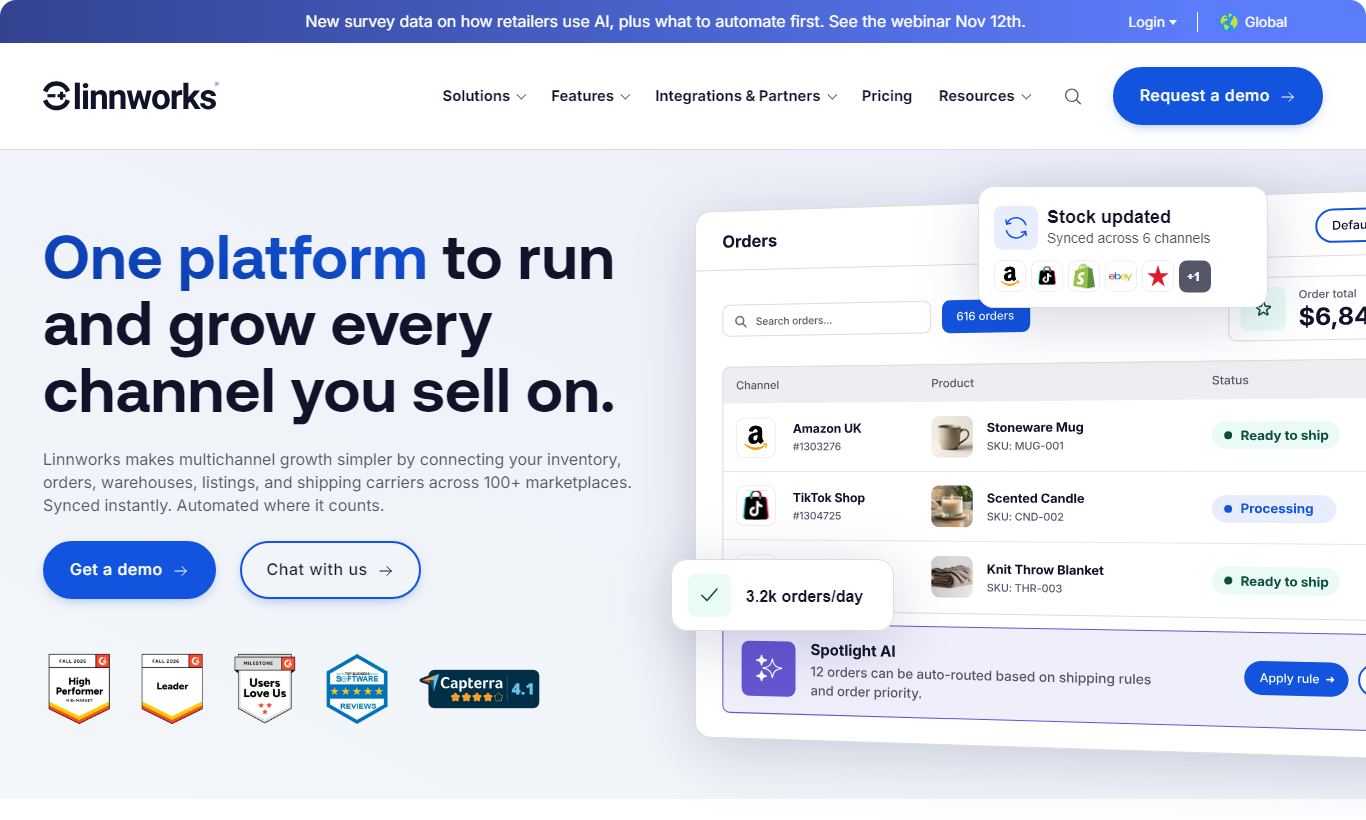
This is the engine at the heart of Linnworks. When a product sells on Amazon, the stock level drops instantly, and that updated figure gets pushed out to eBay, Shopify, your website, and every other connected channel in real time. You can set channel-specific stock rules, such as holding a safety buffer of 5 units back from a particular channel, or listing a different quantity on lower-priority channels. For a business selling the same SKU across six storefronts, this alone wipes out a category of operational risk that costs retailers real money: overselling.
Order Management and Routing
Linnworks pulls orders from all your connected channels into a single queue. From there, you can apply automation rules to route orders to the right warehouse, 3PL, or dropship supplier based on criteria like SKU, order value, destination country, or channel of origin. Rules are built using a straightforward condition-based editor, no coding required. For example: "If order contains SKU beginning with FRIDGE- and destination is mainland UK, route to Warehouse 2 and assign carrier DPD." This level of routing logic usually needs custom development in less mature platforms.
Shipping Label Generation
Linnworks integrates with over 50 shipping carriers globally, including Royal Mail, DHL, FedEx, UPS, Hermes, and many regional carriers. You can print single labels or process batches of hundreds in one click. The platform supports packing station workflows: scan a barcode, confirm contents, print label, done. That flow cuts pick-and-pack errors sharply in busy fulfilment operations. Carrier allocation can also be automated: orders under 1kg go to Royal Mail Tracked 48 automatically, heavier items go to DHL, for instance.
Purchase Orders and Supplier Management
Linnworks includes a full purchase order module. You can set reorder points per SKU, and the system generates suggested POs when stock drops below your defined threshold. POs go straight to suppliers from within the platform, and incoming stock can be received against open POs to update inventory counts automatically. For businesses with 500+ SKUs across multiple suppliers, this replaces a mess of spreadsheets and email threads with a traceable, auditable procurement workflow.
Reporting and Analytics
The reporting suite covers sales by channel, SKU performance, fulfilment metrics, and inventory valuation. Reports can be scheduled and exported to CSV or pushed into BI tools via API. The channel performance dashboard is genuinely useful for merchants who need to decide where to focus their listing efforts. It shows which channels generate the highest margin orders versus the highest volume. The out-of-the-box dashboards are functional rather than beautiful, though, and power users often supplement Linnworks data with a dedicated BI tool like Tableau or Power BI.
Warehouse Management (WMS Lite)
For businesses operating their own warehouse, Linnworks offers bin location management, multi-location inventory tracking, and a mobile scanning app for pick-and-pack operations. It won't replace a full WMS in a large distribution centre. But for a business running a 5,000 - 20,000 sq ft fulfilment operation with 2 - 10 pickers, it gives enough structure to cut location errors and improve throughput without the cost and complexity of a standalone WMS.
Pricing
Linnworks doesn't publish standard pricing on its website. Every plan is quote-based, built around the number of orders you process, the channels you connect, and how many users need access. It's a deliberate enterprise-sales approach, and it means you'll need to book a discovery call before you get a real number. Based on widely reported market data and user community discussions, the entry point typically sits around $449 - $699 per month for smaller configurations, with mid-tier accounts commonly ranging from $1,000 - $2,500 per month. Enterprise contracts for high-volume merchants can exceed $5,000/month.
Linnworks does offer a free trial, typically 14 days, so you can test the platform against your own data before committing. There's no permanent free plan. Annual billing is standard and usually required. Monthly billing may be available, but often at a premium. The platform formerly had a product called Linnworks.net (now simply Linnworks) and a lighter product called Veeqo, which Amazon acquired separately. Make sure you're comparing the right product tier for your needs.
What We Love
- Real-time multichannel inventory sync with per-channel buffer rules. This stops overselling across Amazon, eBay, Shopify, and 100+ other channels at the same time.
- Highly configurable order routing automation. Condition-based rules send orders to the right warehouse or 3PL without any developer involvement.
- 50+ carrier integrations with batch label printing. It supports packing station scan-and-print workflows that scale to thousands of shipments per day.
- Solid purchase order module with automated reorder point suggestions. It closes the loop between sales velocity and procurement without requiring external tools.
- Wide integration ecosystem. There are 100+ native connectors covering marketplaces, shopping carts, carriers, accounting (Xero, QuickBooks), and 3PLs.
Watch Out For
- Onboarding is complex and time-consuming. Most businesses report a 4 - 8 week implementation process. Rush it and you'll end up with data sync errors that are painful to unwind.
- No transparent public pricing. The quote-based model makes budgeting difficult and adds friction for buyers who want to size things up on their own before talking to sales.
- Reporting dashboards feel dated. The UI works fine but sits behind modern standards. Many users end up exporting data to external BI tools for anything beyond basic analysis.
- Not cost-effective for low-volume sellers. Businesses processing fewer than 300 - 500 orders per month will likely find the ROI hard to justify compared to lighter tools like Veeqo or Sellbrite.
Who Is It Best For?
The multichannel retailer processing 500 - 10,000 orders per month: A business selling on Amazon Seller Central, eBay, and a Shopify DTC store at once, with a team of 3 - 15 in fulfilment, is the sweet spot. Linnworks was built for exactly this profile. The inventory sync, order routing, and carrier integration features pay for themselves within months by cutting out manual reconciliation and reducing shipping errors.
The wholesale distributor running B2B and B2C in parallel: A company that sells to retail chains via purchase orders while also running a consumer website faces messy inventory demands. Stock needs to be allocated, reserved, and committed across very different order types. Linnworks handles this without needing separate systems for each channel, and the PO management module covers the supplier side too.
The 3PL operator managing inventory for multiple clients: Third-party logistics providers need to partition inventory, generate client-specific reports, and manage fulfilment rules per client. Linnworks supports multi-client warehouse operations and has a solid user base in the 3PL segment, making it one of the few platforms that actually serves this use case without demanding expensive custom development.
How Does It Compare?
Linnworks vs Cin7: Cin7 is a strong competitor in inventory management, and it beats Linnworks on B2B and manufacturing features like BOMs and production orders. If you're running a product-based business with assembly or kitting at scale, Cin7 probably fits better. For straight multichannel ecommerce order flow, though, Linnworks wins out. Its marketplace integrations run broader and have been tested harder over more years. See our full Linnworks vs Cin7 comparison.
Linnworks vs Skubana (Extensiv): Skubana, now rebranded as Extensiv Order Manager, targets a similar audience and ships with a cleaner, more modern UI plus strong analytics. Extensiv suits direct-to-consumer brands that want detailed reporting. Linnworks covers more carriers and marketplaces, and its merchant base skews larger across the UK and Europe. Check our Linnworks vs Extensiv breakdown for the full feature comparison.
Final Verdict
Linnworks has earned its reputation as a top-tier multichannel commerce operations platform, but only for the businesses it's actually built for. If you're managing meaningful order volume across multiple sales channels, and your current setup involves manual stock updates, spreadsheet-based POs, or juggling separate shipping tools per channel, Linnworks can genuinely transform your operations. The automation depth, integration breadth, and order routing flexibility are hard to match at this price point.
The caveats are real though. Budget for a proper implementation. Don't expect to be live in a weekend. Understand that the pricing conversation requires engaging the sales team, and factor that into your evaluation timeline. If you're processing under 300 orders a month, look at lighter-weight alternatives first. But if you're scaling fast, operating multiple channels, and ready to invest in infrastructure that grows with you, Linnworks is a well-proven choice.
Try Linnworks Free →FAQ
How much does Linnworks cost per month?
Linnworks doesn't publish standard pricing publicly. Based on market data and user reports, plans typically start around $449 - $699/month for smaller configurations and rise to $1,000 - $2,500/month for mid-market accounts. Enterprise contracts for high-volume merchants can exceed $5,000/month. A 14-day free trial is available.
Does Linnworks offer a free plan or free trial?
Linnworks doesn't offer a permanent free plan. It does provide a 14-day free trial that gives you access to the full platform, so you can test it against your real channels and data before committing to a paid contract.
Is Linnworks worth it for small businesses?
Linnworks generally isn't cost-effective for businesses processing fewer than 300 - 500 orders per month. Smaller sellers are better served by lighter, more affordable tools like Veeqo (free for Amazon sellers), Sellbrite, or even native channel tools. Linnworks delivers its best ROI at higher order volumes, where automation savings are significant.
What sales channels does Linnworks integrate with?
Linnworks integrates natively with over 100 sales channels and tools, including Amazon, eBay, Shopify, WooCommerce, Magento, Etsy, OnBuy, Walmart, and many more. It also connects to 50+ shipping carriers and accounting platforms including Xero and QuickBooks.
How does Linnworks compare to Cin7?
Cin7 is stronger for businesses with manufacturing, assembly, or complex B2B wholesale workflows. Linnworks has a broader marketplace and carrier integration footprint and focuses more on high-volume multichannel ecommerce order management. For pure ecommerce operations, Linnworks is generally the stronger choice. For product-based businesses with production needs, Cin7 may be preferable.
How long does it take to implement Linnworks?
Most businesses report an implementation timeline of 4 - 8 weeks for a full deployment, including channel connections, data migration, automation rule setup, and staff training. Rushing the implementation is a common cause of data sync errors. Linnworks offers onboarding support, and many businesses also bring in a certified implementation partner.
Does Linnworks support multiple warehouses?
Yes. Linnworks supports multi-location inventory management, including bin location tracking within each warehouse, stock transfers between locations, and routing rules that direct orders to the most appropriate fulfilment location based on criteria you define.
We may earn a commission when you click affiliate links. This never affects our editorial scores.
| Best for | — |
| Category | — |
Answer a few quick questions and we'll match you to the best tool for your needs.
→ Suggest a Tool