
BigCommerce Review 2026: Is It Worth It?
BigCommerce is a cloud-based ecommerce platform built for growing and enterprise-level online retailers. It offers unlimited staff accounts, no transaction fees on any plan, and native multi-storefront support that most competitors lock behind expensive upgrades. Starting at $39/month, it competes directly with Shopify and Magento, pairing ease of use with enterprise-grade features like B2B quoting, headless commerce support, and strong built-in SEO tools. It works best for mid-market merchants and B2B sellers who've outgrown Shopify but want to skip Magento's technical overhead. Smaller stores may find the pricing steep for what they actually use, and the theme selection is narrower than Shopify's. Retailers processing $500K or more annually get the strongest case for BigCommerce, since it delivers real scalability without the pain of switching platforms later.
What we love
Watch out for
BigCommerce at a glance
What to test in your BigCommerce trial
15-day free trial
- Set up two payment gateways (Stripe and PayPal) and confirm zero transaction fees are applied to test orders
- Create a product with custom URL slug, meta title, and meta description to verify built-in SEO tools work as needed
- Build and send an abandoned cart recovery email sequence to a test customer account
- Add three staff accounts with different permission levels to test how easy it is to manage team access
- Import your actual product catalog and test variant management and bulk editing on real data
- Calculate your annual sales projection and confirm which plan tier fits your growth before the trial ends
Quick Verdict
BigCommerce is one of the most feature-complete SaaS ecommerce platforms available in 2026. Unlike Shopify, it charges zero transaction fees regardless of which payment processor you use, and it doesn't treat core functionality like abandoned cart recovery or multi-currency selling as premium add-ons. For a merchant doing serious volume, that alone can mean thousands of dollars saved per year. The platform's architecture is built for scale too. Multi-storefront management, headless commerce APIs, and native B2B tools are included at price points that competitors reserve for enterprise contracts.
BigCommerce isn't for everyone, though. Its theme marketplace is smaller than Shopify's, the annual sales revenue caps on lower plans can force premature upgrades, and the back-end interface, while functional, has a learning curve that casual store owners may find frustrating. If you're a high-volume retailer, a B2B seller, or a brand running multiple storefronts, BigCommerce deserves a serious look. If you're opening your first $10,000-a-year hobby store, it's probably more platform than you need.
Start Your Free Trial →What is BigCommerce?
BigCommerce was founded in 2009 in Austin, Texas, and went public on the Nasdaq in 2020 under the ticker BIGC. It now powers more than 45,000 online stores across 150+ countries, serving clients that range from independent retailers to enterprise brands like Skullcandy, Vodafone, and Harvey Nichols. The platform calls itself an "open SaaS" ecommerce solution. That means you get the stability and managed infrastructure of a hosted platform, plus the freedom to customize through open APIs, headless front-ends, and third-party integrations, without getting locked into a proprietary ecosystem.
BigCommerce targets mid-market and enterprise B2C retailers, along with B2B merchants who need features like customer-specific pricing, purchase order workflows, and bulk order management. Its pitch against Shopify is simple: more built-in functionality, no transaction fees, and better native SEO controls. Against Magento/Adobe Commerce, it competes on total cost of ownership. You get much of Magento's power without managing your own servers or hiring a dedicated development team.
Key Features
Feature Checklist
Multi-Storefront Management
One of BigCommerce's most compelling differentiators is the ability to manage multiple storefronts from a single back-end. A merchant running three distinct brands, say a wholesale channel, a direct-to-consumer site, and a regional international store, can manage unified inventory, shared product catalogs, and consolidated order management without logging into separate accounts. Each storefront gets its own domain, theme, and pricing rules. Shopify only approximates this through separate accounts or expensive Shopify Plus plans. On BigCommerce, it's available natively on the Enterprise tier, and it's a genuine operational time-saver for multi-brand operators.
Native B2B Features
BigCommerce includes a B2B Edition add-on (available on Plus and above) that brings capabilities most B2B merchants would otherwise need a separate platform or heavy customization to achieve. These include customer-group-specific pricing, quote management workflows where sales reps can build and send quotes directly from the admin, purchase order payment support, net payment terms (Net 30/60/90), and a buyer portal where corporate customers can manage their own users and reorder from purchase history. For a manufacturing company or wholesale distributor moving from a manual ordering process, this is a significant operational upgrade.
Built-in SEO Tools
BigCommerce takes SEO seriously in ways that matter to organic traffic growth. Every product, category, and content page exposes fully editable URL slugs, meta titles, meta descriptions, and Open Graph tags without requiring an app. The platform automatically generates sitemaps and submits them, supports structured data (schema.org) for product rich snippets, and handles canonical URL management to prevent duplicate content issues from faceted navigation. That's a notoriously tricky problem, and one that causes real SEO damage on other platforms. For merchants investing in content and long-term organic acquisition, this built-in foundation beats the app-dependent approach Shopify requires.
Checkout and Payment Flexibility
BigCommerce supports over 65 payment gateways natively, including Stripe, PayPal, Square, Braintree, and Amazon Pay, and charges zero additional transaction fees on any of them. Compare that to Shopify, which charges 0.5 to 2% on transactions processed outside Shopify Payments. On a store doing $1M annually, that fee difference alone could top $10,000 a year. The platform also supports one-page checkout customization via its Checkout SDK, which lets developers build fully branded, conversion-optimized checkout experiences without breaking PCI compliance. Apple Pay, Google Pay, and Buy Now Pay Later options (Afterpay, Klarna, Zip) all come standard.
Headless Commerce and API Infrastructure
For brands that want to decouple their front-end experience from their commerce back-end, serving content through a React/Next.js site, a mobile app, or a voice interface while BigCommerce handles inventory, orders, and payments, the platform offers a strong REST and GraphQL API layer. BigCommerce's Catalyst framework (released in 2024) provides a Next.js-based starter storefront that cuts the time-to-launch for headless implementations dramatically. That matters for enterprise brands that need performance, composability, and creative control beyond what any theme system can offer.
Pricing
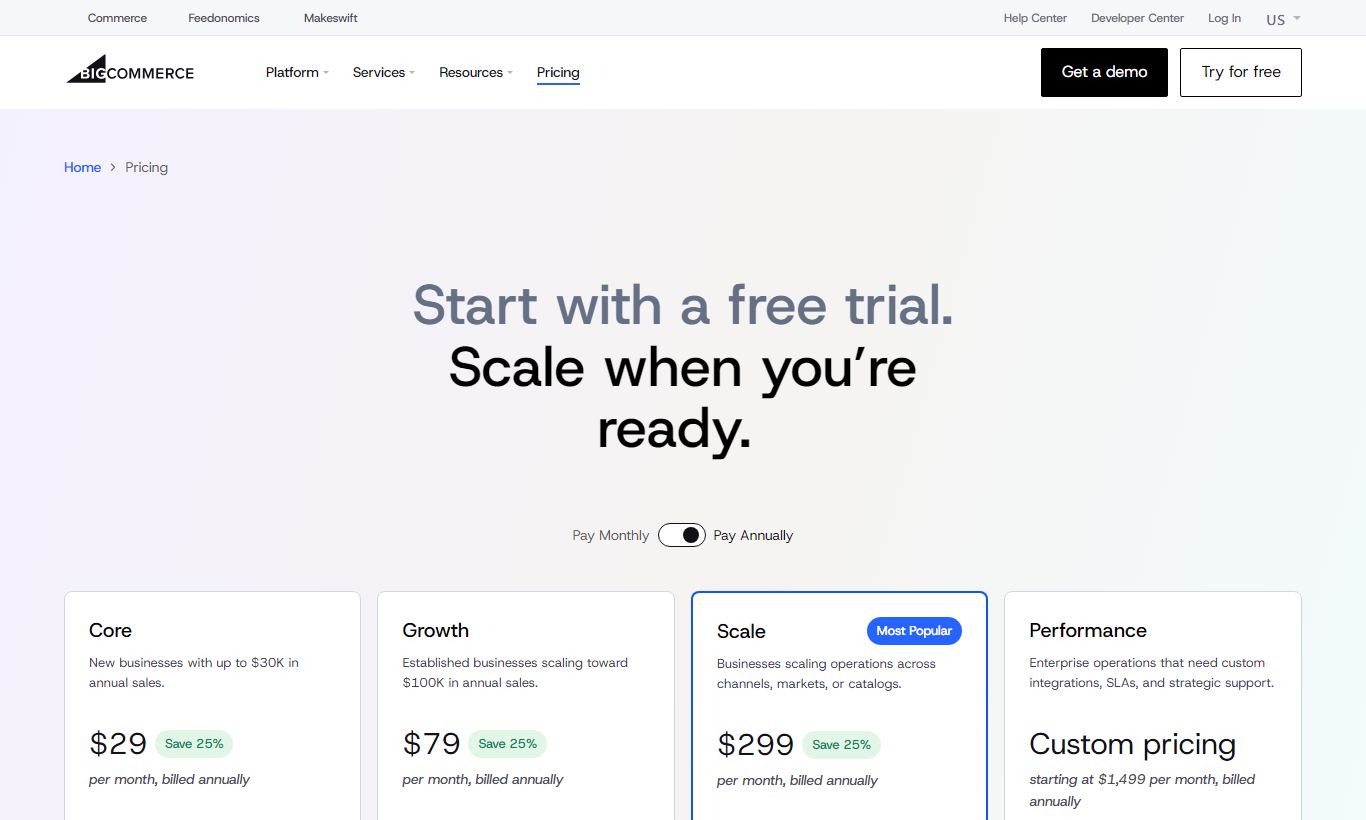
BigCommerce offers four main pricing tiers. All plans include a 15-day free trial and no credit card is required. Pricing below reflects monthly billing. Annual billing saves about 25%.
- Standard - $39/month (or ~$29/month billed annually): Supports up to $50K in annual online sales. Includes unlimited products, staff accounts, file storage, and bandwidth. Real-time shipping quotes, single-page checkout, and gift cards are all included, with no transaction fees. Good fit for early-stage stores with modest volume.
- Plus - $105/month (or ~$79/month billed annually): Supports up to $180K in annual sales. Adds abandoned cart recovery (automatic email sequences), stored credit cards, customer groups and segmentation, and Google Customer Reviews. Most growing DTC stores end up here.
- Pro - $399/month (or ~$299/month billed annually): Supports up to $400K in annual sales. Adds product filtering (faceted search), custom SSL, Google Shopping integration, and priority support. You can extend the $400K cap in increments for an additional fee.
- Enterprise - Custom pricing: Removes all annual sales caps. Adds multi-storefront management, advanced B2B features (B2B Edition), price lists, unlimited API calls, and a dedicated account manager. Enterprise contracts typically start around $1,000 to $1,500 a month, based on publicly disclosed ranges.
One thing to watch for: if your store exceeds the annual sales threshold for your plan, BigCommerce automatically upgrades you to the next tier. The policy is disclosed upfront, but it can still catch fast-growing merchants off guard mid-year.
What We Love
- Zero transaction fees on all plans: Shopify tacks on a 0.5% to 2% surcharge if you skip its native payment processor. BigCommerce charges nothing, no matter which of the 65+ supported gateways you pick. At scale, that difference adds up fast.
- Unlimited staff accounts on every plan: Even the $39/month Standard plan lets you add unlimited admin users. That matters for teams where warehouse staff, customer service agents, and marketers all need back-end access.
- Native abandoned cart recovery on Plus and above: Automated email sequences fire without any third-party app, and you can customize both timing and messaging. Shopify holds this back for its $105/month plan, and Squarespace locks it behind Commerce Advanced.
- Strong built-in SEO architecture: Fully editable URLs, automatic canonical tag management, structured data output, and XML sitemap automation all come standard. No SEO app needed. That saves $10 to $30 a month and spares you a common technical debt headache down the line.
- Headless-ready API infrastructure with Catalyst framework: The Next.js-based Catalyst starter kit puts composable commerce architecture within reach for mid-market brands that don't have six-figure implementation budgets.
Watch Out For
- Annual sales caps can force costly plan upgrades: Hit $50K on Standard or $180K on Plus mid-year, and BigCommerce triggers an automatic upgrade. That's a jump of $66 to $294 a month, and it can catch fast-growing stores off guard if they haven't budgeted for it.
- Smaller theme marketplace than Shopify: BigCommerce's theme store offers around 200 themes compared to Shopify's 170+ premium themes and a far larger free and third-party ecosystem. You'll more often need custom theme development, which adds upfront cost.
- App ecosystem lags behind Shopify's: The BigCommerce app marketplace has roughly 1,000+ integrations versus Shopify's 8,000+. Niche tools, particularly for emerging marketing channels, loyalty programs, or specialized verticals, may not have native BigCommerce integrations.
- Back-end interface has a steeper learning curve: Multiple users on community forums (Reddit's r/bigcommerce, G2) say the admin UI is less intuitive than Shopify's, especially for product variant management and bulk editing tasks. Onboarding new staff takes longer than on competing platforms.
Who Is It Best For?
The scaling DTC brand doing $200K to $5M annually: Picture a direct-to-consumer apparel or home goods brand that's outgrown Shopify's transaction fee structure. It needs more built-in marketing and SEO tools, and it doesn't want to bolt on a stack of $30/month apps to get there. BigCommerce's Plus or Pro plans hit that sweet spot, enough feature density without forcing an enterprise-level spend.
The B2B manufacturer or wholesale distributor: A company selling industrial supplies or trade goods needs customer-specific pricing tiers, quote workflows, and net payment terms, and building custom software for that isn't realistic. BigCommerce's B2B Edition (available on Enterprise) swaps out the patchwork of spreadsheets and manual processes for a structured buyer portal and proper sales rep tooling.
The enterprise brand launching a headless commerce experience: A media company, CPG brand, or retailer wants a Next.js-powered storefront for speed and editorial flexibility, but it still needs a dependable commerce engine underneath handling inventory, orders, and payments. BigCommerce's Catalyst framework and GraphQL API get you there without a full custom build.
How Does It Compare?
BigCommerce vs Shopify: Shopify wins on theme variety, app ecosystem breadth, and new-user onboarding simplicity. BigCommerce wins on transaction fees (zero vs. up to 2%), built-in B2B tooling, and SEO architecture. For stores processing over $500K/year using non-Shopify Payments processors, BigCommerce's total cost of ownership is usually lower.
BigCommerce vs Magento (Adobe Commerce): Magento offers deeper customization and is the go-to for truly complex, custom-built commerce requirements. But it demands developer resources, server management, and a much higher total cost of ownership. BigCommerce gives you 80% of Magento's flexibility at a fraction of the infrastructure cost. That's the right trade-off for most mid-market merchants who don't have a dedicated development team.
Final Verdict
BigCommerce is a mature, genuinely powerful ecommerce platform, and it earns its place in the conversation for any merchant doing serious online volume. Its zero-transaction-fee model, unlimited staff accounts, and native B2B capabilities are real advantages, not marketing spin. The investment in headless infrastructure with the Catalyst framework shows a platform that's thinking clearly about where enterprise commerce is heading.
The platform isn't the right choice for absolute beginners or merchants with simple, low-volume stores. Shopify's smoother onboarding and larger app store serve those users better. But for the DTC brand that's tired of paying Shopify's tax on every sale, the B2B seller who needs structured buyer workflows, or the enterprise team planning a headless build, BigCommerce deserves a serious evaluation. Start with the 15-day free trial and stress-test the back-end before committing. You'll have a clear answer within a week.
Try BigCommerce Free →FAQ
How much does BigCommerce cost per month?
BigCommerce plans start at $39/month (Standard), with Plus at $105/month, Pro at $399/month, and Enterprise at custom pricing. Annual billing cuts costs by about 25% across all plans.
Does BigCommerce charge transaction fees?
No. BigCommerce charges zero transaction fees on all plans, no matter which payment gateway you use. Shopify, by comparison, charges 0.5 - 2% on transactions processed outside Shopify Payments.
Is BigCommerce better than Shopify?
It depends on your needs. BigCommerce works better for high-volume merchants, B2B sellers, and anyone using third-party payment processors, thanks to zero transaction fees and stronger built-in features. Shopify suits beginners and stores that lean on a large app ecosystem.
Does BigCommerce have a free trial?
Yes. BigCommerce offers a 15-day free trial on all plans with no credit card required. That gives merchants enough time to build a store and test the platform before committing.
What are BigCommerce's annual sales limits?
Standard supports up to $50K/year in online sales, Plus up to $180K/year, and Pro up to $400K/year. Exceeding your plan's limit triggers an automatic upgrade to the next tier. Enterprise plans have no sales caps.
Is BigCommerce good for B2B ecommerce?
Yes, particularly on Enterprise plans with the B2B Edition add-on. It supports customer-specific pricing, quote management, purchase order payments, net payment terms, and a self-service buyer portal. That makes it one of the strongest SaaS platforms for B2B use cases.
Can BigCommerce support headless commerce?
Yes. BigCommerce offers a REST and GraphQL API layer along with the Catalyst Next.js framework for headless builds. It's one of the most developer-friendly SaaS platforms for composable or headless commerce architectures.
Is BigCommerce worth it for small businesses?
For most small businesses just starting out, BigCommerce's $39/month Standard plan may offer more than they need. Shopify's simpler interface and larger app store are often a better fit until a business reaches $100K+ in annual revenue. Past that point, BigCommerce's cost advantages start to matter a lot more.
We may earn a commission when you click affiliate links. This never affects our editorial scores.
| Best for | — |
| Category | — |
Answer a few quick questions and we'll match you to the best tool for your needs.
→ Suggest a Tool