
Semrush Review 2026: Is It Worth It?
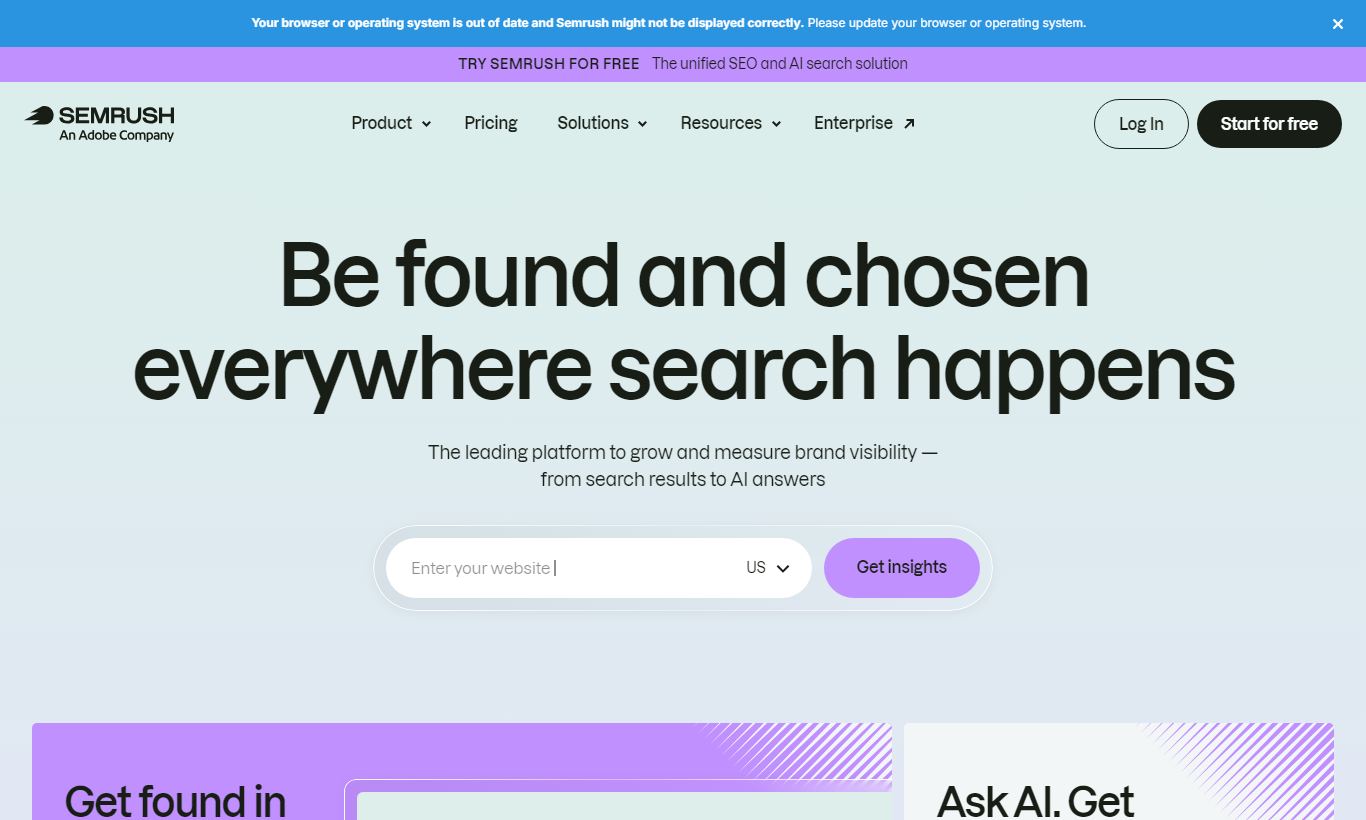
Semrush is an all-in-one SEO and digital marketing platform used by over 10 million marketers worldwide. It offers keyword research, site auditing, competitive intelligence, backlink analysis, rank tracking, and content marketing tools under one roof. The Pro plan starts at $139.95/month, which is a serious investment. It pays off for agencies, in-house SEO teams, and growth-focused businesses that need deep competitive data. Compared to alternatives like Ahrefs or Moz, Semrush wins on breadth. No other platform combines PPC research, social media management, and technical SEO in a single subscription the way Semrush does. A 7-day free trial is available on paid plans. For teams serious about organic and paid search, Semrush is the most complete toolkit on the market today.
What we love
Watch out for
Semrush at a glance
What to test in your Semrush trial
7-day free trial
- Research 5-10 target keywords in Keyword Magic Tool and filter by intent to test accuracy against your actual sales data
- Run a Site Audit on your website and review the prioritised technical issues list against your current SEO roadmap
- Analyze 3 competitor domains and compare their top keywords and traffic estimates against your own performance
- Set up Position Tracking for 20 keywords and verify daily SERP rankings match what you see when searching in Google
- Decide if Semrush fits your team size and budget before the trial ends, accounting for plan limits and add-on costs
Quick Verdict
Semrush is the most feature-complete SEO and digital marketing platform available today. It covers keyword research, technical site auditing, PPC competitive intelligence and content marketing, and functions as an operations centre for search-driven growth. For agencies managing multiple clients or in-house teams at mid-market and enterprise companies, the ROI is easy to justify. Consider how many point solutions it replaces.
The caveats are real. The starting price of $139.95/month is steep for solo operators, the learning curve is genuinely demanding, and the single-seat Pro plan will frustrate any team larger than one person. But if you're serious about outranking competitors, understanding where your paid search budget is being beaten, and building a content engine that scales, Semrush is the closest thing the industry has to a definitive answer. A 7-day free trial lets you pressure-test the full platform before committing.
Start Your Free Trial →What is Semrush?
Oleg Shchegolev and Dmitry Melnikov founded Semrush in 2008. It started as a small SEO toolkit and has since grown into a Nasdaq-listed company (SEMR) with over 10 million registered users across 142 countries. The platform is built for digital marketing professionals: SEO specialists, PPC managers, content strategists, and agency account teams who need to make data-driven decisions across organic and paid channels. It sits at the premium end of the market, competing directly with Ahrefs, Moz Pro, and Similarweb, and it's increasingly stepping on the toes of enterprise tools like BrightEdge and Conductor.
What sets Semrush apart from most SEO tools is its deliberate push beyond pure search. Over the past several years, it has acquired and folded in social media scheduling, PR monitoring, local listing management, and an AI-assisted writing tool. The result is a platform marketing teams can actually build their workflow around, not just a single-use research tool they dip into occasionally.
Key Features
Feature Checklist
Keyword Magic Tool
The Keyword Magic Tool is the core of most Semrush workflows. It draws on over 25 billion keywords across 142 geographic databases, and it goes well beyond basic volume metrics. Each keyword comes with keyword difficulty (KD%), average CPC, competitive density for paid ads, trend data, and search intent classification. That intent tag matters more than people give it credit for. Filtering a keyword list by "Commercial" or "Transactional" intent lets content teams prioritise pages that are actually built to convert, not just pull in traffic. Take an e-commerce manager researching "running shoes": they can filter for transactional variants, isolate keywords with KD under 50, and export a prioritised content brief in under ten minutes.
Site Audit
Semrush's Site Audit crawls your website and checks it against more than 140 technical SEO factors, sorting issues by severity: Errors, Warnings, and Notices. The resulting site health score gives teams one KPI to track over time. The tool earns its keep through its link to the On-Page SEO Checker. Once Site Audit flags broken internal links, slow-loading pages, or duplicate meta descriptions at scale, the On-Page Checker benchmarks your individual pages against the top 10 ranking results for your target keywords and suggests specific copy, structure, and schema fixes. For a content-heavy site with hundreds of pages, this combination turns weeks of manual auditing into a structured, prioritised sprint.
Competitive Intelligence & Traffic Analytics
Type any competitor domain into Semrush's Domain Overview and you get a report you can act on right away: estimated monthly organic and paid traffic, their top-performing keywords, their most-linked pages, and changes in ranking positions over time. The Traffic Analytics tool goes deeper. It estimates traffic by source (direct, referral, search, social, paid), average session duration, and even audience overlap between competitors, which is handy when you're sizing up market share or scouting acquisition targets. The Advertising Research module shows the actual ad copy and landing page combinations a competitor is running on Google Ads, so PPC teams don't waste time retesting what rivals have already proven.
Position Tracking & Reporting
Semrush's Position Tracking tool monitors daily SERP rankings for a defined set of keywords, broken down by device type (desktop vs. mobile), geographic location (down to city level), and SERP feature visibility, including Featured Snippets, Local Packs, and Image Packs. For agencies, generating white-label PDF reports on a schedule (daily, weekly, or monthly) cuts out a big chunk of manual reporting work. Guru and Business plan users can connect reports to Google Looker Studio for live dashboards, a real upgrade from static PDF exports for clients who want to check in on their own.
Backlink Analytics & Link Building
Semrush's backlink index holds over 43 trillion links and updates daily. The Backlink Analytics tool assigns each linking domain an Authority Score (a proprietary 1 to 100 metric similar to Moz's Domain Authority) and flags potentially toxic backlinks that could be dragging down your rankings. The Backlink Audit tool goes further, running a toxicity analysis across your entire link profile and generating a disavow file formatted for direct upload to Google Search Console. That alone saves hours of manual vetting. For teams actively building links, the Link Building Tool folds outreach straight into the workflow. It suggests prospects based on your target keywords, tracks outreach status, and logs responses, working as a lightweight CRM built specifically for link acquisition campaigns.
Pricing
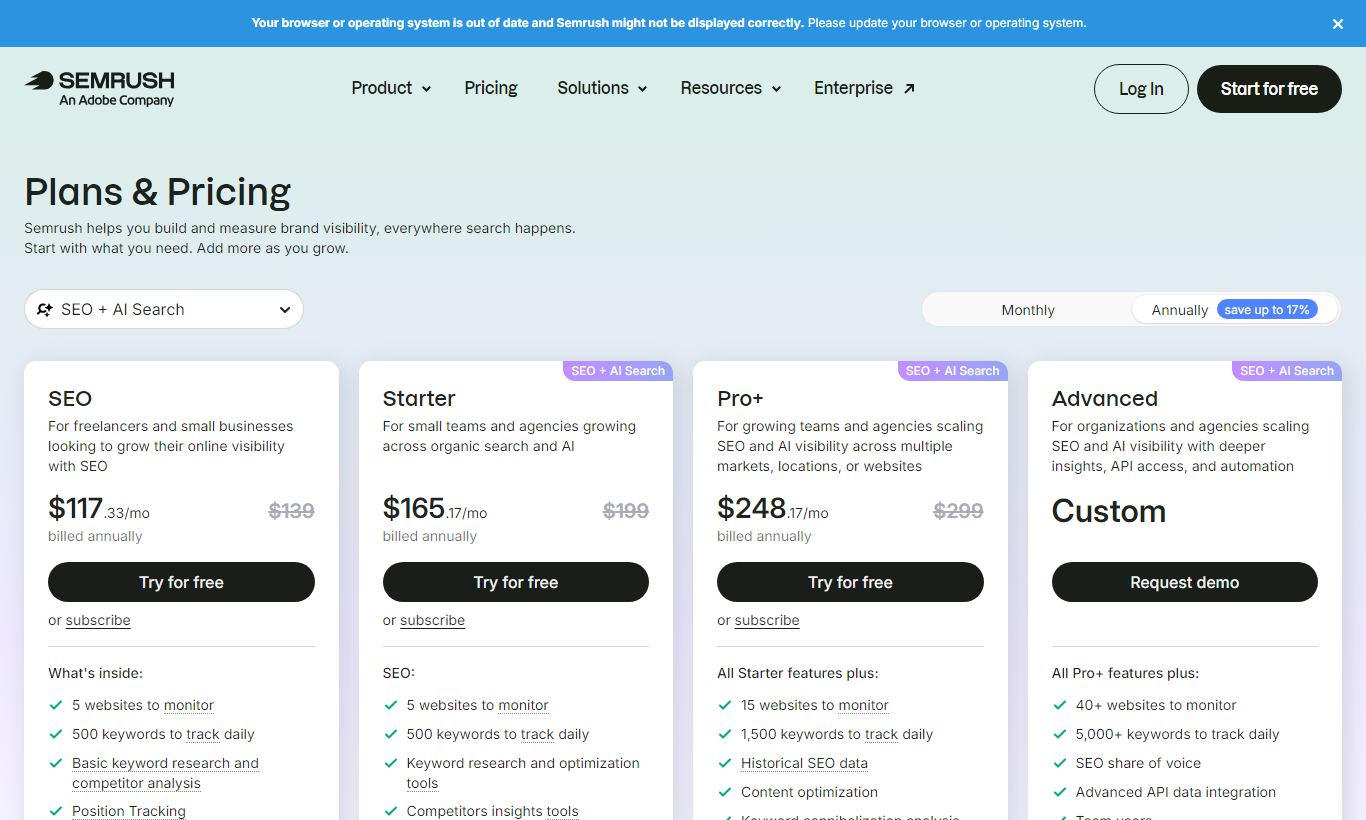
Semrush offers three core subscription tiers. Annual billing brings real savings over paying month to month.
- Pro - $139.95/month ($117.33/mo billed annually): Built for freelancers and early-stage in-house teams. Includes 5 projects, 500 tracked keywords, 10,000 results per report, and 1 user seat. Site Audit caps out at 100,000 pages per month. This tier covers all the core SEO tools but leaves out the Content Marketing Toolkit and historical data access.
- Guru - $249.95/month ($208.33/mo billed annually): The best fit for growing agencies and established in-house teams. Steps up to 15 projects, 1,500 tracked keywords, 30,000 results per report, and 3 user seats. Adds the Content Marketing Toolkit, historical data (going back years for trend analysis), multi-location tracking, and Looker Studio integration.
- Business - $499.95/month ($416.66/mo billed annually): Built for large agencies and enterprise marketing departments. Supports 40 projects, 5,000 tracked keywords, 50,000 results per report, 5 user seats, API access for custom data pipelines, Share of Voice reporting, and white-label client reporting.
Beyond the core plans, Semrush sells several add-ons. Semrush Local starts at $20/month per location for listing management and local rank tracking. The Agency Growth Kit (pricing varies) adds a client portal, lead generation widget, and CRM-lite functionality. You can also buy extra user seats individually. Semrush doesn't offer a permanently free plan with any real functionality. There's a free account tier that allows a handful of queries per day, but it works more as a preview than something you'd actually use day to day. A 7-day free trial is available on Pro and Guru plans with full feature access.
What We Love
- The Keyword Magic Tool's intent classification filters (Informational, Commercial, Navigational, Transactional) let content teams build editorial calendars that map directly to the buyer journey, not just traffic targets.
- Site Audit's 140+ technical check crawl, combined with a single health score and a severity-prioritised issue queue, makes systematic technical SEO maintenance possible even for teams without a dedicated developer.
- The competitive intelligence tools expose competitor PPC ad copy, estimated spend, and organic keyword gaps all at once, so you don't need separate tools for SEO and paid search research.
- The 43-trillion-link backlink database, with built-in toxic link scoring and one-click disavow export, saves link auditors hours of spreadsheet work on every domain they review.
- White-label PDF reporting with scheduled delivery and Looker Studio integration gives agencies a client-facing reporting stack without needing a separate reporting tool.
Watch Out For
- The Pro plan's single-seat limit and 5-project cap is a genuine bottleneck for any agency or team of two or more. You'll likely find yourself bumping against Guru pricing ($249.95/month) faster than expected.
- Traffic estimates for low-traffic sites (under roughly 5,000 monthly visits) are often way off. Multiple independent studies and user reports confirm that Semrush can over- or under-estimate by 50% or more at this scale. Always verify with first-party data from Google Search Console.
- New users consistently call the platform's breadth overwhelming. With 55+ tools across SEO, content, social, and advertising, jumping in without a structured learning path leads to underused features, so budget time for Semrush Academy courses or structured onboarding.
- There's no mid-year plan adjustment. Upgrading mid-cycle gets charged at a prorated rate, but downgrading means waiting until renewal. Teams with fluctuating workloads, like seasonal agencies, may find this rigid compared to tools with more flexible scaling.
Who Is It Best For?
Digital agencies managing 5 to 40 client accounts will find the Guru or Business plan earns its cost quickly. The combination of multi-project management, white-label reporting, competitive intelligence across client verticals, and the Link Building Tool's outreach CRM means it effectively replaces three or four separate subscriptions. An agency billing even modest retainers can recoup the Guru plan cost from a single client's monthly engagement.
In-house SEO and content teams at B2B or e-commerce companies doing active content marketing and competing in crowded keyword landscapes will get the most from the Guru plan's Content Marketing Toolkit, historical data, and Position Tracking. Take a SaaS company launching a content programme in a competitive category. It can use Semrush to map the competitor keyword landscape, spot topical gaps, brief writers with SEO-optimised outlines, and track rankings from day one, all within the same platform.
PPC managers who also own SEO responsibilities (a common setup in lean marketing teams) get a particular benefit from Semrush's dual-channel coverage. The Advertising Research tool shows what competitors are spending on Google Ads and what's working for them, while the organic keyword tools inform a coordinated search strategy. No other single platform at this price point covers both as thoroughly.
How Does It Compare?
Ahrefs: Ahrefs has a larger and arguably more accurate backlink index, and its Site Audit crawler is well-regarded for precision. It doesn't match Semrush on PPC research depth, social media tools, or the content marketing suite. If your main need is link analysis and backlink prospecting, Ahrefs may be the better fit. For a full marketing team that needs broader coverage, Semrush wins. See our full Semrush vs Ahrefs comparison.
Moz Pro: Moz Pro is more affordable (starting around $99/month) and has a gentler learning curve, which makes it popular with SEO beginners. Its keyword database and competitive intelligence features are much shallower than Semrush's, though, and it skips PPC research entirely. Moz works fine for SMBs with modest SEO goals. Semrush is the right pick when competitive depth matters. See our Semrush vs Moz Pro comparison for a full breakdown.
Final Verdict
Semrush earns its premium price tag for the users it's built for. If your business treats search, organic or paid, as a primary growth channel, the platform's combination of keyword intelligence, technical SEO auditing, competitive analysis, and reporting infrastructure is hard to match at any price. The Guru plan at $249.95/month is the practical sweet spot for most agencies and in-house teams. The Content Marketing Toolkit and multi-user access alone justify the step up from Pro.
Where Semrush falls short is at the margins. Solo consultants with small retainers may struggle to justify the cost, and users expecting plug-and-play simplicity will face a learning investment upfront. But for any organisation where search visibility is a serious competitive differentiator, Semrush isn't a line item to cut. It's infrastructure. Use the 7-day free trial to put your own domain and top three competitors through the platform and see what surfaces. The findings alone will tell you whether the subscription is warranted.
Try Semrush Free →FAQ
How much does Semrush cost in 2026?
Semrush has three main plans: Pro at $139.95/month, Guru at $249.95/month, and Business at $499.95/month. Annual billing brings these down to roughly $117, $208, and $417 per month. Extra user seats and add-ons, like Semrush Local or the Agency Growth Kit, cost more on top of the base subscription.
Does Semrush offer a free trial?
Yes. Semrush gives you a 7-day free trial on its Pro and Guru plans with full access to the plan's features. You'll need a credit card to sign up. There's also a limited free account tier that allows a small number of queries per day without payment, but it won't cut it for professional use.
Is Semrush better than Ahrefs?
It depends on what you need. Semrush covers more ground, with PPC research, content marketing, and social media scheduling, while Ahrefs generally wins on backlink data accuracy and crawl depth. For all-in-one marketing teams, Semrush is usually the better pick. For pure link analysis, Ahrefs is the stronger specialist. See our full Semrush vs Ahrefs comparison.
Is Semrush worth it for small businesses?
For most small businesses, the Pro plan at $139.95/month is a real investment, and it pays off once you're actively publishing content, running Google Ads, or competing against well-funded rivals in search. If your SEO activity is minimal, lighter tools like Ubersuggest, Mangools, or even Google Search Console can give you enough value at a lower cost.
How accurate is Semrush traffic data?
Semrush's traffic estimates work well for directional comparisons and competitive benchmarking between similarly sized domains. But they can be way off for low-traffic or niche sites, sometimes by 50% or more. Always check them against Google Search Console and Google Analytics for your own properties. Treat Semrush traffic figures as relative indicators, not exact measurements.
Can multiple users share one Semrush account?
Each plan includes a set number of seats: Pro allows 1 user, Guru allows 3, and Business allows 5. You can buy extra seats as paid add-ons. Sharing login credentials breaks Semrush's terms of service and risks account suspension, so teams should budget for the right seat count when comparing plans.
Does Semrush include local SEO features?
Local SEO features come as a paid add-on called Semrush Local, starting at $20/month per location. It covers listing management across directories, review monitoring, and a local heatmap rank tracker. None of these features are included in the standard Pro, Guru, or Business plans.
We may earn a commission when you click affiliate links. This never affects our editorial scores.
| Best for | — |
| Category | Development & DevOps |
Answer a few quick questions and we'll match you to the best tool for your needs.
→ Suggest a Tool