
Tidio AI (Lyro) Review 2026: Is It Worth It?
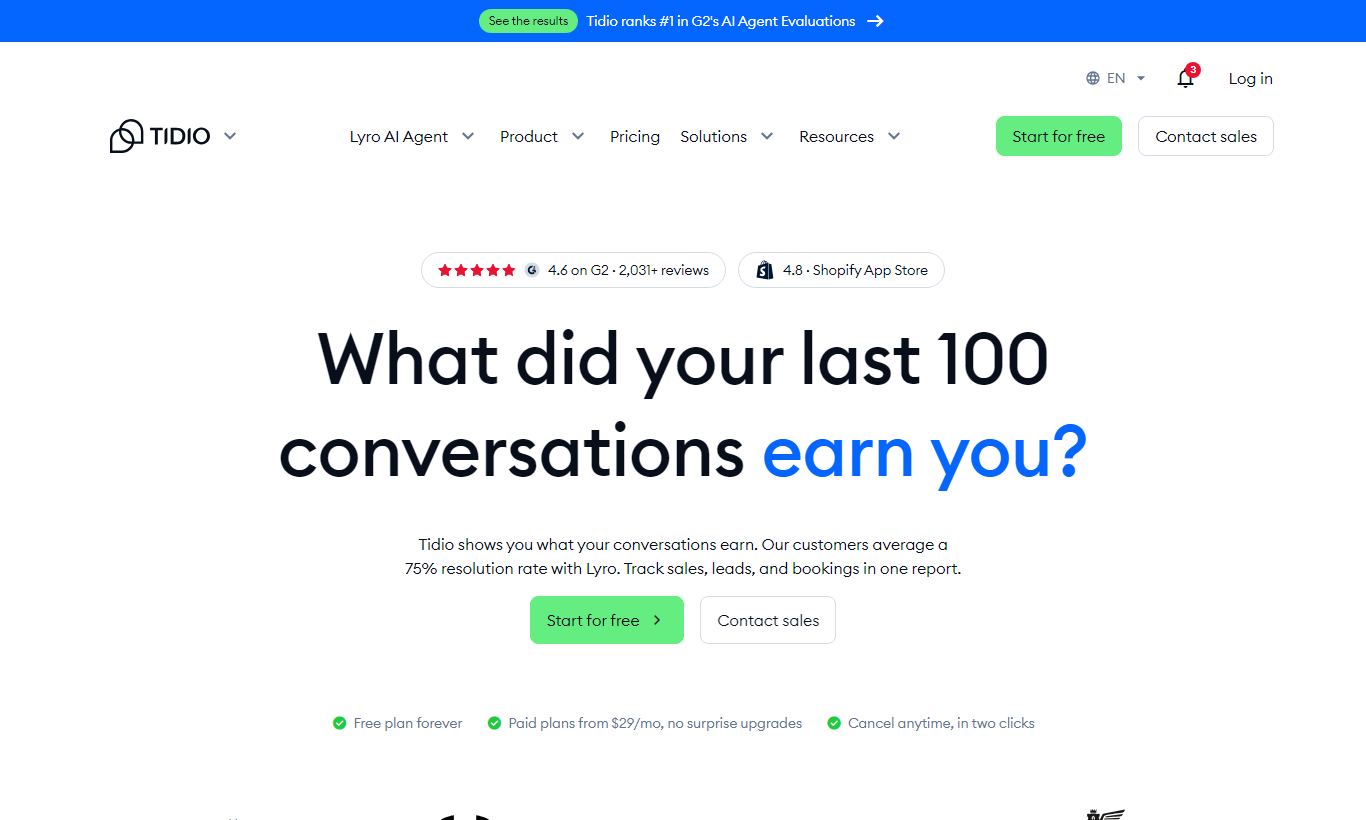
Tidio AI (Lyro) is a customer support platform built for small and mid-sized e-commerce businesses that want to automate live chat, handle repetitive tickets, and cut support volume without hiring more agents. Its AI engine, Lyro, uses conversational AI trained on your own FAQ content to resolve up to 70% of common questions on its own. Pricing starts with a free tier offering 50 Lyro AI conversations per month, scaling up to paid plans from $29/month. Compared to enterprise rivals like Intercom or Zendesk, Tidio gives up some raw power in exchange for ease of use. Setup takes under an hour, and you won't need a developer. It's a strong fit for Shopify stores, bootstrapped SaaS teams, and solo support operators. Larger teams needing advanced analytics, SLA management, or deep CRM integration may find it limiting. Overall rating: 4.3/5.
What we love
Watch out for
Tidio AI (Lyro) at a glance
What to test in your Tidio AI (Lyro) trial
Free plan
- Connect your FAQ page to Lyro AI and test it resolving your top 10 support questions
- Set up Shopify integration and verify order data appears in agent chat panel
- Create one flow-based chatbot with 3-4 branches for common scenarios like returns
- Configure a proactive chat trigger for visitors idle on your pricing page
- Monitor Lyro's conversation count and estimate if monthly caps fit your volume
- Decide before month-end whether to upgrade or if caps and thin reporting limit you
Quick Verdict
Tidio AI (Lyro) is a strong pick for small and mid-sized e-commerce businesses and lean support teams that need to automate a real chunk of their inbound query volume without enterprise-level complexity or pricing. Its AI engine, Lyro, works right out of the box. Connect it to your FAQ page, and it starts deflecting repetitive questions within minutes. The free plan is one of the most usable in the category, and the Growth plan at $59/month gives a solo operator or a team of five enough capability to run a full support operation.
Tidio's limits show up at scale. Strict monthly caps on AI conversations, thin reporting, and email ticketing that feels like an afterthought next to its live chat roots mean growing support teams will eventually outgrow it. For its target audience, though, it's one of the most accessible and genuinely useful customer support tools out there.
Start Your Free Trial →What is Tidio AI (Lyro)?
Tidio was founded in 2013 and is headquartered in San Francisco, with a core engineering team based in Poland. The company built its reputation as a live chat widget provider for small e-commerce businesses before pivoting toward AI-powered customer support with the 2023 launch of Lyro, its conversational AI layer built on Claude (Anthropic's language model). Today, Tidio positions itself as an "AI customer service agent" platform rather than a simple chat widget, and that framing is largely accurate. The product serves over 300,000 businesses, the overwhelming majority of which are Shopify merchants, WooCommerce stores, and lean SaaS startups. It's not built for enterprise contact centres, and it doesn't pretend to be.
Lyro's core premise is that most support teams spend the majority of their time answering the same 20 questions. Automate those, and you free your agents for the conversations that actually require human judgment. That argument gets made a lot in this space, but Tidio executes on it better than most tools at this price point.
Key Features
Feature Checklist
Lyro AI: Autonomous Customer Support
Lyro is the headline feature and the main reason to pick Tidio over a simpler live chat tool. To activate it, you point Lyro at a URL (typically your FAQ or Help Centre page), and it ingests that content as its knowledge base. From there, it handles inbound chat questions, things like "Where is my order?", "What's your return policy?", or "Do you ship internationally?", in natural, conversational language with no scripted flow. In internal testing by Tidio, backed up by third-party user reports, Lyro resolves between 50 and 70% of conversations without human intervention. That's a meaningful number. For a store receiving 500 support chats per month, that's potentially 300 conversations your team never has to touch. When Lyro hits a question outside its knowledge base, it escalates cleanly to a human agent with full context preserved.
Flow-Based Chatbot Builder
Separate from Lyro's AI layer, Tidio includes a visual chatbot builder that lets you create structured, branching conversation flows, think "press 1 for returns, press 2 for billing" but in chat form. The builder uses a drag-and-drop canvas with conditional logic, so you can route visitors to different departments, qualify leads, or trigger Shopify actions (like sending a discount code) based on their responses. It's genuinely powerful, but it rewards patience. Build a flow with more than four or five branches and it gets visually cluttered fast. Non-technical users often report needing 30 to 60 minutes to learn the canvas before they feel confident. Pre-built templates for common e-commerce scenarios (abandoned cart, order status, lead capture) cut that ramp-up time down considerably.
Shopify and WooCommerce Integration
Tidio's e-commerce integrations are a genuine differentiator. When a Shopify customer starts a chat, the agent panel pulls up that customer's order history, current cart contents, and recent browsing activity automatically. Agents can check order status without leaving the Tidio inbox, and Lyro can be configured to answer "Where is my order?" queries by fetching live order data from Shopify. The abandoned cart automation stands out in particular. Tidio can trigger a proactive chat message when a visitor has been idle on the cart page for a configurable duration, a feature that Tidio's own case studies cite as recovering 3 to 5% of abandoned carts on average. WooCommerce users get similar, though slightly less deep, integration through a native plugin.
Multichannel Inbox
Tidio pulls live chat, email tickets, Instagram Direct Messages, and Facebook Messenger conversations into a single inbox. For a two- or three-person support team juggling customer contact across multiple channels, this is a real time-saver. Conversations are tagged, searchable, and assignable to specific agents or departments. The inbox UI is clean and fast, noticeably more responsive than some larger platforms. The main gap is WhatsApp. Tidio doesn't natively support WhatsApp Business API, which is increasingly a must-have feature in markets outside North America and Western Europe.
Visitor Tracking and Proactive Triggers
Tidio's live visitor list shows every active user on your site in real time, including which page they're on, how long they've been there, and how they arrived (direct, organic, referral). You can set triggers to fire a proactive chat message based on rules, for example, "if a visitor has been on the pricing page for more than 45 seconds, send a message offering to answer questions." This kind of behaviour-based engagement is common in enterprise tools but rare at Tidio's price point, and it can genuinely increase the number of conversations started with high-intent visitors.
Pricing
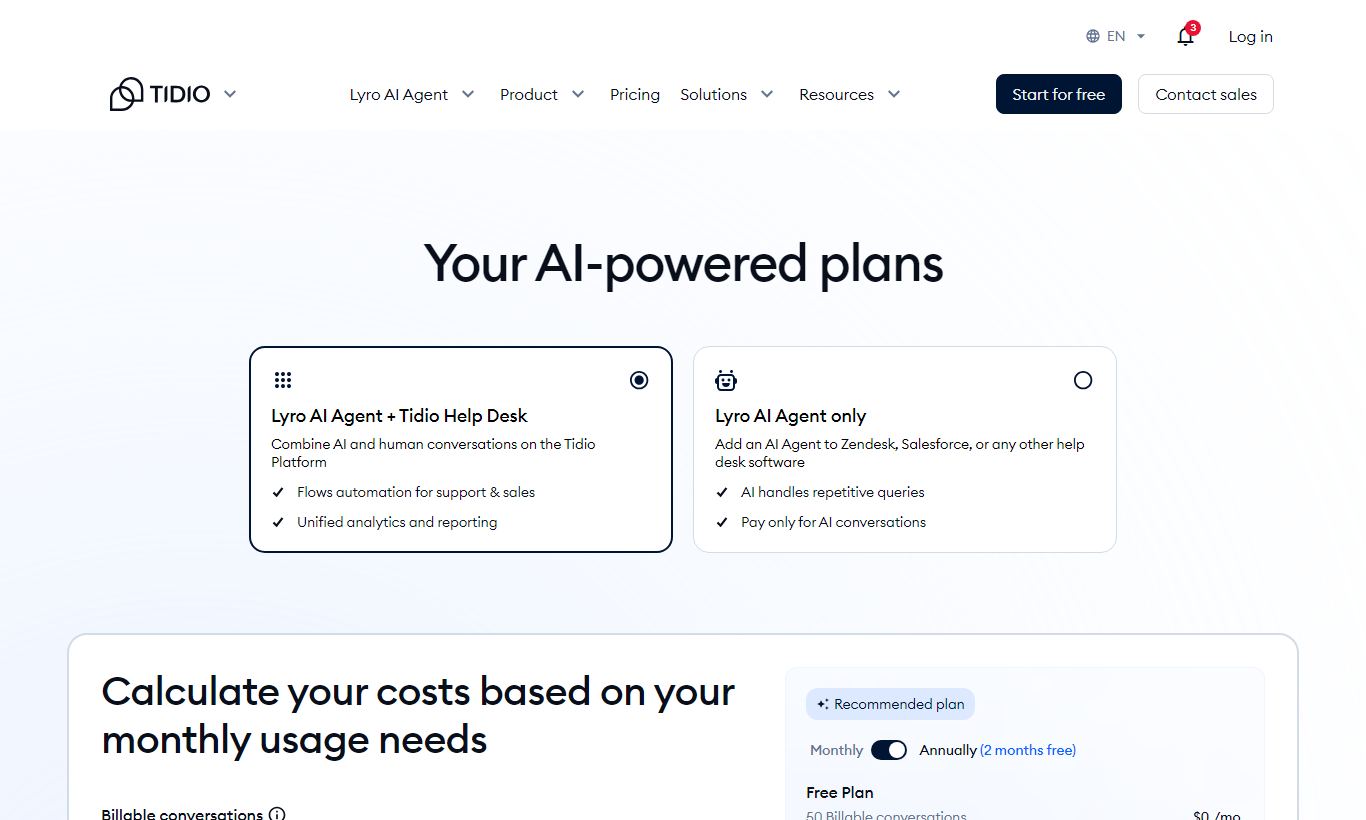
Free ($0/month): Includes 50 Lyro AI conversations per month, 50 live chat conversations, unlimited agent seats, basic chatbot flows, and Tidio branding on the widget. There's no time limit. This is a permanent free tier, not a trial. For a very small store testing the waters, it's genuinely functional.
Starter ($29/month): Removes the live chat conversation cap, removes Tidio branding, and adds email ticketing and an analytics overview. Lyro AI conversations remain at 50/month (additional packs can be purchased separately). This plan suits solo operators who mainly need live chat coverage.
Growth ($59/month): Raises Lyro AI conversations to 250/month, adds advanced analytics, department routing, Zapier integration, and the full Shopify/WooCommerce deep integration. Most small business teams will find this plan the best fit. It's the recommended starting point for anyone running a real support operation.
Tidio+ ($749/month): Enterprise-grade tier with a dedicated success manager, custom Lyro AI training support, advanced API access, SLA routing, and custom reporting. The price jump from Growth to Tidio+ is steep, and it leaves a noticeable gap for mid-market teams that have outgrown $59/month but aren't ready for $749/month.
Additional Lyro AI conversation packs are sold as monthly add-ons. Expect roughly $36 for 50 additional conversations, with the cost per conversation dropping at higher volumes. Annual billing discounts are available but not publicly listed on all tiers. Tidio's sales team typically offers 15-20% off for annual commitments.
What We Love
- Lyro AI resolves up to 70% of repetitive queries autonomously, using only your existing FAQ content. No custom model training, no data labelling, and no ML expertise required.
- Sub-60-minute setup from sign-up to live widget. The onboarding flow walks you through it step by step, and the Shopify app installs in under five minutes with no code changes needed.
- Permanent free tier with unlimited agent seats. Most competitors either cap agents on free plans or cut off free access after 14 days. Tidio does neither.
- Shopify integration surfaces actionable order data inside every chat. Agents see order status, cart contents, and purchase history without switching tabs, which cuts average handle time noticeably.
- Proactive behaviour-based triggers let you fire chat messages to high-intent visitors based on page dwell time, scroll depth, or referral source. It's a conversion-focused feature you rarely find below $100/month.
Watch Out For
- Lyro AI conversation caps are hard limits with no automatic warnings. Once you exhaust your monthly quota, the AI stops responding and falls back to human agents without alerting your team first. That can create an unexpected surge in manual chat volume mid-month.
- Reporting is thin on lower tiers. The Starter and Growth plans lack SLA tracking, team performance dashboards, and CSAT trend analysis over time. You'll know your volume, but not much about your team's efficiency or customer sentiment at scale.
- The chatbot flow builder has a real learning curve. Users new to visual logic builders consistently report that multi-branch flows get hard to manage fast, and there's no version history or rollback feature if you accidentally break a working flow.
- No native WhatsApp support. For businesses with a large customer base in South Asia, Latin America, or the Middle East, where WhatsApp is a primary support channel, this is a genuine gap that Zapier workarounds don't fully close.
Who Is It Best For?
The Shopify merchant handling 200 - 800 support chats per month: This is Tidio's clearest bull's-eye. A founder or a two-person team spending hours answering "Where's my order?" can automate most of that volume with Lyro on the Growth plan, which frees up time for higher-value tasks. The abandoned cart automation and native order data surfacing make Tidio feel built specifically for this use case.
The bootstrapped SaaS startup with a small support queue: A SaaS company with under 1,000 monthly active users and a support inbox that gets 50 - 150 tickets per week can run its entire support operation on Tidio's Growth plan. The multichannel inbox, live chat, email tickets, and Lyro AI are all there, and the cost stays manageable until the team scales past what the platform can handle analytically.
The agency or consultant managing live chat for multiple small clients: Tidio's multi-website support (three sites on Starter, more on Growth) and clean white-labelling options on paid plans make it practical for a digital agency running chat support on behalf of several clients from a single Tidio account. The agent workspace is fast enough that one operator can genuinely monitor and respond across three or four client sites at once.
How Does It Compare?
Tidio vs. Intercom: Intercom is the more mature platform. It has deeper product-tour features, a stronger CRM layer, and far more sophisticated bot-building capabilities. But Intercom's pricing starts at roughly $74/month for basic features and climbs fast. Teams with complex needs often land at $300 to $500/month. Tidio wins decisively on simplicity and cost for e-commerce teams. Intercom wins for product-led SaaS growth. See our full Tidio vs Intercom comparison for a side-by-side breakdown.
Tidio vs. Freshdesk: Freshdesk is a more complete helpdesk platform. It has stronger SLA management, a more mature ticketing engine, and better team reporting. For teams where email ticket management is the main workflow, not live chat, Freshdesk is the stronger choice. Tidio wins where Freshdesk struggles: live chat UX, AI deflection speed, and e-commerce native integrations. See our Tidio vs Freshdesk guide for a detailed feature comparison.
Final Verdict
Tidio AI (Lyro) is one of the most compelling customer support tools available for small e-commerce businesses and lean startup teams in 2026. It combines a genuinely capable AI engine, a fast setup experience, deep Shopify integration, and a usable free tier, and that combination is hard to find elsewhere in a crowded market. For a Shopify store or bootstrapped SaaS company paying $59/month on the Growth plan, the ROI math is simple. If Lyro automates even 150 conversations a month that would otherwise consume 30 minutes of agent time, the tool pays for itself many times over.
The ceiling is real, though. Teams processing high ticket volumes that need SLA compliance, granular team analytics, or WhatsApp support will find Tidio's limitations frustrating before long. For them, Zendesk or Freshdesk, with their steeper price tags and more complex onboarding, are the more honest recommendation. For Tidio's target customer, though, it's an easy call. It's one of the best-value tools in its category.
Try Tidio Free →FAQ
How much does Tidio cost in 2026?
Tidio offers four tiers: Free ($0/month), Starter ($29/month), Growth ($59/month), and Tidio+ ($749/month). Additional Lyro AI conversation packs are available as add-ons. Annual billing typically saves 15 to 20% on paid plans.
What is Lyro AI and how does it work?
Lyro is Tidio's conversational AI engine, built on Anthropic's Claude model. It reads your existing FAQ or help content and uses that knowledge base to answer customer questions on its own, in natural language. When Lyro can't resolve a query, it hands off to a human agent with the full conversation history intact.
Does Tidio have a free plan or free trial?
Yes. Tidio's free plan is permanent, not time-limited, and includes 50 Lyro AI conversations per month and 50 live chat conversations with unlimited agent seats. There's no separate free trial on paid plans, but the free tier works well enough to test the core product properly.
Is Tidio good for Shopify stores?
Tidio is one of the best-value live chat and AI support tools built specifically for Shopify. Its native integration puts order data, cart contents, and customer history right in the agent chat panel, and its abandoned cart automation can send proactive messages to shoppers who leave without buying.
How does Tidio compare to Intercom?
Intercom is more powerful for SaaS product-led growth workflows, with deeper CRM integration and more sophisticated automation. Tidio costs a lot less and sets up faster, which makes it the better choice for e-commerce teams and small businesses. Intercom's pricing can reach $300 to $500/month for similar team sizes.
What are Tidio's main limitations?
Three complaints come up most often. There are hard monthly caps on Lyro AI conversations with no proactive alerts when you're close to the limit. Analytics on lower-tier plans stay shallow, with no SLA tracking or CSAT trends. And there's no native WhatsApp support, which is a real gap for businesses with customers around the world.
Is Tidio worth it for small businesses?
For small e-commerce businesses or startups with repetitive support volume, Tidio's Growth plan at $59/month is excellent value. If Lyro deflects even 40 to 50% of inbound chats, the time saved easily covers the cost. The Shopify integration alone saves merchants from paying for several other tools.
Can Tidio handle multiple support channels?
Yes. Tidio's unified inbox supports live chat, email tickets, Instagram DMs, and Facebook Messenger. It doesn't natively support WhatsApp or SMS. For teams that lean heavily on WhatsApp, that's a real gap, and partial Zapier workarounds don't fully close it.
We may earn a commission when you click affiliate links. This never affects our editorial scores.
| Best for | — |
| Category | Customer Support |
Answer a few quick questions and we'll match you to the best tool for your needs.
→ Suggest a Tool