
Zoho CRM Review 2026: Is It Worth It?
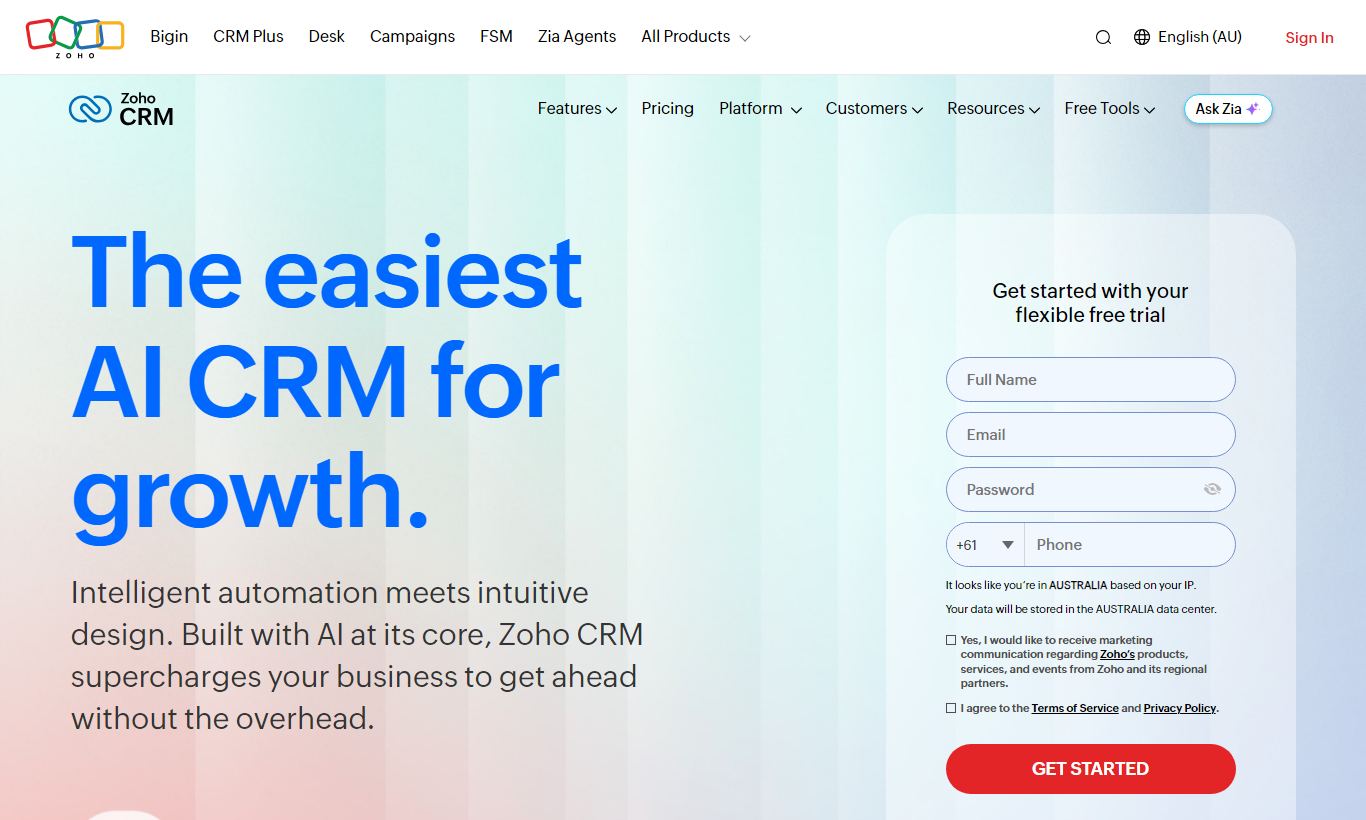
Zoho CRM is a feature-rich customer relationship management platform built for small to mid-sized businesses that want enterprise-grade capabilities without enterprise-grade pricing. Starting at $14/user/month, with a free plan for up to 3 users, it packs in AI-powered lead scoring, multichannel communication, workflow automation, and deep analytics across every paid tier. Its feature set rivals Salesforce at a fraction of the cost, though the UI feels dense and the learning curve is steeper than simpler rivals like HubSpot CRM. For growing sales teams that want to fold email, phone, social, and live chat into one platform without paying per-feature premiums, Zoho CRM delivers real value. It's a strong pick for businesses with 5 to 500 users willing to spend time on setup for long-term efficiency gains.
What we love
Watch out for
Zoho CRM at a glance
What to test in your Zoho CRM trial
15-day free trial
- Set up your sales pipeline with multiple stages and test drag-and-drop deal management with your real opportunities
- Create a Blueprint workflow that enforces a required step (like discovery call notes) before deals can advance
- Log an interaction via email, phone, and SMS from a single contact record and verify all three appear on the timeline
- Run a weighted forecast report using stage-based probabilities to see if revenue projections match your pipeline
- Build a custom dashboard with at least three reports (lead conversion, deal velocity, rep activity) and test filters
- Decide before the 15 days end whether the dense UI and setup time are worth the lower cost versus HubSpot or Pipedrive
Quick Verdict
Zoho CRM punches well above its price point. For businesses that have outgrown spreadsheets or a basic free CRM and need real sales automation, multichannel communication, and reporting that actually drives decisions, all without a six-figure software budget, Zoho CRM is one of the strongest options on the market. The free plan is genuinely useful for tiny teams. The jump to the Standard tier at $14/user/month unlocks enough to run a serious sales operation.
Here's the honest caveat: Zoho CRM isn't plug-and-play. Its depth is both its strength and its challenge, and teams without a dedicated admin or CRM champion may find initial setup overwhelming. But businesses willing to spend a few weeks on configuration get a real payoff in automation and visibility. If that's you, there's little reason to pay twice as much elsewhere for comparable features.
Start Your Free Trial →What is Zoho CRM?
Zoho CRM is part of the wider Zoho product line, built by Zoho Corporation, a privately held software company founded in 1996 and headquartered in Chennai, India, with major operations in the United States. The CRM product launched in 2005 and now serves over 250,000 businesses across 180 countries. Most SaaS companies run on venture funding. Zoho doesn't. It's bootstrapped and profitable, which gives it pricing stability and a longer runway for its product roadmap than most competitors can match.
The platform is built mainly for B2B sales teams and businesses with structured sales pipelines: professional services firms, software companies, manufacturing distributors, and agencies handling multi-touch deals. It sits in the mid-market CRM segment, competing directly with Salesforce Essentials, HubSpot Sales Hub, and Pipedrive. Its edge is breadth. Few CRMs at this price point bundle built-in telephony, social media monitoring, AI scoring, and territory management all in one package.
Key Features
Feature Checklist
Sales Pipeline & Deal Management
Zoho CRM's core pipeline view is a Kanban-style drag-and-drop board where deals move through customisable stages. Each deal record holds contact history, associated contacts and accounts, documents, notes, and a full activity timeline. You can set up multiple pipelines, which helps if your business runs separate sales motions, say new business versus renewals. One genuinely practical feature is the ability to set stage-level probability percentages that feed directly into the weighted forecast report. That gives sales managers a realistic revenue projection without any manual calculation.
Zia, the AI Sales Assistant
Zia is Zoho's built-in AI layer, available from the Professional tier upward. In practice, Zia does several genuinely useful things. It scores leads and contacts based on historical conversion patterns, flags deals that have gone cold based on inactivity, suggests the best time to contact a prospect based on their past engagement, and can detect anomalies in your pipeline, like a sudden drop in deal creation. It also offers a conversational search interface. Type "Show me deals closing this month over $10,000" and you get an immediate filtered view. It's not magic, but it cuts down the manual analysis work sales managers would otherwise have to do themselves.
Multichannel Communication
Zoho CRM genuinely stands out for the breadth of communication channels built directly into the platform. From a single contact record, a rep can send an email, make a VoIP call via Zoho PhoneBridge (integrated with services like Twilio, RingCentral, and Zoho's own Telephony), send an SMS, or start a live chat via SalesIQ integration. Social media monitoring lets you track mentions on Twitter/X, Facebook, and LinkedIn and log them to the relevant contact. Every interaction gets logged to the timeline automatically. For a sales team touching prospects across multiple channels, this consolidation kills the tab-switching that otherwise eats into productivity.
Workflow Automation & Blueprint
Zoho CRM offers two layers of automation. Standard workflows let you trigger actions (send email, update a field, create a task, notify a user) based on record creation or modification. Blueprint is the more powerful tool, available from Professional tier, and it's essentially a visual process builder that enforces a defined sequence of steps in your sales process. For example, you can require a rep to log a discovery call note before a deal can move from "Qualified" to "Proposal Sent." That's especially useful for sales managers who want consistent process across a distributed team, and it's something most competitors at this price point don't offer at all.
Reporting & Analytics
The reporting module ships with over 40 pre-built reports covering lead conversion rates, deal velocity, rep activity, revenue by source, and more. Custom report building uses a drag-and-drop interface and supports filters, groupings, and calculated fields. Dashboards are fully customisable and can be shared across the team. The Territory Management feature (Enterprise tier) adds geographic or account-based assignment logic on top of reporting, which matters a lot for larger field sales teams. One standout is the Cohort Analysis report, which lets you compare deal close rates by acquisition month, a level of sophistication you rarely see below the Enterprise tier in competing products.
Pricing
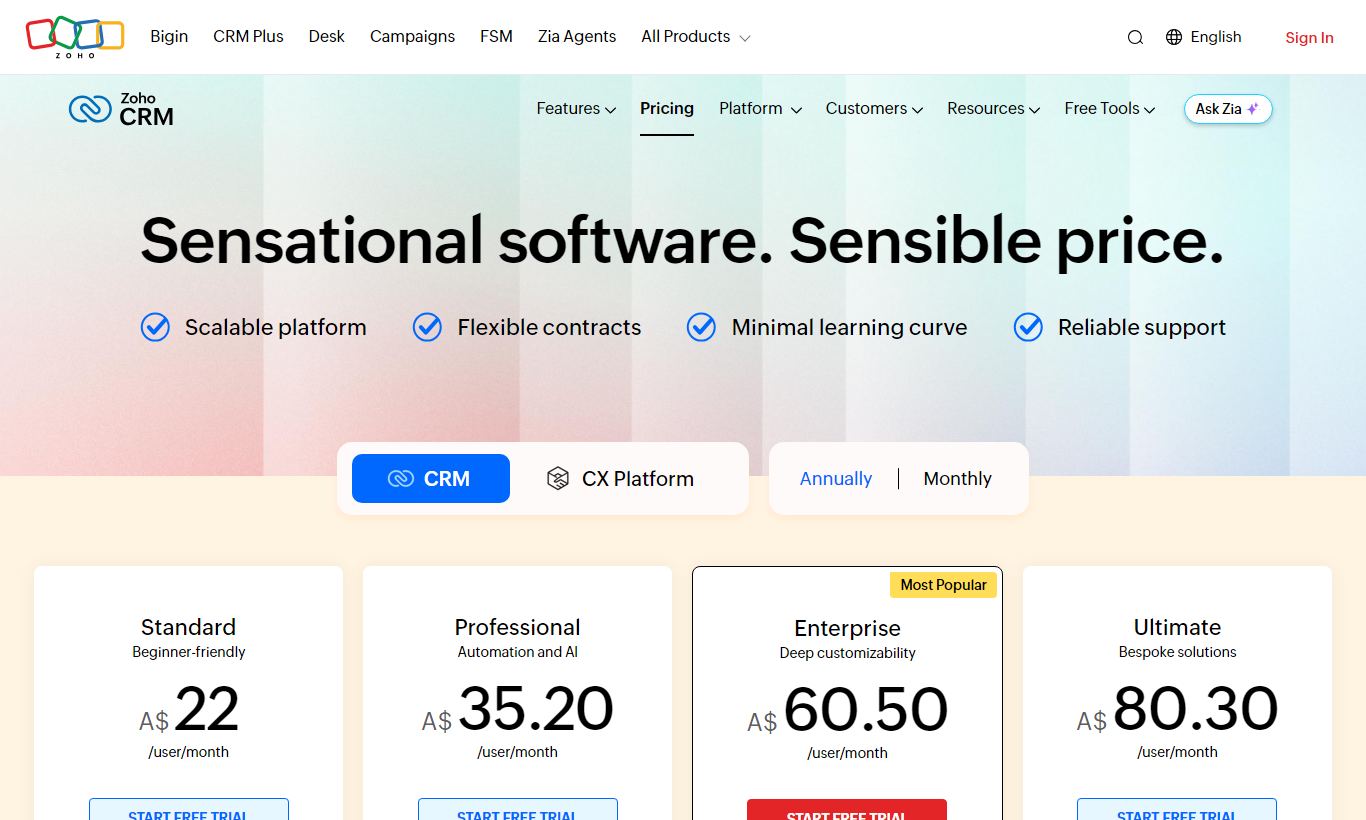
Zoho CRM pricing is per-user, per-month, billed either monthly or annually. Annual billing saves about 34% across all paid tiers. All prices below are per user per month, billed annually unless otherwise noted.
- Free: $0 for up to 3 users. Includes basic lead, contact, account, and deal management, plus task management and standard reports. No automation or AI features. Fine for very early-stage teams.
- Standard: $14/user/month (annual) or $20/user/month (monthly). Adds scoring rules, workflows (5 active), email insights, multiple pipelines, and web forms. A solid entry point for growing teams.
- Professional: $23/user/month (annual) or $35/user/month (monthly). Adds Blueprint process management, SalesSignals (real-time notifications), inventory management, Google Ads integration, and up to 10 active workflows.
- Enterprise: $40/user/month (annual) or $50/user/month (monthly). Adds Zia AI, territory management, custom modules, multi-user portals, advanced analytics, and unlimited workflows. This is the tier where Zoho CRM's full capability opens up.
- Ultimate: $52/user/month (annual) or $65/user/month (monthly). Adds Zoho Analytics (BI platform) bundled in, enhanced AI features, higher storage, and dedicated onboarding support. Best for data-driven organisations that want advanced dashboarding without paying for a separate BI tool license.
A 15-day free trial is available on all paid tiers, no credit card required. Zoho also offers a 30-day trial on the Ultimate plan. For small businesses, the free plan is a legitimate starting point, not a crippled teaser.
What We Love
- Blueprint process enforcement - The visual process builder forces reps to follow defined steps before advancing deals. It's a strong fit for training new hires and keeping pipeline hygiene intact at scale.
- Multichannel communication in one record - Email, phone, SMS, live chat, and social media interactions all log automatically to a single contact timeline. No more hunting for context across five different tools.
- Zia AI lead scoring and anomaly detection - It surfaces at-risk deals and cold leads automatically using behavioral patterns, saving managers hours of manual pipeline review each week.
- Exceptional pricing-to-features ratio - Enterprise-tier capabilities like territory management, custom modules, and AI scoring cost $40/user/month, roughly half of what Salesforce charges for a comparable feature set.
- Deep Zoho ecosystem integration - Native connections to Zoho Books (accounting), Zoho Desk (support), Zoho Campaigns (email marketing), and 40+ other Zoho products work without friction, so you can skip the expensive middleware.
Watch Out For
- Steep initial learning curve. The interface is dense with options, menus, and configuration settings. New users without prior CRM experience regularly cite the onboarding process as overwhelming, and the out-of-the-box experience is less intuitive than HubSpot or Pipedrive.
- Customer support quality is inconsistent. Free and Standard users are limited to email support. Live chat and phone support sit behind higher tiers and premium support add-ons. Response times for complex technical issues can stretch to 48-72 hours, and that shows up often in user reviews.
- AI features require the Enterprise tier or above. Zia, easily Zoho's most compelling differentiator, is only available from the $40/user/month Enterprise plan. Teams on Standard or Professional miss out entirely unless they upgrade.
- UI feels dated compared to newer competitors. Despite a 2022 interface refresh, the overall design aesthetic lags behind tools like Pipedrive and Attio. Power users adapt quickly, but design-sensitive teams may find the visual experience less polished than modern alternatives.
Who Is It Best For?
A B2B software company with a 10 - 50 person sales team will find Zoho CRM's Professional or Enterprise tier makes a real difference. Blueprint enforces a structured demo-to-close process, SalesSignals sends real-time alerts on prospect engagement, and Zia keeps watch on pipeline health. Together they cover the core problems a scaling inside sales team runs into. The native integration with Zoho Desk means support tickets from existing customers show up right inside deal records, so you don't get the classic situation where sales has no idea a customer has an open support ticket.
A professional services firm (consulting, law, accounting, recruiting) managing long-cycle, relationship-driven deals will benefit from Zoho CRM's contact-centric model. You can track every call, email, and meeting against a contact and their associated accounts, and custom modules let you track matter stages or project phases. That makes it easy to bend the system around a non-standard sales process. The activity reporting also helps principals see which BD activities are actually driving revenue.
A growing e-commerce or SMB owner moving off spreadsheets with 1 - 5 users can start on the free plan and move up to Standard ($14/user/month) as headcount grows. The web form to lead capture to automated follow-up workflow, available only on the Standard tier, can recover real revenue that would otherwise slip through the cracks. This kind of user sees ROI fast, without ever needing to touch the platform's deeper configuration options.
How Does It Compare?
Zoho CRM vs HubSpot CRM: HubSpot's free tier is broader and its UI is a lot more approachable for non-technical users, but its paid tiers escalate sharply. The Sales Hub Professional plan starts at $90/user/month, more than double Zoho's Enterprise tier. For feature-for-feature value on a budget, Zoho wins convincingly. For ease of adoption and marketing automation depth, HubSpot holds an edge.
Zoho CRM vs Salesforce Sales Cloud: Salesforce remains the benchmark for enterprise customisation, AppExchange integrations, and multi-cloud architecture. But its Starter Suite begins at $25/user/month with significant feature limitations, and meaningful capability doesn't start until the Pro Suite at $100/user/month. Zoho CRM delivers 80% of Salesforce's day-to-day functionality at 40% of the cost. That makes it the rational choice for any organisation not already embedded in the Salesforce ecosystem.
Final Verdict
Zoho CRM earns its place as the go-to CRM recommendation for budget-conscious teams that refuse to sacrifice capability. Its mix of a genuinely usable free plan, competitive paid tiers, AI-powered sales intelligence, and native multichannel communication makes it one of the most complete CRM offerings under $50/user/month. The learning curve is real, and support quality could be better. Neither of those should disqualify a team that takes CRM implementation seriously.
If you're currently running spreadsheets, a disconnected email and calendar setup, or a basic free tool that's hit its ceiling, Zoho CRM is the most financially sensible upgrade path in 2026. If you're already paying Salesforce Enterprise prices for a 30-person team, spend a week in Zoho CRM's trial and calculate the savings. For most SMBs and scaling mid-market companies, the case is compelling.
Try Zoho CRM Free →FAQ
How much does Zoho CRM cost per month?
Zoho CRM ranges from $0 (Free, up to 3 users) to $52/user/month (Ultimate, billed annually). The most popular paid tier is Standard at $14/user/month annually, or $20/user/month on a monthly plan. All paid plans include a 15-day free trial, no credit card required.
Is Zoho CRM free?
Yes. Zoho CRM offers a permanent free plan for up to 3 users that includes lead, contact, deal, and account management, basic reports, and task tracking. It doesn't include workflow automation, AI features, or advanced analytics. Those are reserved for paid tiers.
Is Zoho CRM better than HubSpot?
On pricing and feature depth, Zoho CRM wins, especially from the Professional tier upward. HubSpot's free CRM is broader and easier to use out of the box, and its marketing automation tools are best-in-class. But HubSpot's paid Sales Hub tiers cost a lot more. If budget is tight and your team can handle a steeper setup, Zoho CRM gives you better long-term value.
Is Zoho CRM good for small businesses?
Yes, Zoho CRM works well for small businesses. The free plan covers the basics for teams of 1 to 3, and the Standard plan at $14/user/month adds enough automation to genuinely boost sales productivity. Small businesses do best by starting simple and turning on more features as their process matures.
Does Zoho CRM have a mobile app?
Yes. Zoho CRM offers native iOS and Android apps with full contact, deal, and activity management, offline access, business card scanning, check-in features for field reps, and voice notes. The mobile app is rated 4.3/5 on both the App Store and Google Play as of 2025.
What integrations does Zoho CRM support?
Zoho CRM integrates natively with the entire Zoho suite (Books, Desk, Campaigns, Projects, SalesIQ, and 40+ others), plus third-party tools including Google Workspace, Microsoft 365, Slack, Mailchimp, Zapier, Twilio, RingCentral, Shopify, and QuickBooks. The Zoho Marketplace lists over 800 extensions. API access comes with Professional and above for custom integrations.
What is Zia in Zoho CRM?
Zia is Zoho CRM's built-in AI assistant, available on the Enterprise and Ultimate plans. It scores leads and deals based on historical conversion data, flags anomalies in your pipeline, suggests the best time to contact a prospect, supports conversational search, and reads email sentiment. Few AI features at this price point deliver sales intelligence you can actually act on instead of just data summaries. Zia is one of them.
Is Zoho CRM worth it in 2026?
For most small to mid-sized sales teams, yes. Zoho CRM packs in AI scoring, multichannel communication, workflow automation, and custom reporting, features competitors charge a lot more for. The trade-off is a bigger setup investment compared to simpler tools. Teams that configure it properly tend to see strong ROI within the first quarter of use.
We may earn a commission when you click affiliate links. This never affects our editorial scores.
| Best for | Full-suite CRM platform |
| Category | CRM Software |
Answer a few quick questions and we'll match you to the best tool for your needs.
→ Suggest a Tool