
Sales Creatio Review 2026: Is It Worth It?
Sales Creatio is a no-code CRM and sales automation platform built for mid-market and enterprise teams that need deep process customisation without heavy IT involvement. It combines a visual process designer, a 360-degree customer profile, lead-to-revenue pipeline management, and AI-powered forecasting in one workspace. Pricing starts at $25 per user/month (Growth tier), with a free 14-day trial available. The platform works well for organisations that have outgrown out-of-the-box CRMs like Salesforce Essentials or HubSpot Sales Hub but don't want to pay enterprise consulting fees to configure something that fits. It falls short on mobile depth, and the initial learning curve is steeper than lighter CRMs. Overall rating: 4.3 out of 5. A strong choice for process-driven sales teams.
What we love
Watch out for
Sales Creatio at a glance
What to test in your Sales Creatio trial
14-day free trial
- Build one multi-step approval process in Studio without writing code
- Create a custom pipeline with stage-specific required fields and forecast weights
- Set up automated lead assignment based on territory or custom rules
- Import your contacts and verify the 360-degree profile shows all interaction history
- Run a predictive forecast report and compare AI-scored leads to your manual pipeline
- Decide if the learning curve and 4-6 week setup timeline works for your team before trial ends
Quick Verdict
Sales Creatio earns its place in a crowded CRM market by doing something most competitors only promise: giving non-technical sales ops teams genuine, code-free control over their own workflows, data models, and pipeline logic. Want a five-stage enterprise approval process? Build it in the visual Studio. Need to auto-route leads by territory? Same deal, no ticket to IT required. That's a real operational win for mid-market companies scaling past 50 reps.
Still, "powerful" and "simple" rarely travel together, and Creatio doesn't break that rule. First-time users will spend real time in onboarding, and the mobile app lags behind what the desktop experience delivers. If your team lives on their phones, or you need a CRM running in 48 hours, there are faster options out there. But if you're serious about building a repeatable, measurable sales operation on a platform that grows with you, Sales Creatio is hard to beat at this price point.
Start Your Free Trial →What is Sales Creatio?
Creatio (formerly bpm'online) was founded in 2014 and is headquartered in Boston, MA, with R&D offices in Europe. The company repositioned its brand around 2019 to emphasise its no-code philosophy. Sales Creatio is the dedicated CRM product within that broader platform ecosystem, which also includes Marketing Creatio and Service Creatio. Sales Creatio is built for B2B-heavy sales teams in industries like financial services, manufacturing, logistics, and professional services, typically with 20 to 2,000 users. It competes directly with Salesforce Sales Cloud, Microsoft Dynamics 365 Sales, and SugarCRM, but positions itself as the more agile, process-first alternative, one that doesn't require a Salesforce admin army to maintain.
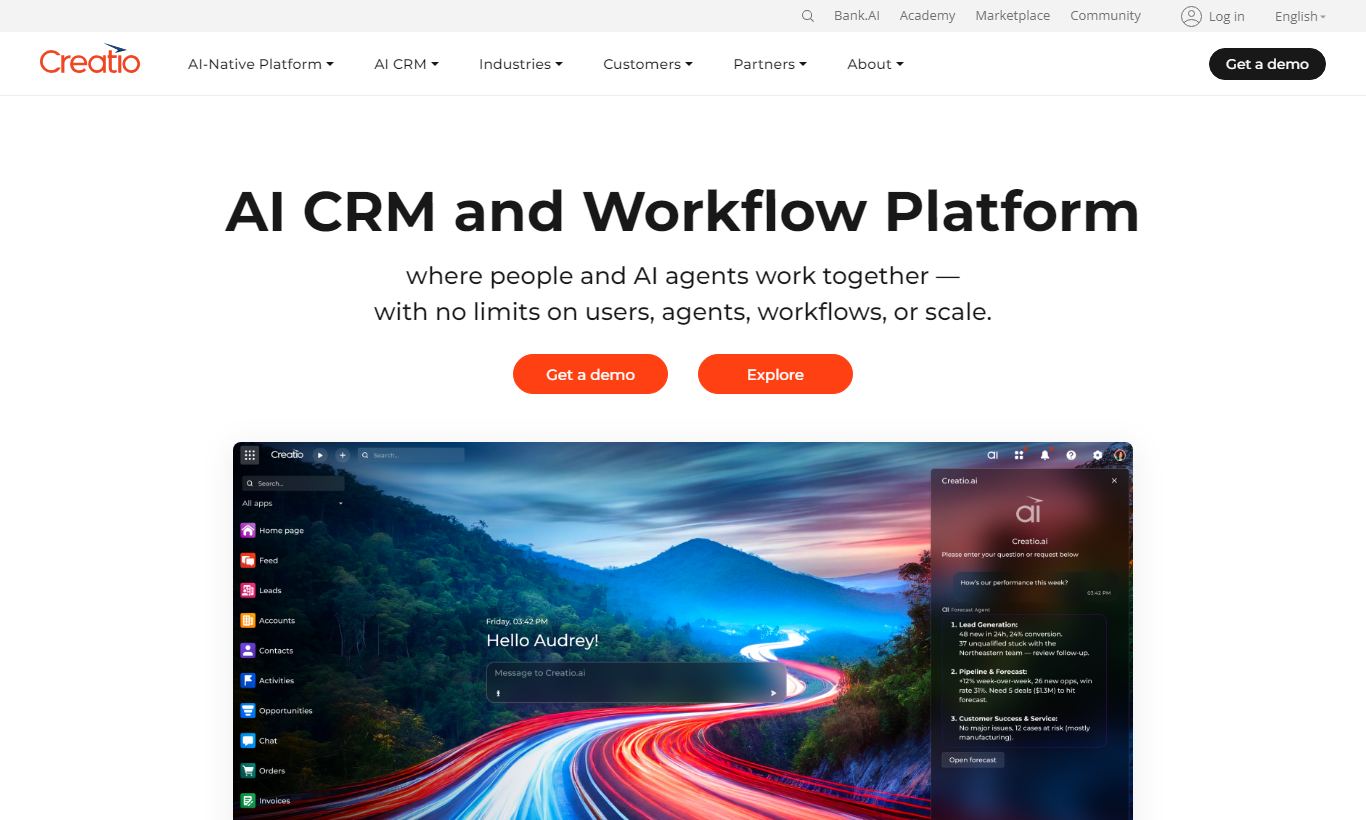
The core philosophy is "composable CRM," the idea that every team has its own sales motion and the platform should bend to fit it rather than the other way around. Creatio's no-code Studio lets revenue ops teams build and modify objects, automations, and UI layouts without writing a line of code. The tooling runs genuinely deep, and many customers report their first customisations shipped in days rather than weeks.
Key Features
Feature Checklist
360-Degree Customer Profile
Every contact, account, and opportunity in Sales Creatio is tied to a unified customer record that aggregates communication history, social data, linked deals, open tasks, and enrichment data from connected sources. When a rep opens an account, they see a timeline of every touchpoint (emails sent, calls logged, meetings attended, documents shared) alongside firmographic data like company size, industry, and revenue. This makes handoffs between reps, or between sales and account management, straightforward. A practical example: when a new enterprise AE takes over a stalled deal, they can reconstruct the entire relationship history in under five minutes without pestering colleagues.
Visual Process Designer (No-Code Studio)
The crown jewel of the platform. Creatio's Studio section lets revenue ops or even power-user sales managers build BPMN-style workflow automations using a drag-and-drop canvas. You can create multi-step approval chains, automated lead assignment rules, nurture sequences triggered by deal stage changes, or data validation gates that prevent reps from progressing a deal without entering required fields. These processes run on the actual data objects in your CRM, not a separate automation layer, which means you can branch logic on any field in your schema. This is the feature that most directly separates Creatio from HubSpot or Pipedrive for process-heavy organisations.
Opportunity & Pipeline Management
Sales Creatio's opportunity module supports multiple simultaneous pipeline types. A company selling both transactional deals and long-cycle enterprise contracts can run separate pipeline configurations with distinct stage logic, probability curves, and required fields at each gate. Kanban and list views are both available. Forecast roll-ups happen in real time and can be sliced by rep, team, region, or custom segment. A manufacturing company with a 9-month sales cycle, for instance, can configure weighted forecasts that auto-update based on stage movement and historical win rates, all without an Excel model living on the sales director's laptop.
AI-Powered Lead Scoring & Predictive Forecasting
Creatio embeds machine learning models that score incoming leads based on behavioural signals and historical conversion data, and flag at-risk opportunities based on activity gaps or sentiment changes in communication. The predictive forecasting engine uses your own historical close rates per stage to produce a probability-adjusted pipeline view alongside the rep's manual forecast. These are native to the platform from the Growth tier upward, not third-party add-ons. Smaller teams or teams with limited historical data will see less accuracy early on, but the models improve the longer you use them.
Integrations & Open API
Out of the box, Sales Creatio connects to Microsoft 365, Google Workspace, LinkedIn Sales Navigator, Twilio (for calling), and major marketing automation platforms. A REST API and webhook framework allow custom integrations, and a native Marketplace offers 400+ pre-built connectors. For teams running on a tech stack involving ERP systems like SAP or Oracle, Creatio has pre-built packages for both. This breadth of integration is an enterprise-grade capability that lighter CRMs simply don't match at a comparable price point.
Pricing
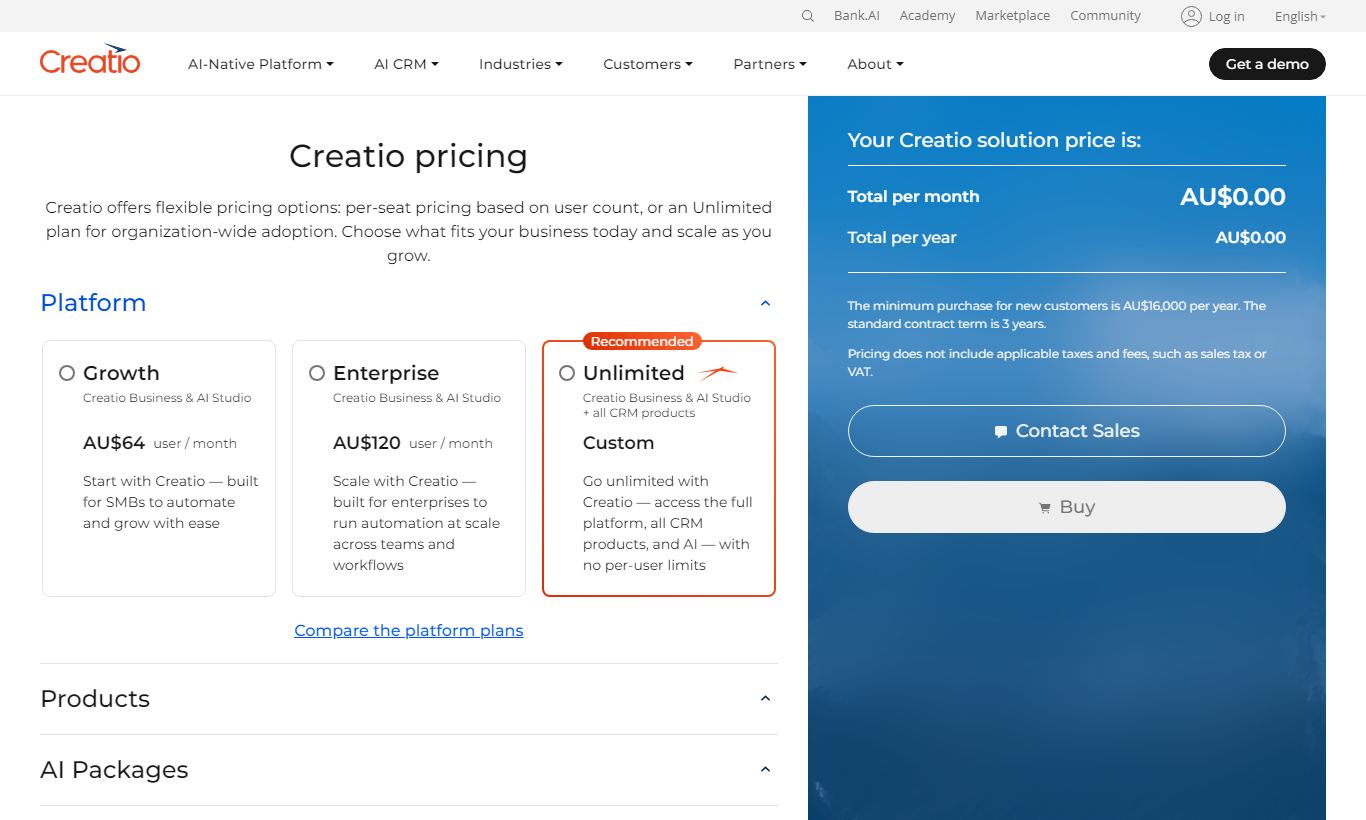
Sales Creatio charges per user, per month, billed annually, with a 14-day free trial on all paid tiers. There's no permanent free plan. Three tiers are available:
- Growth, $25/user/month (billed annually): Core CRM functionality, contact and account management, opportunity tracking, basic pipeline, email integration, and standard reporting. Good fit for small-to-mid sales teams getting started with a structured CRM.
- Enterprise, $55/user/month (billed annually): Adds no-code Studio customisation, advanced process automation, AI lead scoring, predictive forecasting, custom objects, territory management, and priority support. This is the tier where Creatio's real strengths show up.
- Unlimited, $85/user/month (billed annually): Full platform access including unlimited automations, advanced analytics, dedicated customer success, sandbox environments, and premium SLA. Built for large-scale deployments with complex governance needs.
Monthly billing is available but costs more. Expect roughly 20 to 25% higher per-user costs without an annual commitment. Creatio also offers a free platform edition for teams that want to build on the no-code infrastructure without bundled CRM data. It's worth a look for highly custom use cases. Compare that to Salesforce Sales Cloud, which starts at $25/user/month for Starter but requires Enterprise at $165/user/month for comparable automation. At the Enterprise tier, Creatio's pricing looks hard to beat.
What We Love
- True no-code customisation at the data model level: HubSpot locks custom objects behind its upper tiers. Creatio doesn't. From the Enterprise plan onward, you can create, modify, and relate custom data objects using a visual schema builder, and you won't need a developer to do it.
- BPMN-native process automation: The visual workflow engine runs directly on CRM data. It handles conditional branching on any field, multi-user approval routing, and SLA timers, a level of sophistication you rarely find below $100/user/month.
- Multiple concurrent pipeline configurations: You can run different sales motions (transactional vs. enterprise, direct vs. channel) with entirely separate stage logic, required fields, and forecast weights in one CRM instance. For diversified sales orgs, that's a genuine operational win.
- Native AI scoring and forecasting included at Enterprise tier: Predictive lead scoring and probability-adjusted pipeline forecasting come built in. There's no separate AI add-on to buy and no third-party integration to wire up, unlike Salesforce Einstein, which adds significant cost.
- Rich integration ecosystem with ERP-grade connectors: Pre-built integrations for SAP, Oracle, Microsoft Dynamics (Finance), LinkedIn Sales Navigator, and Twilio give enterprise sales teams the connective tissue to tie CRM into broader business operations without custom-built middleware.
Watch Out For
- Steeper onboarding curve than lightweight CRMs: The depth of customisation available in Creatio Studio is also its biggest UX challenge. New admins consistently report needing 4 - 6 weeks to fully configure and launch the platform, compared to 1 - 2 weeks for Pipedrive or HubSpot Sales Hub Starter. Budget for proper implementation time.
- Mobile app lags behind the desktop experience: The iOS and Android apps cover the essentials, logging calls, viewing contacts, updating deals, but lack the full process automation visibility and custom object support available on desktop. Field reps who rely heavily on mobile will feel the gap.
- Core automation features locked to Enterprise tier: The Growth tier ($25/user/month) covers basic CRM but withholds the no-code Studio, AI scoring, and advanced automation that make Creatio genuinely compelling. Teams budgeting at entry-level may find themselves needing to upgrade sooner than expected.
- Reporting UI less intuitive than dedicated BI tools: Built-in dashboards are functional but the report builder has a dated feel compared to modern tools like Tableau or even HubSpot's reporting. Complex cross-object reports require workarounds, and some users connect external BI tools (Power BI, Looker) for serious analytics work.
Who Is It Best For?
Mid-market B2B sales ops leaders (50 - 500 reps) who've outgrown HubSpot or Pipedrive and need granular control over pipeline logic, approval workflows, and territory management without a Salesforce budget. Picture a regional VP of Sales at a logistics company who wants reps to follow a specific 7-stage enterprise sales process, with required fields enforced at each gate and automatic escalations when deals sit idle for 14 days.
Revenue operations teams in regulated industries, financial services, insurance, manufacturing, that need audit trails, multi-step approval chains, and configurable compliance checkpoints built into the sales process itself, not bolted on afterward. A compliance officer at a financial advisory firm, for example, can build a deal approval process that routes opportunities through legal review before an AE can generate a proposal, entirely within Creatio.
Enterprise IT-light organisations with ambitious CRM customisation needs but no Salesforce admin on staff. A 120-person SaaS company whose sales ops manager wants to build a custom partner deal registration portal, add a reseller object to the data model, and automate co-sell routing, all without opening a developer requisition, will find Creatio's no-code Studio genuinely useful.
How Does It Compare?
Salesforce Sales Cloud: Salesforce is still the market leader in raw breadth and ecosystem size. But matching automation capability (Flow, Einstein AI, custom objects) means paying for the Enterprise tier at $165/user/month, three times Creatio's Enterprise pricing. If a team doesn't need AppExchange depth or the global Salesforce partner network, Creatio delivers 80% of the capability for 33% of the cost. See our full Sales Creatio vs Salesforce Sales Cloud breakdown.
HubSpot Sales Hub: HubSpot wins on ease of use, marketing-sales alignment, and a genuinely excellent free tier. Its workflow automation, though, is thinner for complex B2B processes, and custom objects stay limited even on the Professional plan. Once a team's process complexity outgrows what HubSpot's deal stages and sequences can handle, Creatio becomes the better choice. Compare them directly: Sales Creatio vs HubSpot Sales Hub.
Final Verdict
Sales Creatio is a genuinely no-code CRM platform that punches above its weight for mid-market and enterprise teams that care deeply about process consistency and pipeline control. The combination of visual process automation, a flexible data model, and native AI forecasting at the Enterprise tier ($55/user/month) adds up to real value in a market where comparable functionality often costs two to three times as much.
It's not for everyone. If your team is fewer than 15 reps, runs a high-velocity transactional sales model, or needs a CRM up and running in a week, simpler tools like Pipedrive or HubSpot Starter will serve you better and frustrate you less. But if you're building a scalable, process-driven revenue operation, especially in a regulated or complex-sale environment, Sales Creatio deserves a serious look. The 14-day free trial asks nothing of you except your time.
Try Sales Creatio Free →FAQ
How much does Sales Creatio cost?
Sales Creatio offers three paid tiers: Growth at $25/user/month, Enterprise at $55/user/month, and Unlimited at $85/user/month, all billed annually. Monthly billing costs more per user. A 14-day free trial is available on all tiers.
Is there a free plan for Sales Creatio?
There's no permanent free CRM plan. Creatio does offer a free edition of its no-code platform for teams who want to build custom applications. You can also get a 14-day free trial of the full Sales Creatio product without a credit card.
Is Sales Creatio worth it for small businesses?
For small teams under 15 reps, or those with simple sales processes, Sales Creatio is likely overkill. Its value scales with how complex your process is. Small businesses are usually better served by Pipedrive or HubSpot Sales Hub Starter. Sales Creatio starts to earn its keep at mid-market scale, where process control and customisation actually matter.
How does Sales Creatio compare to Salesforce?
Sales Creatio offers comparable process automation and customisation at roughly one-third of Salesforce's Enterprise tier pricing ($55 vs $165/user/month). Salesforce has a bigger ecosystem and the AppExchange marketplace behind it. Sales Creatio wins on value and speed of implementation for teams that don't need the full Salesforce partner network.
Does Sales Creatio require coding to customise?
No. The no-code Studio lets non-technical users build custom data objects, automations, UI layouts, and business rules without writing a line of code. Some advanced integration scenarios might need a developer, but most CRM customisation tasks can be done through the visual interface.
What industries is Sales Creatio best suited for?
Sales Creatio is particularly strong in financial services, manufacturing, logistics, professional services, and SaaS. These are industries where B2B sales cycles run long, approval workflows get complicated, and process consistency actually matters. It has pre-built industry accelerators for several of these verticals.
Does Sales Creatio have a mobile app?
Yes, Sales Creatio has iOS and Android apps. The mobile experience covers core CRM tasks, logging activities, viewing contacts, updating deals, but it lacks the full customisation and process visibility you get on the desktop platform. Heavy mobile users may find it limiting compared to mobile-first CRMs.
Can Sales Creatio integrate with ERP systems?
Yes. Sales Creatio has pre-built integrations for SAP and Oracle ERP, Microsoft Dynamics Finance, and a REST API for custom connections. That makes it one of the few mid-market CRMs with credible, pre-packaged ERP integration and no need for expensive middleware.
We may earn a commission when you click affiliate links. This never affects our editorial scores.
| Best for | No-code CRM and process automation |
| Category | CRM Software |
Answer a few quick questions and we'll match you to the best tool for your needs.
→ Suggest a Tool