
FreeAgent Review 2026: Is It Worth It?
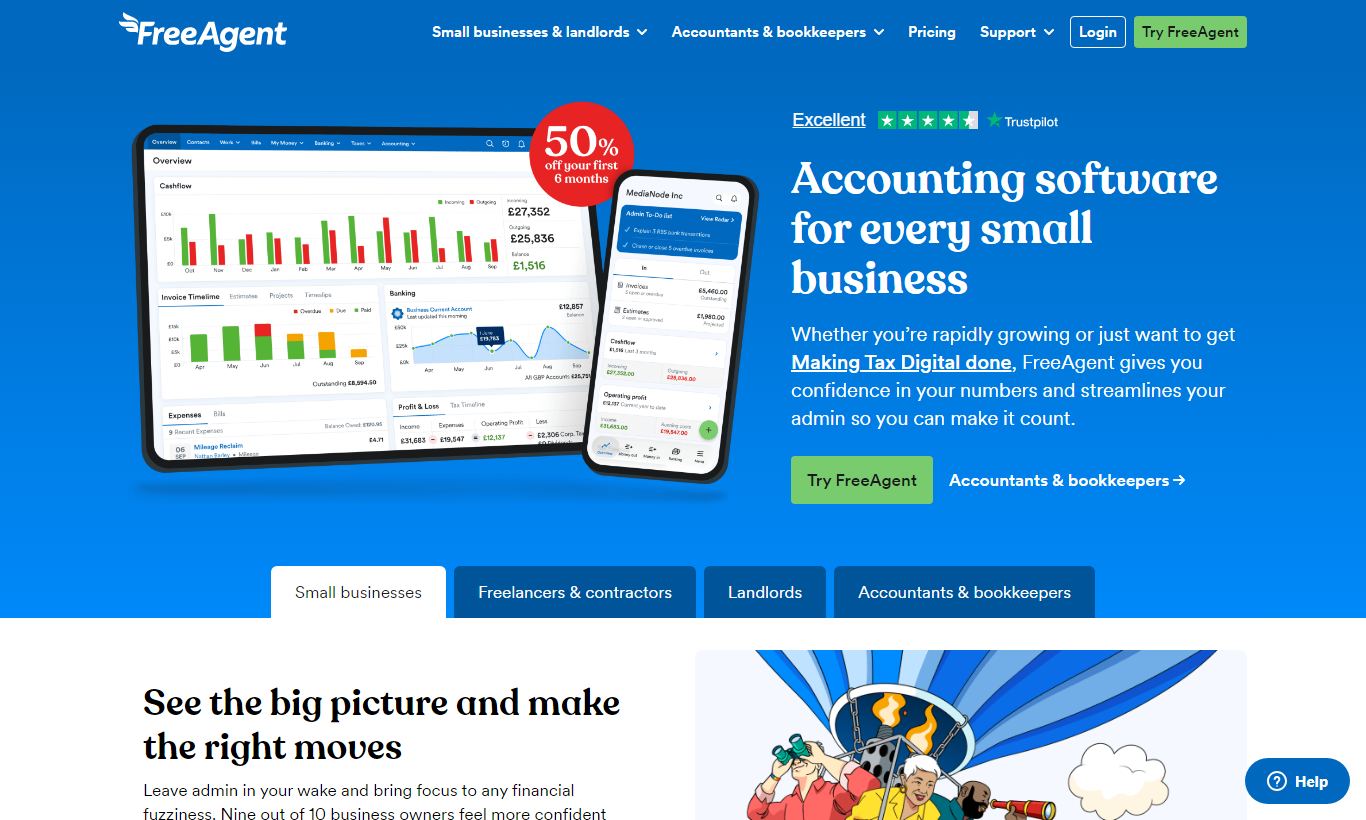
FreeAgent is a cloud-based accounting platform built for UK freelancers, contractors, and small business owners. It handles invoicing, expense tracking, payroll, tax filing (including Self Assessment and VAT), and real-time cash flow in one dashboard. Pricing starts at £19/month (billed annually) after a 30-day free trial, and the flat rate doesn't scale against your revenue. Its biggest strengths are MTD (Making Tax Digital) compliance, automatic bank feeds, and an interface non-accountants can actually understand. It struggles with multi-currency complexity, inventory management, and teams larger than about 20 people. For UK sole traders, contractors, and micro-businesses who want to stay on top of taxes without hiring a bookkeeper, FreeAgent is one of the smartest investments you can make at this price point. Overall rating: 4.4/5.
What we love
Watch out for
FreeAgent at a glance
What to test in your FreeAgent trial
30-day free trial
- Connect your actual UK bank account and verify transactions auto-categorise within a few days
- Log 2-3 business expense receipts in the mobile app and check they link to the right bank transactions
- Create a test invoice, send it, and confirm you can see when your client opens it
- Check the tax timeline dashboard and verify it shows your real Self Assessment or Corporation Tax estimate
- If you handle multi-currency work, test invoicing a client in USD or EUR and note any missing FX features
Quick Verdict
FreeAgent earns its place as the go-to accounting tool for UK freelancers and small business owners by doing something most accounting platforms fail at: making tax feel manageable. It handles everything from daily expense logging to Self Assessment submissions without demanding that you understand double-entry bookkeeping first. The interface is genuinely approachable, the tax timeline feature removes the anxiety of missed deadlines, and automatic bank feeds mean most users spend under an hour a week on their books.
FreeAgent isn't trying to be Xero or QuickBooks, though. If you need multi-currency invoicing across 10+ currencies, granular inventory tracking, or role-based access for a finance team of five, you'll hit its limits fast. But for the audience it's built for, sole traders, contractors, and businesses with under £1M in annual turnover, it delivers real value. It's especially good if your accountant already uses it, since the collaboration features are built right in.
Start Your Free Trial →What is FreeAgent?
FreeAgent was founded in 2007 in Edinburgh, Scotland, by Ed Molyneux, Olly Headey, and Roan Lavery, three former freelancers fed up with spreadsheets and shoebox receipts. NatWest Group acquired the company in 2018, which gave it financial stability and tighter integration with NatWest and Royal Bank of Scotland business banking. NatWest and RBS business account holders get free access to FreeAgent, and that alone has made it the default accounting tool for hundreds of thousands of UK small businesses.
FreeAgent sits in the SME accounting segment, between basic invoicing apps like Wave and enterprise-grade platforms like Sage Intacct. Its sweet spot is the UK's 5.5 million self-employed workers: sole traders, limited company contractors, and micro-businesses with 1 to 10 employees. It's HMRC-recognised software for Making Tax Digital for VAT and MTD for Income Tax, and that recognition matters more each year as UK businesses lose the option to avoid digital tax filing. The product has won multiple awards from the Federation of Small Businesses, and UK accountants who work with contractor-heavy client bases consistently rate it highly.
Key Features
Feature Checklist
Tax Timeline & Self Assessment Filing
This is the feature that makes FreeAgent genuinely special for UK users. The tax timeline sits on your dashboard and shows exactly what tax obligations are coming up, VAT returns, Corporation Tax, Self Assessment deadlines, colour-coded by urgency. FreeAgent also calculates your estimated tax liability in real time as you add income and expenses throughout the year. There's no end-of-January panic, because you can see all year long what you'll owe. For sole traders, FreeAgent can file your Self Assessment directly to HMRC from within the platform. For limited company directors, it handles both the personal SA and the company CT600 Corporation Tax return. This alone is worth the subscription fee for most contractors.
Invoicing & Estimates
FreeAgent's invoicing is polished and practical. You can create branded invoices in minutes, set up automatic payment reminders at intervals you define, and accept online payments via Stripe or GoCardless directly from the invoice. The estimates feature lets you convert an accepted quote into an invoice with a single click, genuinely useful for project-based workers. Recurring invoice scheduling handles retainer clients without any manual effort. One notable feature is invoice view tracking. You can see when a client has opened your invoice, which removes the "I never received it" excuse entirely. For UK businesses, invoices automatically include the correct VAT treatment, whether that's standard rated, exempt, or reverse charge for overseas services.
Bank Feeds & Expense Tracking
FreeAgent connects directly to over 60 UK banks via Open Banking, pulling transactions in automatically. The categorisation engine learns your habits over time. After a month or two, most transactions get auto-categorised correctly. For expenses on the go, the mobile app lets you photograph receipts, which are stored against the transaction record. This counts as HMRC-compliant digital record-keeping under MTD rules. Mileage tracking is built in, using HMRC's approved per-mile rates, so you can log business trips and have the deduction calculated automatically. Where FreeAgent falls slightly short is in bulk expense rules. Power users who process hundreds of transactions weekly will find Xero's bank rules engine more sophisticated.
Payroll
FreeAgent includes full RTI (Real Time Information) payroll for UK businesses, so you can run payroll, calculate PAYE and National Insurance, and submit to HMRC directly from the platform. It handles up to 10 employees on all paid plans, which covers most micro-businesses. Payslips are generated automatically and can be emailed to staff. Pension auto-enrolment calculations are included, though the actual pension submissions require integration with a pension provider. The payroll module works well but lacks some of the flexibility of dedicated payroll tools like BrightPay. Salary sacrifice schemes and complex benefits-in-kind, for example, require manual workarounds.
Project Tracking & Time Logging
For service-based businesses, FreeAgent includes lightweight project management. You can create projects, log time against them, and track profitability in real time. Time entries flow directly into invoices. Select a project and all unbilled hours populate the invoice automatically. This is a real time-saver for consultants or agencies billing by the hour. The project view shows outstanding costs, billed amounts, and margin at a glance. It won't replace dedicated project tools like Harvest or Toggl, but for straightforward time-and-materials billing, it removes an entire layer of tool-switching.
Accountant Collaboration
FreeAgent was designed from day one with the accountant-client relationship in mind. You can invite your accountant to access your account with their own login, and they can work directly in your books. No exports, no emailed spreadsheets. The platform maintains a full audit trail, so it's always clear what was changed and when. Many UK accountancy practices have a FreeAgent practice licence, meaning they work in dozens of client accounts from a single dashboard. If your accountant uses FreeAgent, and plenty of UK ones do, that alone justifies the choice of platform.
Pricing
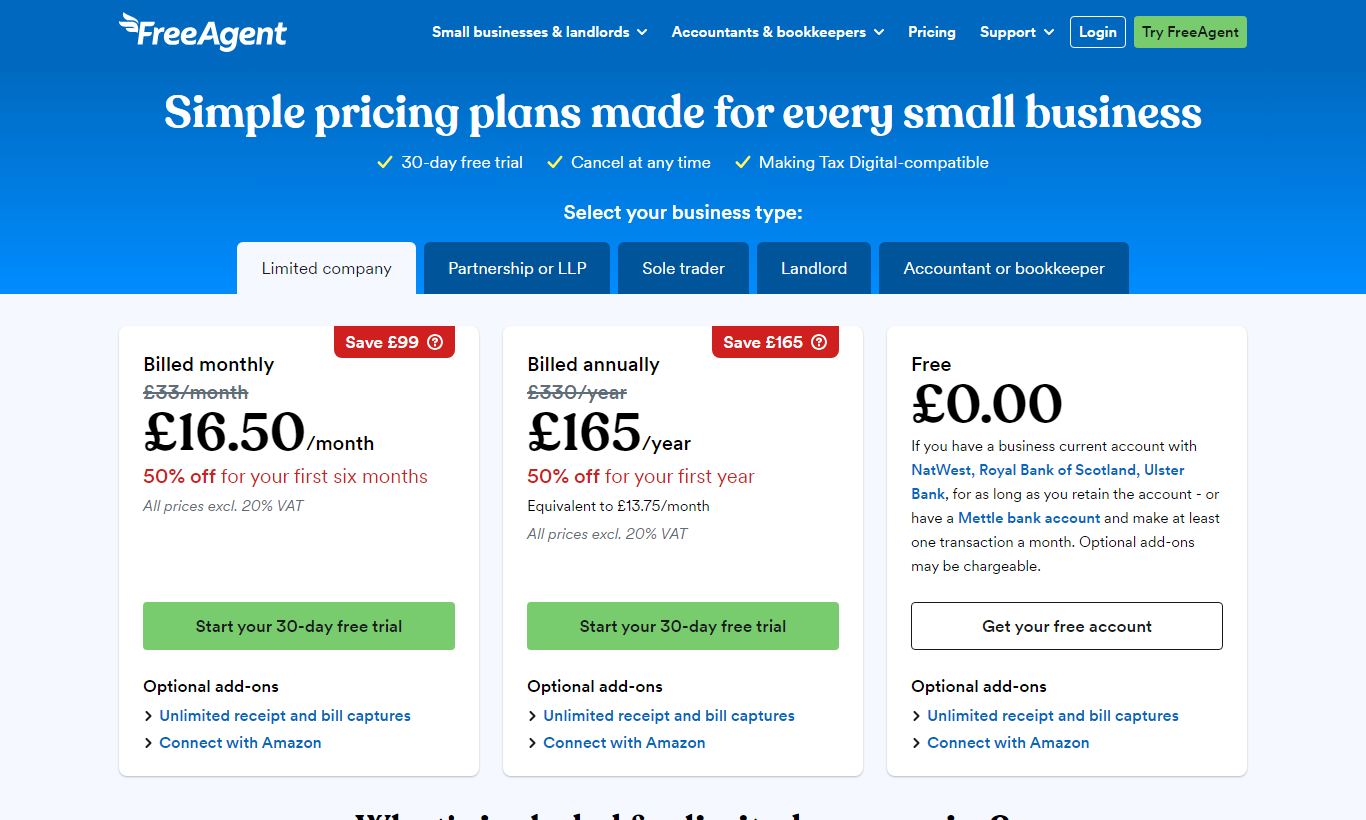
FreeAgent's pricing is refreshingly flat. You pay the same monthly rate no matter how many invoices you send or how much revenue you turn over. There's a 30-day free trial with full access to all features, and no credit card is required.
- Sole Trader: £19/month (billed annually at £16/month equivalent). Covers all core features including invoicing, expenses, bank feeds, Self Assessment filing, and the tax timeline. Limited to sole trader tax treatment only.
- Partnership: £24/month (billed annually at £20/month equivalent). Adds partnership tax support for businesses with multiple partners. Includes all Sole Trader features plus partnership-specific reporting.
- Limited Company: £29/month (billed annually at £24/month equivalent). This is the most popular tier. It adds Corporation Tax CT600 filing, dividend vouchers, director's loan account tracking, and full limited company statutory accounts. Payroll for up to 10 employees is included.
NatWest and Royal Bank of Scotland business account holders get FreeAgent free of charge as part of their banking package, which sets it apart from most rivals. Monthly billing is available at a small premium on each tier. There's no enterprise tier, so businesses that genuinely outgrow the platform have to migrate rather than upgrade. VAT is charged on top of all prices.
What We Love
- Real-time tax liability estimates: The tax timeline calculates your running Self Assessment or Corporation Tax bill throughout the year. That kills end-of-year surprises and makes quarterly budgeting genuinely doable.
- Direct HMRC filing built in: Submit Self Assessment, VAT returns, and CT600s directly from FreeAgent without needing third-party bridging software. It's fully MTD-compliant for both VAT and Income Tax.
- Invoice view tracking: You know the exact moment a client opens your invoice, which makes follow-up calls better timed and kills the "never received" excuse that delays cash collection.
- Flat-rate pricing regardless of transaction volume: A freelancer sending 2 invoices a month pays the same as one sending 200. No per-transaction fees, no revenue-based scaling, no surprises on your next bill.
- Easy accountant access with full audit trail: Invite your accountant with their own login. They see everything in real time with a complete change history, so the monthly "send me your spreadsheet" back-and-forth disappears entirely.
Watch Out For
- UK-only tax engine: FreeAgent is built around HMRC's tax system. Self Assessment, PAYE, VAT, and Corporation Tax. If you have overseas tax obligations, US 1099 filing, or you operate across multiple tax jurisdictions, it isn't built for you.
- Limited multi-currency support: You can send invoices in foreign currencies, but FreeAgent's multi-currency handling is basic. There's no automatic exchange rate management, no foreign currency bank account reconciliation, and no realised/unrealised FX gain reporting. That's a real gap for businesses with significant overseas revenue.
- Bank rules less powerful than competitors: Xero and QuickBooks offer more sophisticated auto-categorisation rules, including regex matching and multi-condition rules. FreeAgent's learning algorithm is good but less customisable, and that frustrates users processing high transaction volumes each month.
- No inventory or stock management: FreeAgent has no product catalogue with stock levels, no purchase order workflow, and no inventory valuation. Small product-based businesses often complain about this after they've already signed up.
Who Is It Best For?
UK contractors billing through a limited company. This is FreeAgent's home turf. An IT contractor earning £80,000 - £120,000 through a personal service company needs dividend tracking, director's loan management, CT600 filing, and a clear view of what's safe to pay themselves. FreeAgent handles all of this well, and the cost is a rounding error next to the accountant fees it saves.
Freelancers and sole traders with straightforward finances. A copywriter, designer, or photographer who sends 10 - 30 invoices a month, tracks business expenses, and wants to file their own Self Assessment without paying an accountant £400 - 600 a year will find everything they need here. The 30-day free trial lets you check the fit before you commit to anything.
Micro-businesses with a trusted UK accountant on the platform. A small marketing agency with 3 - 8 staff that already works with an accountant familiar with FreeAgent will get the most out of the collaboration features. The shared real-time view cuts out duplicated work during month-end close and VAT quarter-end, and the accountant can file returns without the client exporting a single file.
How Does It Compare?
FreeAgent vs Xero: Xero is more powerful. It has better bank rules, richer multi-currency support, a deeper app ecosystem, and more granular user permissions. But it's also noticeably more expensive (from £15/month for a limited Starter plan that caps invoices, up to £55+/month for full features), more complex, and it lacks FreeAgent's UK-specific tax filing integrations. For a UK contractor or sole trader, FreeAgent almost always wins on value and simplicity. See our full FreeAgent vs Xero breakdown.
FreeAgent vs QuickBooks Self-Employed: QuickBooks Self-Employed is cheaper (around £8/month) and handles basic income and expense tracking plus Self Assessment filing. But it's a genuinely stripped-down product, with no payroll, no project tracking, no VAT returns, and no limited company support. FreeAgent is meaningfully more capable for any business that's grown beyond the very basics. Read our FreeAgent vs QuickBooks comparison for a full feature breakdown.
Final Verdict
FreeAgent isn't trying to be all things to all businesses, and that focus is exactly what makes it excellent for its target audience. If you're a UK freelancer, contractor, or small business owner who wants clean books, stress-free tax filing, and an accountant who can see exactly what you see without a file attached to an email, FreeAgent delivers on all of it with very little friction.
The flat-rate pricing model is genuinely fair. The tax timeline is a feature you didn't know you needed until you have it. The MTD compliance takes a growing regulatory burden off your plate. The gaps in multi-currency, inventory, and complex payroll are real, but most of FreeAgent's target users will never run into them. If you're a NatWest or RBS business account holder and you're not already using it for free, you're leaving money on the table. For everyone else, the 30-day free trial costs you nothing but an hour of setup time.
Try FreeAgent Free →FAQ
How much does FreeAgent cost per month?
FreeAgent costs £19/month for sole traders, £24/month for partnerships, and £29/month for limited companies (all billed monthly). Annual billing drops these to roughly £16, £20, and £24/month. NatWest and RBS business account holders get FreeAgent free.
Does FreeAgent offer a free trial?
Yes. FreeAgent offers a 30-day free trial with full access to all features. No credit card is required to start, so you can test the platform against your real business data before you commit to anything.
Is FreeAgent good for limited companies?
Yes. The Limited Company plan is FreeAgent's most feature-rich tier, and it's the strongest use case for the software. It includes CT600 Corporation Tax filing, dividend vouchers, director's loan account tracking, payroll for up to 10 employees, and full MTD VAT return submission direct to HMRC.
Is FreeAgent Making Tax Digital (MTD) compliant?
Yes. FreeAgent is HMRC-recognised software for MTD for VAT (mandatory since 2019) and MTD for Income Tax Self Assessment (ITSA), which is being phased in from April 2026. You can file VAT returns and Self Assessment directly from FreeAgent without any bridging software.
FreeAgent vs Xero: which is better for UK freelancers?
For most UK freelancers and contractors, FreeAgent is the better choice. It's built for UK tax rules specifically, includes Self Assessment and CT600 filing out of the box, and costs less than Xero's full-feature plan. Xero makes more sense if you need advanced multi-currency support, a wide app ecosystem, or more than 10 payroll employees.
Can FreeAgent handle VAT returns?
Yes. FreeAgent calculates VAT automatically on every transaction and submits VAT returns directly to HMRC under the MTD for VAT rules. It supports standard VAT, flat rate scheme, cash accounting, and annual accounting. You can review and submit VAT returns in minutes from within the platform.
Is FreeAgent worth it for sole traders?
At £19/month (or £16/month annually), FreeAgent is worth it for most sole traders who currently pay an accountant to prepare their Self Assessment, spend time manually tracking expenses, or stress about tax deadlines. If the platform saves you even 2 to 3 hours a month and cuts out annual accountant fees, it pays for itself many times over.
Does FreeAgent integrate with other software?
FreeAgent integrates with Stripe and GoCardless for payment collection, Gusto for payroll (US users only), over 60 UK banks via Open Banking for bank feeds, and has a Zapier connection for custom automations. Its native integration list is smaller than Xero's, which has 1,000+ app connections, but it covers the essentials for most small businesses.
We may earn a commission when you click affiliate links. This never affects our editorial scores.
| Best for | Accounting for freelancers and SMBs |
| Category | Accounting Software |
Answer a few quick questions and we'll match you to the best tool for your needs.
→ Suggest a Tool